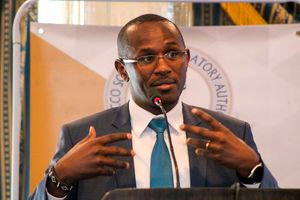
The Ministry of Co-operatives is lining up guidelines that will see small Saccos merged as part of efforts to tighten supervision of thousands of co-operatives spread across the country with thin capital and deposit bases.
Co-operatives Cabinet Secretary Wycliffe Oparanya said many of the small Back Office Service Activity (Bosa)-only Saccos are either inactive or unstable because they serve just a few members, with “limited impact” on financial inclusion.
In Bosa-only Saccos, members’ funds go into purchase of shares and the institutions give loans. The share capital contributions cannot be withdrawn but can be transferred to another member at the point of exiting.
“A time has come for the Sacco sector to explore market-driven solutions of consolidations and mergers of these very many small Bosa-only Saccos. This is the only way to ensure their financial viability and stability,” said Mr Oparanya during the launch of the Sacco Supervision Annual Report 2024.
“...I urge officials of Saccos operating within the same or similar traditional economic and social common bonds to immediately start conversations relating to mergers as a solution to their survival.”
The report showed out of the 177 deposit-taking (DT) and 178 non-withdrawable deposit taking (NWDT) Saccos under the watch of Sacco Societies Regulatory Authority (Sasra), just 40 held 65.83 percent of the Sh749.43 billion deposits.
Mr Oparanya said the sector should now model from the recent development where Sasra oversaw the merger of a small Sacco in Kirinyaga County with a larger one. The merger gave members of the smaller Sacco access to an expanded offering of financial services.
Mergers will help the government in tightening oversight even as it eyes bringing all co-operatives under the supervision of Sasra.
Currently, Sasra oversees all DT and NW-DT Saccos that hold at least Sh100 million deposits. This has left many co-operatives in the hands of the Commissioner of Co-operatives where the oversight is relaxed.
“Governance in Saccos is still a matter of grave concern for the government,” said Mr Oparanya.
The government, in May, appointed a Committee of Experts to review the Sacco Societies Act and regulations and also explore ways of introducing a shared technological services platform for small saccos.
Mr Oparanya said yesterday such a platform will provide a solution to the very many small and medium-sized Saccos across the country to come under the purview of Sasra prudential regulations by enjoying the synergies associated with economies of scale of sharing common services.
Giving an example of Sasra-regulated saccos, Mr Oparanya said 216 of the 355 saccos under prudential regulations make up just 7.4 percent or Sh79.66 billion of the over Sh1 trillion assets, undermining their competitiveness in the credit business which heavily runs on ICT systems that small saccos cannot afford.
In May, Mr Oparanya issued a temporary moratorium on the registration of new saccos in order to take stock of the existing registered entities and assess their viability.
He said yesterday that those saccos which are only registered by name but are not active will be de-registered and liquidated by the Commissioner for Cooperatives as required by law while those which are active and viable will be required to be supervised by Sasra or be equally de-registered and liquidated.