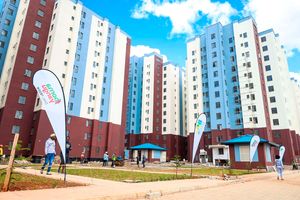
Spending on President William Ruto’s affordable housing programme is set to surge dramatically after the 2027 general election, with the government banking on the proceeds from selling completed housing units to finance the next phase of one of the largest state-backed construction projects in Kenya.
Budget estimates tabled in the National Assembly indicate that the government anticipates significant revenue from houses currently under construction, with these projected sales receipts set to play a pivotal role in financing a post-election expansion of affordable housing projects.
The estimates indicate total spending on affordable, social and institutional housing together with related infrastructure will jump to Sh360.1 billion in financial year 2027/28, a jump of 227.3 percent over Sh110 billion budget for the next financial year starting in July.
Infrastructure linked to affordable housing estates, largely include roads, drainage systems, sewerage and lighting.
The planned post-election housing splurge will also catapult the sector into the government’s single largest recipient of development funds, overtaking roads whose allocation is projected at Sh197.93 billion in FY2027/28.
Roads spending is estimated at Sh176.86 billion in the election year ending June 2027, up from the current approved allocation of Sh92.84 billion, but still far below the projected housing outlay after the polls.
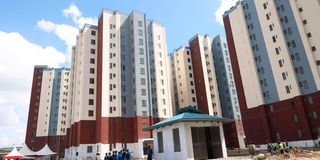
An affordable housing project.
Photo credit: File | Nation Media Group
Affordable housing alone will account for the biggest surge, with allocations projected to climb nearly four-fold to Sh201.1 billion after the polls from Sh50.7 billion in fiscal year 2026/27.
The planned spending explosion comes after the government sharply slows expenditure during the election cycle, cutting affordable housing allocations by 30.9 percent from approved Sh73.3 billion estimates for the current year.
Housing Principal Secretary Charles Hinga said the post-election spike reflects expectations of significantly higher revenue from housing sales alongside increased collections from the housing levy.
“The Sh360 billion projection includes funds expected to be realised from projected housing sales and increased levy collections,” said Mr Hinga.
The remarks point to a major transition in how the programme is expected to sustain itself financially. While the affordable housing drive has largely depended on the housing levy since its rollout in July 2023, the government is now betting that completed units will begin generating substantial cash flows capable of funding new construction.
The strategy suggests that the State expects a large share of the thousands of units currently under development to be sold or occupied through tenant-purchase arrangements over the next two years, unlocking billions of shillings for reinvestment into fresh projects.
The affordable housing programme is built around low-interest mortgages and rent-to-own arrangements under the Boma Yangu initiative, targeting low- and middle-income earners who have traditionally struggled to access formal housing finance.
Current pricing under the programme shows the scale of revenue the government expects to generate from completed units.
Affordable housing units are priced at between Sh1.5 million and Sh2.1 million for one-bedroom houses, Sh2 million to Sh2.5 million for two-bedroom units and Sh3 million to Sh3.3 million for three-bedroom apartments.
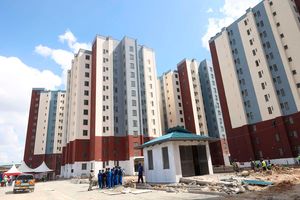
A section of the Affordable Housing Project in Mukuru, Nairobi on December 11, 2024.
Photo credit: File | Nation Media Group
Houses for workers earning Sh150,000 or more per month are sold at market rates. Two-bedroom units cost between Sh2.4 million and Sh4.3 million, while three-bedroom units range from Sh3.6 million to Sh5.76 million.
Social housing units, which are targeted at lower-income households, are priced lower. They range from Sh640,000 to Sh840,000 for one-room units, Sh960,000 to Sh1,260,000 for two-room houses, and Sh1,280,000 to Sh1,680,000 for three-room units.
The pricing structure highlights the government’s attempt to create multiple revenue streams within the programme, with higher-priced market-rate units helping cross-subsidise lower-cost social housing.
Under the tenant-purchase model, occupants make monthly payments over time before eventually owning the units, allowing the State to recycle repayments into additional construction.
The latest budget projections indicate that the government expects those cash flows to become substantial enough to support an aggressive scaling up of projects immediately after the elections.
The projections also suggest confidence that demand for the units will remain strong despite concerns over affordability, financing constraints and slow uptake in some projects launched earlier.
Buyers are currently required to pay a mandatory 10 percent deposit to secure the houses, although President William Ruto announced during the May 1, 2026 Labour Day celebrations that the government plans to cut the deposit requirement by half to five percent.
The reduction is expected to lower entry barriers for buyers and accelerate uptake of completed units, potentially boosting the sales proceeds the government is counting on to fund future construction.
The post-election ramp-up is expected to coincide with the completion and handover of a growing number of housing projects currently under construction across the country.
Official data shows the State-backed housing programme has expanded rapidly over the past two years, making it one of the biggest public construction initiatives in Kenya’s history.
As of December 2025, more than 205,000 housing units were under development nationwide at an estimated cost of nearly Sh500 billion, according to the findings in the 2026 Economic Survey.
The bulk of the projects fall under the affordable housing programme, which accounts for 138,474 units valued at Sh385.83 billion.
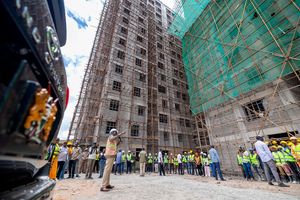
The Makasembo Housing Project in Kisumu on May 29, 2025.
Photo credit: File | Nation
Social housing projects comprise 53,350 units worth Sh81.8 billion, targeting low-income earners — particularly households earning below Sh20,000 a month — with low-cost housing in informal settlements.
Institutional housing includes 12,709 units costing Sh28.6 billion, targeting public servants such as civil servants, police officers and members of the Kenya Defence Forces. The government is also planning to expand institutional housing into student hostels.
A further 778 housing units are being developed by the State-run National Housing Corporation at a cost of Sh3.7 billion.
The huge pipeline of projects means the State expects thousands of completed units to begin entering the market over the coming years, creating a new stream of revenue from sales and tenant-purchase payments.
The anticipated proceeds from house sales are expected to complement inflows from the housing levy, which has continued to outperform Treasury projections.
The levy, funded through a mandatory 1.5 percent deduction from workers’ salaries matched by employers, has become one of the government’s fastest-growing revenue streams.
The Kenya Revenue Authority collected Sh73.2 billion from the levy in FY2024/25, surpassing the National Treasury’s projection of Sh63.2 billion.
That built on Sh54.16 billion collected during the levy’s first year after its introduction in July 2023.
Mr Hinga said the FY2026/27 housing allocation of Sh110 billion is based on projected levy collections under the Budget Policy Statement ceiling.
In the current year ending in June, the original housing budget had initially been set at Sh95 billion before being revised upwards in April to Sh122 billion through Supplementary Budget No.1.
The latest projections also come as official data shows the government has sharply accelerated spending on active projects after earlier criticism that large sums collected through the housing levy remained idle and were temporarily invested in Treasury Bills.
Data from the 2026 Economic Survey shows actual housing expenditure nearly tripled to Sh79.03 billion in the year ended June 2025 from Sh25.49 billion previously.
The sharp increase points to a steep rise from Sh9.13 billion spent in FY2022/23 before the housing levy took effect.
Absorption of housing funds also surged to 96.3 percent of allocated resources in FY2024/25 from 32.6 percent the previous year, signalling faster project implementation and stronger execution capacity within the housing department.
“During the review period, expenditure on housing increased significantly, reflecting improved absorption of allocated funds and scaling up of affordable housing projects,” the Kenya National Bureau of Statistics said in the Economic Survey.
The improved absorption marks a major shift from earlier stages of the programme when procurement delays, project mobilisation bottlenecks and planning constraints slowed deployment of levy collections.
The government’s latest spending projections suggest that Housing and Urban Planning officials believe the programme has reached a turning point where completed housing units will begin generating enough proceeds to sustain an even larger wave of construction after the 2027 elections.