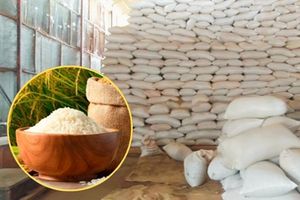
Treasury Cabinet Secretary John Mbadi and Kenya Revenue Authority (KRA) Commissioner General Humphrey Watanga risk sanctions on accusations of ignoring a court order by allowing 55,000 tonnes of duty-free rice imports worth about Sh5.5 billion.
Also facing contempt of court accusations is KRA Commissioner, Customs & Border Control, Ms Lilian Nyawanda, following the two shipments late last year, despite a court order temporarily barring rice imports unless permitted by the judge.
Kenya Revenue Authority Commissioner, Customs and Border Control, Ms Lilian Nyawanda.
Photo credit: Dennis Onsongo | Nation Media Group
Government officials are accused of issuing a new gazette notice to circumvent another order frozen by the court, which also required that any fresh imports must be cleared by it.
The restriction was imposed during proceedings in an ongoing case at the High Court, where the government is defending a July 28, 2025, gazette notice authorising duty-free importation of 500,000 metric tonnes of Grade 1 milled white rice.
The imports were to be shipped in until December 31, 2025, to avert a shortage, according to the government, but a petition against the duty-free imports was filed on the basis that local farmers still held stocks and would be shortchanged by the deals.
The notice was challenged on constitutional grounds, with petitioners arguing that the policy undermines local farmers and violates principles of public participation.
In August 2025, the court issued temporary orders allowing the importation of only 250,000 metric tonnes and placed the entire rice import program under judicial supervision.
However, petitioners allege that these safeguards were bypassed last December when the Treasury issued a fresh gazette notice extending the import window to May this year, without seeking the court’s approval.
They accuse customs officials of acting on the new notice to clear fresh rice shipments arriving at the Port of Mombasa in violation of a court order amid claims that local stores are already stocked with unsold rice.
Fresh court filings reveal that the rice was shipped to Kenya by four traders and offloaded at the Port of Mombasa last week.
The consignment, which the court has since ordered confiscated temporarily, was aboard two vessels that originated from India and Thailand.
Cargo records have been submitted to the court by Kirinyaga Senator Kamau Murango and Baragwi Ward Representative David Mathenge in the petition seeking to compel the government to purchase rice from local farmers before permitting imports.
Kirinyaga Senator Kamau Murango.
Photo credit: File | Nation Media Group
The controversy has embroiled senior government officials in a legal and political storm, with petitioners accusing the National Treasury and the KRA of facilitating large-scale imports in apparent defiance of court orders issued last August.
Cargo manifests filed in court detail the scale of imports by four companies. Records indicate that the vessel Spica Eternity, which docked in Mombasa in October 2025, carried about 35,000 metric tonnes of white milled rice shipped from Kandla Port in India.
The rice was exported by Olam Agri India Private Limited, acting on behalf of Olam Global Agri, and consigned mainly to Ecoview Commodities Ltd and Njema Commodities Ltd.
A second vessel, IVS Crimson Creek, arrived in mid-December 2025 carrying approximately 20,000 metric tonnes of white rice. The consignment originated from Thailand and was exported by Olam Thailand Limited and Golden Granary Co. Ltd, again on behalf of Olam Global Agri. All the Thai rice was consigned to Preferred Grains Ltd, a Mombasa-based importer.
The two vessels account for roughly 55,000 metric tonnes of rice imported within a short period—volumes that petitioners argue could not have been lawfully cleared while court restrictions were in force.
The total volume of the consignment translates to 55 million kilograms, putting the estimated retail value at about Sh5.5 billion, calculated at a local retail price of Sh100 per kilogram.
The petitioners contend that the imports could flood the market just as local farmers in Nyanza, Central, and Western Kenya regions, along with traders, were holding significant unsold stocks.
“These clearances constitute fresh acts of contempt,” the petitioners state in their application, warning that continued release of duty-free rice undermines the conservatory orders meant to protect farmers pending the case’s final determination.
The government disputes these claims, warning the court that blocking imports would worsen a looming food crisis.
In filings by the Ministry of Agriculture and other state agencies, officials project that national rice stocks will run out by the end of this month if imports are halted.
According to the government, Kenya requires about 750,000 metric tonnes of rice between January and June 2026, while reserves stood at approximately 110,000 metric tonnes at the start of the year.
Domestic production, officials say, supplies less than 20 per cent of annual demand, estimated at up to 1.5 million metric tonnes.
Government lawyers argue that rice has become a staple for millions of households, particularly in urban and food-deficit areas, and that climate shocks, erratic rainfall, and reduced water availability in irrigated schemes have exacerbated the deficit.
They warn that restricting imports would drive up prices and disproportionately harm low-income households.
Petitioners counter that the state has failed to fully absorb local harvests over several seasons and cannot rely on imports to mask policy failures. They insist that warehouses and stores in rice-producing regions already hold large quantities of unsold rice.
The court has since issued interim orders suspending implementation of the contested new gazette notice and directing KRA to detain the disputed consignments pending further directions.
A ruling on whether senior officials will be cited for contempt—and on the future of the rice import program—is expected on January 29, 2026.