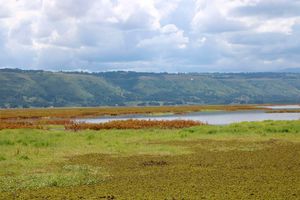
By day, Mukindu Dam in Nyandarua County looks peaceful; a sheet of water ringed by farmland. But the water is not as clear as it looks. A carpet of Salvinia molesta, an invasive water fern, has spread across the surface, and beneath it, hippos have been hiding since 2022.
For David Njenga, whose farm sits next to the dam, the trouble started years earlier, in 2018, before the drought that pushed the first hippos in from Lake Ol Bolossat.
David Njenga, a farmer from Mukindu in Ol Kalou, narrates n August 21, 2026, how hippos used to invade his farm and destroy his crops before they were captured.
Photo credit: Boniface Mwangi I Nation Media Group
“That year, I lost one of my dairy cows that was mauled by a hippo, and I have never been compensated,” he said.
Hippo footprints now cut across a section of his farm where he grows maize. For five years, the frequency of the invasions has strained his finances. Even his kitchen garden, the vegetables his family relies on, has not been spared. He tried keeping watch at night with his dog. It did not work.
“That is a dangerous animal,” he said.
Between 2018 and now, the hippo population at Mukindu Dam has grown to more than 50, and as their grazing ground shrank, the surrounding farms became their main food source. The cost has been counted in more than crops. In 2018, a toddler was killed by a hippo early one morning after following his father out of their homestead. Since then, parents have lived with daily fear for their children walking to school because hippos typically raid farms at night and return to the dam at dawn, right when children are heading out.
“No one who encounters a hippo lives to tell the tale,” one resident said of the early morning risk.
Further northeast, Thomas Nderitu’s farm borders Lake Ol Bolossat itself. He traces his troubles to 2017, when the lake began showing early signs of drying and hippos started moving onto surrounding farmland.
“In 2017, I lost three acres of potato and maize crops to the hippos. I reported it to the police and was referred to the agriculture officer and the Kenya Wildlife Service (KWS) to apply for compensation,” he said.
A trench dug around Mukindu Dam in Nyandarua County to prevent hippos from invading people’s farms.
Photo credit: Boniface Mwangi I Nation Media Group
The Nyandarua County government dug a trench around the lake in response to the complaints, but it only offered short-term protection. By 2023, a prolonged drought had pushed hippos out toward private and public dams nearby, Mukindu among them, where the population climbed past 50 and conflict with residents intensified.
“It was common to bump into the hippos even during the day when the lake had dried up,” Nderitu said.
The situation in Mukindu escalated to the point that residents warned they would deal with the hippos themselves if authorities did not act. That threat brought KWS to the dam for more than a month to translocate the animals.
The operation ran at night because hippos are nocturnal and only leave the water to feed after dark.
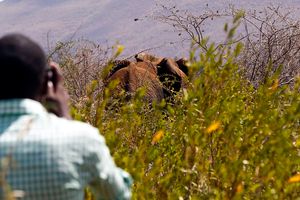
The Climate Action team joined the KWS team on one of these stakeouts. Somewhere in Lake Ol Bolossat, water levels have been rising again over the last three years, drawing some hippos back on their own. Chasing the rest felt like a game the hippos were built to win: they see better in the dark and move fast in water. We stayed wrapped against the night chill around a bonfire kept burning both for warmth and to discourage any hippo from bolting the dam.
According to Dr Jeremiah Pogon, a KWS veterinary officer, translocating stressed, confined hippos takes patience. In the first three weeks, the team captured 12 hippos and moved them to Lake Nakuru National Park.
“We have six stations all around the dam manned by rangers who stay vigilant throughout the night. The intention is to keep the hippos in the water and not let them access any grazing ground around the dam. This forces them into the designated boma, where we have food, and that is how we are able to capture them,” Pogon said.
To track movement in the dark, Dr Dominic Mijele, KWS’s assistant director in charge of wildlife translocation, said the team installed CCTV cameras at the boma to monitor when a hippo entered the trap before closing the gate.
“We are using 360-degree cameras that can see in the dark and through the fog. The boma is made of a trench. Once a hippo gets into it, it cannot go back to the dam, and at the end of the trench there is a container where we force the animal into,” he said.
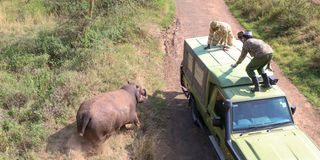
On the night we filmed, the hippos stayed in the water and evaded capture. A week later, KWS called: one of the last two hippos had been caught. We returned to Ol Kalou to watch the translocation to Lake Nakuru National Park.
Dr Dominic Mijele, assistant director, Veterinary and Capture, and Head of Capture and Translocation at the Kenya Wildlife Service, during the translocation of hippos to Lake Nakuru from Mukindu Dam in Nyandarua County on August 7, 2026.
Photo credit: Boniface Mwangi I Nation Media Group
“Mukindu Dam did not have hippos. In 2022/23, Lake Ol Bolossat almost dried completely, and the hippos got out of the muddy lake and came to the dams around here. The dam is surrounded by community members who are mostly farmers. There was an increase in human-wildlife conflict; some people were injured, and one was killed by a hippo. That necessitated translocating the hippos to a better habitat,” he said.
The Nyandarua KWS office says most of the compensation claims it currently handles are for crop losses caused by hippos, a burden that has affected food security in a county that leads the country in potato production.
“In the last year we have had over 100 cases of crop destruction around this area. We have had threats to humans, including children going to school in the morning. Sometimes we had to escort them to school. It was tiresome and sometimes dangerous for our rangers,” a KWS official said.
Lake Nakuru National Park was chosen as the hippos’ new home partly because, like Ol Bolossat, it is one of several Rift Valley lakes whose water levels have risen over the past decade and a half, turning once-saline water hospitable to fish and hippos. Moving an adult hippo is a race against time and body temperature.
“We cannot use anaesthesia because the hippo may drown if it gets back into the water. During the journey we have to sedate the animal so it doesn’t get excited. The goal is to have no mortalities, either on the animal side or among the team carrying out the operation,” Mijele said.
At Nakuru, rangers scouted the release site, drawing a small crowd of tourists on a morning game drive. When the container door opened, the hippo stormed out, bit the bar of a nearby vehicle, and disappeared into the bush.
“This was one of our biggest hippo translocation operations in recent times. Communities in Mukindu will now farm peacefully and get their harvests. We are happy we have not had any mortality on the part of the animals, and we expect the hippo population to grow here in Lake Nakuru,” Mijele said.
According to the IUCN Red List, more than 100,000 hippos remain worldwide, most of them in East Africa. Habitat loss, illegal trade in hippo meat and ivory, and human-wildlife conflict are driving numbers down. Counting them precisely is difficult since hippos are nocturnal and spend their days submerged. Kenya’s 2021 wildlife census put the national hippo population at an estimated 1,788, though that figure is likely an undercount.
“Lake Ol Bolossat is a tourism attraction that has not been exploited. We are in the process of gazetting it as a national reserve so it can benefit the county government of Nyandarua through revenue,” Wambugu said.
As a Key Biodiversity Area, the Ol Bolossat ecosystem is also home to more than 300 bird species, including the endangered grey-crowned crane. Paul Gacheru, a wildlife expert with Nature Kenya, argues that resolving the conflict requires more than moving animals.
“We need to properly demarcate the riparian land, gazette Lake Ol Bolossat, have biodiversity-friendly infrastructure to accommodate birds like the cranes, and carry out ecological restoration within and around the lake to ensure there is enough water to support the hippos,” he said.
For residents like David and Thomas, the hippos are gone from Mukindu for now. But they say KWS still needs to move faster on processing the compensation claims sitting on file.