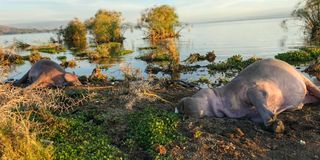
Mystery surrounds the death of nine hippopotamuses at Lake Naivasha after three more carcasses were discovered by fishermen floating in different locations.
According to Mr Labaan Ewoi, a member of Kamere Beach Unit (BMU), two hippos were found dead in the Malewa and Crayfish areas on Wednesday while another carcass was spotted in Fishermen area on Thursday morning.
Mr Ewoi said that he received information from fellow fishermen who sited the carcasses floating in the water while heading to work.
Mr Ewoi who has been a fisherman for the past nine years lamented that despite Kenya Wildlife Service(KWS) promising to conduct a thorough investigation to curb the vice, deaths are still being reported.
“When KWS came they said that they will conduct an investigation since the deaths were alarming and that they need to establish the cause of death. We are worried as locals of Naivasha, it is rare to hear such cases, hippos only feed on riparian land,” he said
He went on to say that on November 12 2026, he sighted two hippos floating on the water in the Kibokoni area and informed KWS on the same by sending photos.
He said later other fishermen reported to have come across two carcasses in Malewa appeared to have been bloated.
According to Mr Ewoi, the fishermen reported that the carcasses had no visible physical injuries, although one carcass had already started decomposing.
The latest discoveries bring the number of hippos reported dead in the lake to nine, as fishermen last week reported finding four carcasses, an addition to two which were discovered the other week.
When reached for comments, KWS Senior Assistant Director Corporate Communication Duncan Juma confirmed that five carcasses have so far been located with another reported death yet to be verified.
He said that KWS rangers on Wednesday managed to locate the reported carcass near crayfish, although they were unable to access its location.
Mr Juma said that one carcass which was found by fishermen in the Kibokoni area had been examined by a veterinary doctor who attributed the death to old age.
“We have a report of another carcass but we are yet to confirm, as of now we have five confirmed cases and one unconfirmed,” he said.
On October 27, residents discovered two hippos along the shores of the Lake at Kamere beach, lying a few metres apart and appearing unresponsive.
A stray dog scavenges for meat from a skeleton of a hippo on the shores of Lake Naivasha on January 20, 2026.
Photo credit: Boniface Mwangi | Nation Media Group
A video which circulated online showed the hippos struggling to lift themselves from the ground before collapsing again, moments that preceded their eventual death.
In a statement dated November 19, KWS noted that the veterinary examination, including a detailed postmortem established that the two hippos died from consumption of fishing nets and excessive maize stalks.
A postmortem examination of a sub-adult female hippo revealed a compacted mass of discarded synthetic fishing net that had caused a complete physical blockage at the junction between the stomach and small intestine.
The obstruction triggered severe physiological complications, with veterinary doctors identifying cardiopulmonary failure, secondary to complete foreign body obstruction as the tentative cause of death.
In the second case, an adult female hippo postmortem revealed massive gas distension of its multi-chambered stomach, which displaced the diaphragm forward into the chest cavity and severely compressed the lungs, interfering with normal breathing.
Veterinary team further identified acute gastrointestinal bloat as the likely mechanism leading to respiratory distress and eventual cardiopulmonary failure.
According to KWS, maize stalks were observed among the stomach contents and may have contributed to dietary overload and excessive fermentation, leading to gas accumulation and bloating.
The deaths have prompted KWS to appeal to fishermen, local communities, beach management units to embrace responsible practices that expose wildlife to harmful materials.
They have called on fishermen to ensure handling and disposing of fishing nets, gear and equipment and exposure of wildlife to inappropriate food materials.
“Protecting our wildlife is a shared responsibility by all Kenyans. Every action that safeguard the environment helps secure a future where people and nature thrive together,” read part of the statement.
The growing number of carcasses has unsettled fishers who fear that it could undermine consumers’ confidence in fish from the lake.
Ms Grace Nyambura a fisherwoman in Karagita beach said that the deaths have already affected their business, with some consumers avoiding the fish harvested from the lake citing safety.
She called on KWS to address the issue and establish the cause of deaths to avert the loss of more hippos in the Lake as it will also affect eco-tourism.
“I was supplying fish to different hotels within Naivasha but now it is hard to find tenders. The orders have gone down; hotel owners are saying that they cannot buy fish from us since hippos are dying mysteriously in the lake,” she said.