Kenya gets 3 resolutions adopted as UN Environment Assembly closes in Nairobi
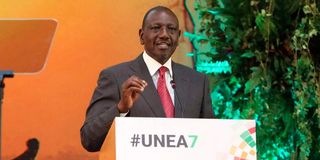
President Willliam Ruto at the high-level segment opening of UNEA-7 in Nairobi on December 11, 2025.

What you need to know:
- Environment, Climate Change and Forestry CS Deborah Barasa said Kenya appreciates the multilateral spirit witnessed this week.
- Event organisers will now start accounting for environmental problems that arise from sporting activities, such as waste management.
The seventh United Nations Environment Assembly (UNEA) ended on Friday evening with three resolutions that Kenya was backing adopted after the weeklong negotiations.
A resolution is an idea proposed by a member state, such as Kenya, after heeding a call made by UNEA through its Bureau, the United Nations Environment Programme (UNEP), and is shared before the Assembly.
This year, UNEA tabled about 15 draft resolutions and only 11 were adopted. The Assembly also adopted three decisions and one ministerial declaration.


A draft resolution submitted by Peru and co-sponsored by Kenya on enhancing the international response to address crimes that affect the environment was among those that did not sail through.
Kenya also supported Mexico’s submission for strengthening the role of UNEP in Nairobi to address environmental challenges and enhance multilateral cooperation.
Environment, Climate Change and Forestry Cabinet Secretary Deborah Barasa said Kenya appreciates the multilateral spirit witnessed this week—one that will help the world align public policies related to the environment to achieve positive outcomes.
CS Barasa said in her closing remarks that even though there was insufficient time allocated for productive exchange of views on some drafts, she hopes this will not be the end of the road.
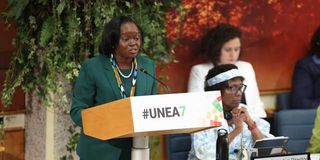
Kenya's environment Cabinet Secretary Dr Deborah Barasa give a speech at the Seventh Session of the United Nations Environment Assembly (UNEA-7) in Nairobi on December 8, 2025.
“This does not in any way diminish their importance. We believe the draft would have been one of those adopted this evening if there was time to consider it,” Ms Barasa said.
“I urge this Assembly to take a decision that will keep the discussions alive, as well as enable the proponents of the draft resolutions and other member states to reintroduce them to UNEA-8,” she added.
Ms Linda Kosgei, Director of Multilateral Environment Agreements at the Ministry of Environment, Climate Change and Forestry, said that after the passing of the resolutions, countries usually unpack them for implementation.
Sustainable solutions through sport
“We do not need to change our laws. The intentions of the resolutions are aligned with the Constitution, Vision 2030, and applicable laws,” she said.
“When you consider artificial intelligence, for example, this is an area that many fear addressing because it is new and has taken on a very fast pace that many do not yet have the capacity to catch up with. This is even the reason why we must address it urgently because, while many dread the new space that is AI, we need to take advantage of the great potential it presents in tackling environmental questions,” she explained.
Ms Kosgei told the Daily Nation that even though the resolutions are not legally binding, they are not a light matter since they express the political commitment of a nation moving along a path of cooperation at the multilateral stage.
This may lead to considerations of firmer legal commitments, as often happens when deliberations and affirmations through resolutions lead states to formalise issues they consider to have enjoyed sufficient support, development and push—eventually resulting in legally binding products such as treaties.
“This does not have a direct effect on any change of laws nationally. In fact, one of the considerations that must be made in negotiating resolutions is that they must not be inconsistent with our laws,” she said.
One of the draft resolutions that Kenya sponsored and that passed was on promoting sustainable solutions through sport.
Speaking to the Daily Nation after the closing plenary, Athletics Kenya President Lt. Gen (Rtd) Jackson Tuwei said he was “a very happy person” after the adoption of Kenya’s proposal.
“It is a milestone in terms of sport development,” he said.
He said the resolution touches on all aspects of sports, ranging from organisers, technical officials and equipment used, to the athletes.
“We have to go back to the drawing board and see how we need to comply with the resolution. I believe all international federations will come up with different rules, regulations and policies,” he said.
He noted that different sports are held in different settings—indoor and outdoor—and during different seasons.
“Every sport will have to look at how they are affected and how they are going to match the requirements of that resolution,” he said.
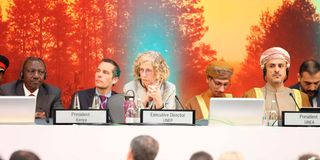
President Willliam Ruto (left) with the United Nations Environment Programme (Unep) Executive Director Inger Andersen and His Excellency Abdullah Bin Ali Al-Amri, President of UNEA at the high-level segment opening of UNEA-7 in Nairobi on December 11, 2025.
“Some of the things that are plastic today will have to be eradicated completely. This will affect even the manufacturers,” he added.
Philip Osano, the chief operating officer at the Center for International Forestry Research and World Agroforestry (CIFOR-ICRAF), explained that since Kenya is a leading country in sporting activities, especially athletics, this resolution is significant.
He explained that environmental deterioration, especially air pollution and elevated heat levels, has been affecting both competitive and recreational sports.
He said that when it comes to science on the impact of the environment on sport, there is not enough evidence yet.
“This resolution will catalyse investment in research to understand environmental risks in sport. There has been a lot of concentration on the impact of sport on the environment. When we have global competitions like the World Cup, we get a lot of criticism on things like the carbon footprint that travel causes. There has been little attention on the environmental risks affecting sports,” he explained.
He said implementation will see national governments include sustainability measures in their national policies and strategies, extend them to the education sector through physical education, and then to community sports.
Event organisers will now start accounting for environmental problems that arise from sporting activities, such as waste management.
Between now and the next Assembly, countries will be expected to report any measures they may have implemented.
The International Pollutants Elimination Network (IPEN) expressed disappointment with the outcomes of the UNEA-7 negotiations, especially around critical minerals and metals mining.
“The UNEA-7 event ended with a weak resolution that offers no policy actions to address environmental and human health threats posed by the mining sector. The resolution only calls for dialogues on so-called ‘sustainable’ approaches to an industry that has proven to be environmentally devastating and has violated Indigenous Peoples’ rights for decades,” they said.