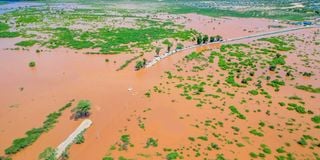
An aerial photo of flooded roads along the Garissa-Mombasa road in Tana River County taken earlier during the el-nino floods in October 2023.

At 64, Mwanaharusi Morowa never imagined she would watch the river that raised her, fed her children and buried her ancestors, turn against her.
For decades, River Tana had been the spine of her life in Makere in Tana River County.
It told her when to plant, when to harvest, when to move the goats, and when the rains were near.
But on a violent evening during the recent El Niño, she found herself trapped in the middle of a flooding village, clinging to a collapsing mud wall as water snarled through her homestead.
“It was like the river had become a stranger. It came from places we never knew water could come from,” she recalls quietly.
When the County Government rescue team found her, the village was already a maze of brown water and drifting debris. Mud huts, homes that had stood for three generations, had dissolved into the raging current.
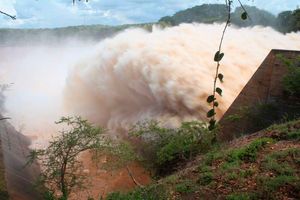
Mango trees rose like lonely islands. Boats moved between rooftops. A cow, half submerged, bellowed weakly. The nearby primary school was washing away bit by bit as rescuers pulled Mwanaharusi into a canoe.
She remembers hearing people scream for help in the distance.
“It was a crisis my grandmother never saw, my mother never saw, and even I had never seen in all my years. That's why the river showed us it no longer knows its boundaries,” she says.
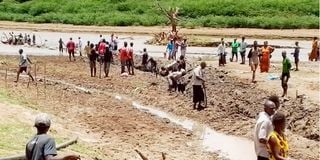
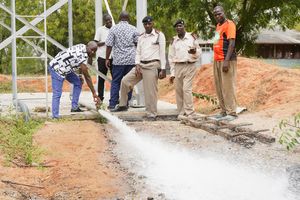
Residents of Ngao and Tarasaa dig trenches in an effort to restore the River Tana to its original course in this picture taken in November 2024.
When the water finally receded weeks later, Makere village was unrecognizable. The farm where she grew maize, bananas, and cowpeas for decades lay buried under thick layers of silt. Her granary was gone.
Even the grave of her husband, the man she had lived beside for 38 years, was swallowed.
“I felt like I had lost him again. The river took the land I wanted to leave for my children. Everything,” she says.
Today, she lives far from Makere in New Makere Cluster, 27 kilometres from the original home, one of the new settlement villages created by the county government to move families to safer ground.
Here she occupies a 50-by-100-foot parcel, enough only for a tent, a small kitchen lean-to, and a narrow path to the pit latrine.
“I was a farmer my whole life. Now I am surviving on help. I cannot till this small land. I feel like a guest in my own county,”she says, gazing at the bare ground around her tent.
Her voice, though steady, is lined with the grief of dislocation. She misses the wide farms, the shade of her old mango tree, the laughter of neighbors across the fence. Floods did not just take her home; they scattered her world.
“My relatives went to another cluster. My friends are in three different areas. We are all lost people now,” she says.
Her story is mirrored in hundreds of households across Tana River County, where rising temperatures, erratic rainfall, and violent floods have forced thousands to abandon lands held for generations.
As the river shifts its course unpredictably, it redraws the map of settlements, grazing fields, farms, and even cultural boundaries.
But for pastoralists like Abdi Hussein, a 46-year-old herder from Bura, the crisis extends beyond flooding.
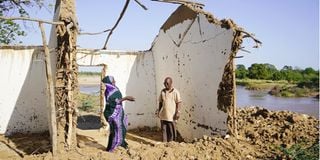
Mwanaharusi Morowa and an elder visit her house destroyed by the River Tana after it broke its banks in Makere village, Tana River County, in this picture taken in November 2024.
Droughts have grown harsher, grazing fields thinner, and competition for pasture deadlier.
“Our rains no longer follow the season. Sometimes the rain comes too hard, sweeps everything. Other times it doesn’t come at all. Our animals suffer, and we fight to survive,” Abdi says, sitting beside his surviving herd of 23 cattle, once 140.
In recent years, herders from Garissa, Wajir, and Mandera have poured into the Tana River searching for the last remaining grass. What begins as desperation often turns to conflict.
“In Bura alone, more than twenty people have died. My own brother was killed over grazing land. We used to share these areas peacefully, but now the pressure is too much,” Abdi says.
With shrinking pasture and rising insecurity, Abdi has had to rethink his entire livelihood.
“I reduced my herd because I could not manage conflict and hunger for the animals. Now I want to start a fenced fattening area in a safer place. A small number of animals I can manage. Large herds are becoming impossible in this new climate,” he says.
Not everyone, however, has accepted relocation. In Laza Miembeni, along the riverine belt, Mariam Ade remains firmly rooted on her ancestral land despite repeated evacuation calls.
“The government did not explain properly where we were going. No land was given with documents. How can I move my children to a place where anyone can come tomorrow and chase us away?” she poses firmly.
To Mariam, the cluster villages represent both hope and danger. She believes that poor coordination by the government has fueled conflict as displaced communities are resettled among others with overlapping land claims.
“All the areas where there has been fighting are because there was no planning. People arrive in places others consider grazing land or ranch land. That is how death happens,” she argues.
An aerial photo of flooded roads along the Garissa-Mombasa road in Tana River County taken earlier during the el-nino floods in October 2023.
Her own community has lost relatives in Bura due to land disputes triggered by relocation.
“I will not risk that. Until proper mapping is done and land is allocated formally, with the law, I am not moving; we shall swim in the next floods once again,” she says.
For elders like 78-year-old Mohammed Bare, the river’s behavior is no longer surprising, only increasingly alarming.
As a man who has lived his entire life along the shifting banks, he has watched the river perform tricks both beautiful and brutal.
“When I was a small boy, we saw the river open one new channel in ten years. Now it opens three or four in one season,” he says.
Over sixty years, Mr Bare has moved to three different villages, each journey forced by the River Tana carving new paths through his people’s farms.
He has seen fertile riverbeds turn into dry plains and empty land suddenly become violent currents overnight.
“From Madogo to the Delta, this river has created more than 18 new tributaries. It breaks through places where our fathers planted mango trees. It destroys villages. It pushes people together even when they have long histories of conflict,” he says.
Relocation itself, he explains, comes with new layers of suffering.
“Where we move, there are no roads, no water, no schools. And when new families arrive, the communities there say: This is grazing land, this is ranch land, this is our ancestral land. Conflict begins before people even finish building houses,” he says.

Decent houses built for survivors of floods through a partnership of the County Government and UN Immigration and Korea at Konani Cluster in Tana Delta, in this picture taken on December 7, 2025.
Yet, he also sees change in social relationships.
“We now live with people we never used to greet. The river forces us to learn from each other. Some days it is difficult. Other days it is beautiful,” he says.
As the human toll of climate change becomes clearer, county officials say the magnitude of environmental shifts demands more resources and faster government action.
Matthew Babwoya, the County Executive Committee Member for Environment and Climate Change, says recent assessments by the county and partner organizations confirm that the Tana River is undergoing unprecedented ecological disruption.
“We have recorded a 40 percent increase in flash-flood events in the last decade alone. Every season now behaves like an emergency. The river no longer follows historical patterns, and that forces both the government and communities to constantly re-adjust,” Babwoya says.
He notes that climate-change models explain the sudden formation of new tributaries, the flattening of wetlands, and the increased erosion upstream.
“These shifts are not natural cycles anymore. We are dealing with a climate-induced redesign of the river system, and that has massive implications for settlement planning, agriculture, grazing, and security,” he says.
He adds that rainfall in the region now exceeds historical projections by up to 35 percent, overwhelming natural channels and increasing the likelihood of more destructive flooding.
Governor Dhadho Godhana, who doubles as the Executive for Special Programs, says the county continues to face one of the largest displacement crises in Kenya.
“What happened in Makere, Mwina, Dumi, Shirikisho, and the North was devastation we haven’t seen in generations. We have so far distributed building materials to more than 5,000 affected families, but the need is much bigger,” the governor says.
He says that while cluster villages are helping residents rebuild, bureaucratic delays are slowing the process.
“One of our biggest challenges has been delays by the County Assembly in approving the land-use and settlement plans. Without those approvals, adjudication stalls, and families end up in limbo,” Governor Godhana says.
Still, he points to recent progress:
“The issuance of the *Wayu-Boru Community Land Title is a major milestone. It sets the pace for more than ten other community land-title processes we are pushing; however, communities need to look at the significance of this from our lenses,” he says.
The governor is frank about the financial gap hindering disaster response.
“As a county, we require at least Sh7.1 billion to stabilize all cluster settlements and support displaced households. Our county budget cannot sustain that level of response,” he says.
He highlights ongoing partnerships with the UN and the Korean government to construct climate-resilient homes in Konani, Mwina, and Dumi, but warns that national government support remains slow.
“If the national government does not treat Tana River as a special case, we will keep losing people, their view towards residents in Tana River is still skewed. Climate change is reshaping our map. We need matching support,” he says.
Kalu Nyale, the Tana River County Meteorology Director, says the trends are consistent with climate projections for the larger Horn of Africa.
“In an average year now, rainfall varies by up to 70 percent from what we recorded two decades ago. The river responds to that kind of volatility by carving new paths. This is no longer guesswork, the data is clear,” Mr Kalu says.
He predicts more erratic cycles in the coming years unless conservation and climate-mitigation efforts accelerate.
“If we don’t invest in early-warning systems and protect riparian zones, the river will keep redrawing its map. Makere, Mwina and Bandi will not be the last,” he warns.
Environmental researcher Dr Halima Dara, who has studied ecological shifts in the Tana River for a decade, says the county is now a classic case of “compound climate stress.”
“Floods destroy farms, drought kills pasture, and shifting river courses displace entire communities. When people are forced together in unfamiliar spaces, historical tensions resurface,” she says.
Her studies show shrinking wetlands, increased siltation, and higher temperatures as key drivers changing River Tana’s behavior.
“When wetlands weaken, the river loses its shock absorbers. The result is violent flooding downstream and prolonged dryness upstream,” she says.
But she insists the crisis is solvable.
“We cannot stop the river from shifting. But with data-driven settlement planning, climate-smart agriculture, and proper land adjudication, Tana River can adapt. This is not a hopeless story; it is a story waiting for the right interventions,” she reiterates.
For Mwanaharusi, Abdi, Mariam, and thousands like them, the future remains uncertain. But as the river continues to rewrite the terrain, their resilience, shaped by decades along its banks, remains their greatest inheritance.
“We must learn again. If the river is changing, we have to change too. But we pray it does not forget us,” Mwanaharusi says softly.