Kenya scores big at UNEA-7 as all its environmental resolutions get green light
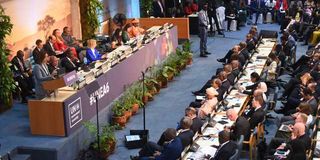
United Nations Environment Assembly (UNEA) President Leila Benali delivering her remarks at UNEP headquarters in Nairobi on February 29, 2024 during the sixth session of the United Nations Environment Assembly (UNEA-6). PHOTOIEVANS HABIL

What you need to know:
- Kenya’s three resolutions at UNEA-7, including a proposal to use sports for environmental advocacy, have all been adopted.
- Environment CS Deborah Barasa said adoption of the resolutions will ease implementation by strengthening global cooperation, resource mobilisation, and the development of policies, strategies, and monitoring tools.
Kenya’s push to elevate sports as a platform for environmental advocacy has received formal support at the ongoing seventh session of the United Nations Environmental Assembly (UNEA-7).
Since Monday, member states have been negotiating 15 draft resolutions, including those on safe, responsible, and sustainable artificial intelligence systems, as well as enhancing the meaningful participation of children and youth in environmental governance.


At the UNEA-7, Kenya is sponsoring three resolutions. By Friday afternoon, all three of Kenya’s resolutions had been approved for adoption. Besides the use of sports in environmental advocacy, Kenya wants member states to agree on the way forward on the environmental dimension of antimicrobial resistance through pollution attributed to the improper disposal of medical waste.
On artificial intelligence and its impact on the environment, Environment CS Deborah Barasa noted that Kenya is keen on a science-based transparency, environmental assessment and international cooperation.
“We are very clear that if data centres are going to come to Africa, they cannot come in the old extractive model: cheap land and water in the Global South, and value captured elsewhere. AI infrastructure should be efficient, powered by clean energy, water-conscious and compatible with national climate and environmental objectives."
What’s next after the adoption of resolutions
“ After a resolution is adopted, implementation becomes seamless because we are now working together in unity as a globe, and so resource mobilisation will be easy. Partners again will flood in and focus on the resolutions at hand. We’ll come up now with policies, strategies, guidelines, M&E tools, human resources and other resource capacity to drive the agenda. So we are really keen to see how we can work together, and after the resolutions, it's not the end. We may come back to review, revise and build up on the resolutions so that we refine them and address all the concerns,” Environment CS Deborah Barasa told Nation.
Convening just a few weeks after the conclusion of global climate talks (COP30) in Belem, Brazil, which saw key agreements such as escalating climate finance and boosting adaptation funding, but also deep divides over phasing out fossil fuels, President William Ruto, speaking during a high-level ministerial segment, called for member states to translate signals into actionable outcomes.
“For Africa, climate change is not an abstract debate; it is daily life. Just days ago, Kenya was compelled to declare a national drought emergency in 20 countries, leaving 2.5 million of our citizens at risk of severe hunger and water scarcity, as delayed rains and climate stresses devastate crops and livestock,” he remarked. “ Across our continent, from failed harvests to destructive floods, from intensifying storms to conflicts worsened by resource scarcity, Africans are paying the price for a crisis they did not create.”
Last week, in an exclusive interview with Nation, Kenya Met acting director, Edward Muriuki, described Kenya’s situation as severe and escalating rapidly.
“According to the National Drought Management Authority (NDMA), six counties (Mandera, Wajir, Garissa, Kilifi, Kajiado, and Tana River) are already in the alert drought phase, requiring urgent interventions. 17 counties are in the normal phase, but the situation is deteriorating. Food insecurity currently affects 1.8 million people, expected to rise to 2.14 million by January 2026.”
For Africa, President Ruto said, the numbers add to existing burdens of debt, “infrastructure deficits, and limited fiscal space. Behind each statistic is a farmer, a small business, a community uprooted. They are the human face of a crisis accelerating faster than our institutions can keep pace.”
[email protected]