Dr Mukami Oundo was attending a wedding on a particular Saturday when an emergency call came in. A lioness was in distress. For the wildlife veterinarian, such interruptions are part of a job in which emergencies can arise anywhere, at any time.
One day, she could be rescuing an abandoned elephant calf or treating an ensnared zebra. On another, she could travel more than 250 kilometres in a day in search of an animal in distress.
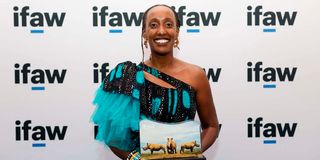
It is this dedication to wildlife that has earned Dr Mukami international recognition. On Saturday, she walked up to a podium at the BAFTA, London after being named animal hero and Wildlife Vet of the Year at the global awards organised by the International Fund for Animal Welfare (IFAW), an organisation dedicated to rescuing, rehabilitating animals and protecting their natural habitats.
In her telling, her journey to that moment began with a passion for animals that she turned into a profession, spending five years studying veterinary medicine and another year completing her internship before joining the Kenya Wildlife Service (KWS) as a veterinary officer.
Today, she responds to wildlife emergencies across the Laikipia-Mwea-Nyandarua ecosystem. Unlike treating domestic animals, where veterinarians can often arrange repeated consultations, treating wildlife presents a different set of challenges. An animal may be examined, treated and released into the wild, leaving the veterinary team with limited opportunities to monitor its recovery.
“They start with triage, they take your temperature, they take your blood pressure, all those things. So we do all that for animals,” she says.
Veterinarians collect blood and stool samples and, where necessary, conduct biopsies on suspected masses or tumours. These samples are taken to the laboratory to establish what is affecting the animal and guide treatment.
In some cases, the team can bring an animal into care, monitor its progress and administer further treatment before releasing it.
With larger animals such as elephants, however, the team may have only one opportunity to intervene.
“Sometimes it works that we are able to treat the animal and get the results and are able to track the animal again once we know what we are dealing with and even maybe do a follow-up treatment. But sometimes we just have that one shot and we give it all we can,” she says.
It is a responsibility that requires quick decisions, technical skill and the ability to work under pressure. For many years, this has been a man’s turf.
“When I was first hired, it had been 16 years since a female veterinarian had worked in that role,” she says. “ I knew I was creating a blueprint so I began by ensuring that additional tents were carried during field deployments so that female students and rangers could be accommodated appropriately. And now being a young woman in this field, I've always had to prove through my words, through my actions, that I'm capable of doing the work and holding my own.”
Her work, she says, has taken her into some of the most demanding situations in wildlife medicine, caring for elephants, zebras, various antelopes, black and white rhinos, big cats, mountain bongos and pangolins.
There is no typical day. Her work includes rescuing abandoned elephant calves, attending to zebras caught in snares and treating animals with injuries inflicted during human-wildlife conflict.
One species that has left a lasting impression on Dr Mukami is the pangolin, a critically endangered animal widely targeted by traffickers. She shares a few fun facts about it. One, Kenya has three out of the four African species of pangolin and two, pangolin is the only mammal in the world covered in scales.
“The first time I saw a live pangolin was in 2022, when I was called in to treat a pangolin who had been rescued from a trafficking ring and was missing half of his hind limb. The rest of the limb had to be amputated, and the surgery was successful. The pangolin, unfortunately, developed complications later and passed away. I learned a lot of lessons from that case,” Dr Mukami explains.
The experience has informed her work as the focal contact person for pangolins in the KWS veterinary department. She has pioneered protocols to guide the care and treatment of rescued animals, which are notoriously difficult to keep in captivity.
Pangolins have highly specialised dietary requirements, feeding on ants and termites. Even their preferences for particular types of ants or termites can differ, making it difficult to keep them healthy outside their natural environment. “When suspected criminals are arrested with pangolins, the legal, ideal situation is to have the pangolins presented in court as live evidence. The protocols help advise the prosecution and the judicial system on why this is not possible.”
While pangolins have become her favourite animal, rhinos, giraffes, and lions are also close to her heart. “In July, together with four colleagues, we performed surgery on a five-day-old white rhino who was born with a genetic issue. The surgery was the first of its kind documented in this species in the country. She is recovering well, and getting to see her recovery has been inspiring,” says the vet doctor.
Her work has also earned her a rather unusual honour. A lioness at the Nairobi Animal Orphanage and a black rhino at Tsavo West National Park have been named ‘Mukami’ after her.
“The lioness was rescued together with her sister in Amboseli and her sister had a really nasty wound. I remember trying to save her but she didn't make it. But I spent a lot of time nursing Mukami, trying to bring her up to speed. She was very tiny, she was about two weeks old and every day I was making sure that she's eating okay. I would even try to stimulate her backside for her to be able to poop properly. She's almost two years old and resides in the animal orphanage.”
For Dr Mukami, however, the greatest concern extends beyond individual animals to the growing threats facing wildlife across the country.
Human-wildlife conflict remains one of the most pressing challenges, particularly as human settlements expand into areas that animals have traditionally used as migration routes and habitats.
“We are also seeing deaths sometimes of unintended species. For example, when retaliation is carried out by humans on, say, they are targeting lions or leopards that have killed their livestock, sometimes they poison a carcass so that they can retaliate on those predators like vultures, who are currently quite endangered. So we are also seeing a decline in their numbers when human-wildlife conflict retaliation happens,” she says.
“Coexistence requires working with all concerned parties, and while this coordination may not be simple, I hope that we continue to put in more effort to see it happen.”
Climate change, she says, is also adding another layer of pressure.
“Changes in weather patterns and prolonged dry periods affect the availability of water and food, forcing animals to move into areas occupied by people. Elephants, for instance, may venture into farms where crops offer an alternative source of food. They don't know that this is supposed to be for humans. We are not supposed to eat this,” she says.
“We've seen elephants falling into wells, searching for water. We've seen them getting stuck in mud, trying to coat themselves in the mud or trying to get some water from the muddy puddles in the drier seasons.”
Other threats include illegal bush meat poaching, snaring, illegal pet trade and wildlife trafficking. Animals such as African grey parrots and monkeys are targeted for the illegal pet trade.
Disease is another concern, although Dr Mukami says work around the One Health approach has helped strengthen efforts to protect wildlife, domestic animals, people and the environment.
“When we do vaccination drives for livestock and companion animals, we are also helping to protect wildlife because diseases that would cross over from wildlife to livestock and maybe even to humans and vice versa.”