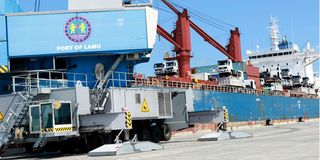
A significant collision and disagreements have continued to be witnessed between the Government of Kenya, environmentalists and a section of community members just a week after the groundbreaking ceremony for the Sh2 trillion Dangote East Africa Petroleum Refinery and Petrochemicals SEZ took place in Lamu.
With construction equipment having already touched down to Lamu, significant activities surrounding the plant have been established to focus more on Kwasasi and Kalavuu villages in Lamu West, the proposed site for the multi-trillion project.
The state, through President William Ruto, seems to be forcing the Dangote East Africa Petroleum Refinery and Petrochemicals SEZ, a regional industrialisation ambition at a time when environmentalists and even a section of the Lamu residents themselves feel the venture is posing a great threat to the sensitive marine ecosystem in the county.
Residents of Kwasasi Village in Lamu County. The village is set to become the site of the Sh2 trillion Dangote East Africa Petroleum Refinery and Petrochemicals Special Economic Zone.
Photo credit: Kevin Odit | Nation Media Group
While proponents project substantial job creation and energy logistics advancement, environmentalist crusaders warn of irreversible damage to local mangroves, coral reefs, and artisanal fisheries.
The ecological situation in Kwasasi and Kalavuu villages is generally shaped by a fragile balance between vital marine and coastal habitats and mounting pressures from climate change and the general infrastructure development.
Kwasasi and Kalavuu villages already border a mega state project, the Sh310 billion Lamu Port in Kililana.
During its phase of construction between 2013 and 2016, the port left thousands of mangroves trees destroyed to pave the way for the establishment of its first three berths.
It is worth noting that the ecological situation of these villages had in previous years already been permanently spared from the threats of coal pollution following the definitive cancellation of the proposed Sh200 billion Coal-fired Power Plant.
The project was to generate 1050 megawatts of power upon completion, and at least 975 acres of land had already been earmarked at Kwasasi for the same.
The plant was, however, resisted because it threatened public health, damaged fragile local ecosystems, and lacked proper legal and community consultation.
Right from the very initial stages, activists and scientists took the intended coal-fired power plant head-on, warning that burning coal would spew air pollution, cause respiratory illnesses, risk acid rain, and poison local soil and fishing waters.
Such intensive campaigns led to the project’s Environmental Impact Assessment (EIA) license to be quashed by the National Environment Tribunal (NET) in 2019.
The decision was ultimately upheld by the Environment and Land Court in Malindi in October 2025, hence blocking the coal plant completely.
Up to date, environmentalists view the 2025 legal victory as a critical step that protected a highly sensitive coastal and marine ecosystem in Kwasasi and its environs.
Remember that the ecological profile of Kwasasi and Kalavuu, now the Dangote Refinery proposed site, is primarily a farming settlement comprising lush bushland, small-scale agricultural farms, and centuries-old trees, including baobab.
The second equipment batch for the Dangote East African oil refinery project arrives at the Lamu Port in this photo, taken on October 20, 2026. Over 154 assorted construction equipment items were offloaded from Mv Great Prosperity, a Hong Kong-flagged dry bulk carrier, at the Lamu Port.
Photo credit: Kevin Odit| Nation Media Group
The village is located along the shoreline of Manda Bay (near Dodori Creek), which generally features a fragile ecosystem rich in mangrove forests, coral reefs, and extensive seagrass beds.
The local indigenous Swahili and Bajuni communities depend entirely on this intact ecology for their subsistence through farming, mangrove harvesting, and artisanal fishing.
Abdul Ali, an elder at Kwasasi, expressed worry that if the project proceeds, it is likely to cause severe degradation, including the local community’s displacement and affect their general livelihoods.
“The Lamu Port construction in previous years led to the destruction of our mangrove ecosystems. The port affected the livelihoods of thousands of our fishermen and farmers. We feel the same way will be reversed with the intended Lamu Oil Refinery in our villages. The government hasn’t told us anything, and we’re seeing activities ongoing within our vicinity daily,” said Mr Ali.
Lucy Karimi, a resident of Kalavuu, expressed fear that the sudden transformation, including the implementation of the Dangote Refinery, will lead to their subsequent displacement.
Ms Karimi questioned why up to date, it has not been made clear what land has so far been allocated, on what legal basis, or how affected households will be compensated and resettled.
She complained that in recent times, they have continued to witness heavy machines moving around their villages, doing intense activities without them being notified or involved in any way.
“We believe where projects affect community or customary lands, then, the government and project proponents have the obligation to demonstrate how the rights of affected communities like us have been respected, including the application of Free, Prior and Informed Consent (FPIC) where applicable. We’re left in the dark,” said Ms Karimi.
Lamu Island BMU Chairperson Abubakar Twalib.
Photo credit: Kalume Kazungu | Nation
Abubakar Twalib, the Lamu Beach Management Unit (BMU) Chair, noted that local communities in the region have depended on the ocean for generations as their source of food, livelihoods, trade and household income.
Mr Twalib called for a proper Marine Spatial Plan to be established to help address arising issues as implementation of the Dangote East Africa Refinery gears on.
“Proper Marine Spatial Plan will look at the whole picture, fishing grounds, lobster and other high-value fisheries, breeding and nursery areas, mangroves, seagrass and coral ecosystems, traditional fishing routes and landing sites, tourism areas, shipping corridors, industrial zones, conservation areas, aquaculture and the general future of the blue-economy investment,” said Mr Twalib.
Environmentalists interviewed affirmed that the local environment will be directly and severely affected once the Dangote Plant is established in Kwasasi, Kalavuu and surrounding areas.
Raya Famau, a local environmental activist and the Executive Director, Lamu Women Alliance (LAWA), questioned the unimaginable, uncertain ecological outcome when a giant refinery like Dangote’s meets the fragile coastal environment in the county.
Ms Raya Famau, the executive director of the Lamu Women Alliance.
Photo credit: File | Nation Media Group
“It’s clear that the ecological landscape of Kwassi, Kalavuu and its environs is facing a new industrial focus. The Kenyan government has already earmarked the broader LAPSSET corridor region, including Kwasasi for the massive Dangote Oil Refinery,” said Ms Famau.
In a statement, Save Lamu, a coalition of community networks incorporating of over 40 local organisations, all of which advocate for sustainable, inclusive and responsible development to preserve the environmental, social and cultural integrity of Lamu and promote community participation in decision-making processes, demanded an independent social and environmental assessment to safeguard the intended area’s recovering ecosystems.
Save Lamu Chairperson Mohamed Somo expressed concern that despite the Constitution of Kenya 2010 requiring transparency and accountability, access to information, public participation, environmental impact assessment, and open and accountable use of public money, the public in Lamu has seen none of the documents that would show these obligations have been met by the government and the implementers of the Dangote Refinery.
“Its climate impact must, therefore, be assessed under the Climate Change Act and against Kenya’s climate commitments, and the terms on which surplus power will be sold should be disclosed,” said Mr Somo.
Muturi Kamau, an environmental activist and the National Network Coordinator, Kenya Oil and Gas Working Group, views the government’s decision to force a project like the mega Dangote refinery as a real environmental gamble.
He said the concentration of ecologically sensitive habitats, dependence on fisheries and tourism, existing land rights concerns, and water constraints mean that the project’s costs and risks may fall disproportionately on coastal communities.
The Dangote refinery sits next to Lamu Port, about 11 kilometres from Lamu Old Town, a UNESCO World Heritage Site.
Mr Kamau is concerned that the project’s emissions could include fine particulates, Sulphur dioxide and benzene, a known carcinogen.
“Oil spill could have devastating consequences for the region’s fragile marine ecosystem. Oil contamination can smother mangrove forests, damage coral reefs and seagrass beds, and destroy critical breeding and nursery grounds for fish, crustaceans, and other marine species that sustain artisanal fisheries,” said Mr Kamau.
Ahmed Walid, an environmental activist and co-founder of Save Lamu, called on the government and Dangote Project proponents to publish the applicable Strategic Environmental Assessment and any supplementary assessments, including the project-specific ESIA, NEMA’s decision and licence conditions, as well as a Health Impact Assessment that incorporates the design, environmental assessment and any Power Purchase Agreement for the power plant.
“We’re demanding the public participation record and plans for ongoing monitoring, engagement and grievance resolution. We’re asking for responsible development. We aren’t asking the public to choose between development and the environment,” said Mr Walid.
Bakar Athman, the Executive Director for Lamu Marine Forum, said Lamu and Kenya deserve nothing less than development that is transparent, properly assessed and consistent with the Constitution and the laws of Kenya.
Mr Athman demanded clarity on matters surrounding water supply, waste and discharge management, oil-spill preparedness, impacts on fisheries and coastal ecosystems, and the environmental and climate implications of the proposed power plant and oil refinery.
Sherelee Odayar, the Oil and Gas Campaigner at Greenpeace Africa, said the Dangote Project threatens to damage one of East Africa’s most fragile coastal ecosystems while locking Kenya into a risky fossil fuel future.
“It will also lock Kenya into decades of carbon-intensive development, worsening climate change and its impacts. The enormous capital required for a project of this scale could instead help accelerate Kenya’s renewable energy future through solar, wind, geothermal, storage and better energy access,” said Ms Odayar.
The concerns come at a time when a petition has been filed at the Malindi Environment and Land Court by 133 residents of Lamu County arguing that their families have farmed, grazed livestock, and lived on the intended refinery land for generations, and that the parcel of land also contains ancestral homes, mosques, and family graves; hence, it should be considered for compensation.
The petitioners are also accusing the state and project developers of completely bypassing strict environmental impact assessments and failing to comply with constitutional requirements regarding access to information and public participation.
While Lady Justice Jane Onyango declined to entirely halt the mega-project’s groundbreaking ceremony on September 30, 2026, the court ordered that a status quo be strictly maintained on the disputed portion of the site.
Adding to the legal pressure, the High Court, under Justice David Mburu, on Tuesday, October 6, 2026, separately certified an urgent case seeking disclosure of agreements and public commitments behind Kenya’s planned stake in Dangote’s Sh2 trillion Lamu refinery.
Justice Mburu ordered the state and other parties to respond within seven days, as petitioner Francis Onyango Awino questions the proposed use of public money, land, tax measures and guarantees.
On September 30,2026, President William Ruto, four other Heads of State and Nigerian Industrialist Aliko Dangote broke ground on the 700,000-barrel-a-day Dangote East Africa Petroleum Refinery and Petrochemicals SEZ at Mokowe in Lamu County.
The ceremony was undertaken amidst community protests and missing assessments: the Environmental and Social Impact Assessment (ESIA) and the Strategic Environmental Assessment (SEA), both of which are tools used to protect the environment and people, but applying at different levels of decision-making.
During the event, President Ruto and billionaire Aliko Dangote defended the project, stating it is necessary for Africa’s industrial future and aiming for full completion by 2030.
Asked whether the Lamu refinery has undergone any environmental or strategic assessments (ESIA) and (SEA), Lamu County National Environment Management Authority (NEMA) Director Edward Menza said they were yet to conduct such assessments.
As per NEMA in Kenya, ESIA must be conducted before the commencement of any project, particularly during the early planning, design and pre-feasibility stages.
According to Mr Menza, ESIA is part of the project development process and is usually done at the initial stages of the project development.
It is a decision making tool and should guide whether a project should be implemented, abandoned or modified prior to implementation.
“People shouldn’t confuse the recent launch of the project by the President with actual work. I am on the ground and there’s nothing so far like real construction. Shipping of construction equipment to Lamu doesn’t mean the project has fully kicked off,” said Mr Menza.
He added, “A project like the refinery is classified as high risk. Therefore, NEMA shall ensure a comprehensive environmental assessment is done. People should expect it to be ready in four months’ time. Everything will be made public and transparent through adverts in our local dailies and people shall even be asked to give views both at county and national level. As NEMA, we shall ensure the project adheres to all the required social and environmental rules and regulations.”
Legally, ESIA requires two key steps.
First, a proponent or investor shall not implement a project likely to have a negative environmental impact, or for which an EIA is required by the Environmental Management and Coordination Act or regulations issued under it, unless an EIA has been concluded and approved in accordance with the law.
Secondly, no licensing authority under any law in force in Kenya shall issue a trading, commercial or development permit or license for any project for which an EIA is required or for a project likely to have a cumulative significant negative environmental impact unless the applicant produces an EIA licence issued by the Authority.
On the issue of land grievances, the government maintains that land reserved for the Dangote refinery is under the Lamu Port-South Sudan-Ethiopia Transport (LAPSSET) Corridor and all claimants had been compensated before.
Lands Principal Secretary Generali Nixon Korir said Lamu was chosen as the refinery’s location because of its proximity to the port and the availability of government-owned land.