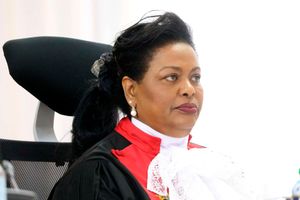
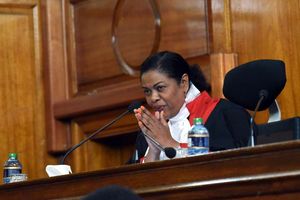
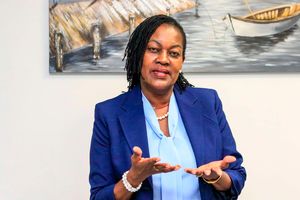
When Judge Phoebe Okowa won a seat at the International Court of Justice early this month, Kenya celebrated. It was another victory to place the country at the top of a multilateral organisation.
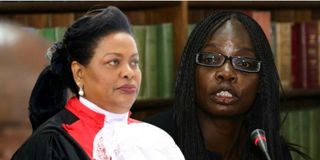
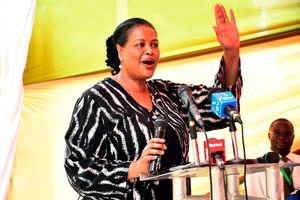
But some worried it could weaken the chances of countrywoman Njoki Ndung’u, who is seeking to be a judge of the International Criminal Court (ICC). As a supreme court judge in Kenya, Justice Ndung’u has little doubt about her qualifications for the position. But it depends on how Kenya campaigns for her ahead of the elections in December.
Supreme Court Judge Lady Justice Njoki Ndung'u.
Photo credit: Wachira Mwangi | Nation Media Group
Prof Vincent Ongore, a Nairobi-based scholar, said Lady Justice Njoki Ndung’u’s candidature, coming shortly after the re-election of Prof Phoebe Okowa to the International Court of Justice (ICJ), presents some kind of fatigue that Kenyan diplomats must overcome.
"This is primarily because the individuals and diplomatic networks expected to spearhead her campaign, particularly on the domestic front, are largely the same ones who were instrumental in securing Prof Okowa’s re-election. This could create an element of diplomatic fatigue and place additional demands on Kenya’s lobbying efforts," he said last week.
Yet she has some advantages. Lady Justice Ndung’u’s candidature was officially launched by President William Ruto. In essence, this elevates her bid to the level of a State-backed project, having received the endorsement and visibility of the highest office in the country.
Another major advantage is her extensive experience in the Judiciary, particularly her work at the Supreme Court, where she has dealt with complex constitutional, legal and human rights questions. Her judicial experience, coupled with her longstanding engagement in human rights advocacy before joining the Judiciary, gives her a strong professional profile and the credentials expected of someone seeking an international judicial position.
Her candidature was offered as Kenya’s growing diplomatic ambition and influence on the global stage. That said, there are some potential drawbacks to her candidature.
The same diplomatic machinery, political goodwill and networks that were mobilised to secure Prof Okowa’s re-election are now expected to rally behind Justice Ndung’u. There is a possibility that sustaining the same level of enthusiasm and commitment in successive campaigns could prove challenging.
The International Criminal Court building in The Hague.
Photo credit: Courtesy | AFP
So far, Justice Ndung’u has travelled to most continents where the ICC has members. She has also spoken to diplomats in major diplomatic capitals of the world, including New York, often travelling with Kenya’s government officials to address gatherings. She is expected to cover most of the 124-member ICC countries before the vote later in December.
Six of the Court's 18-judge bench are to be elected when the Assembly of State Parties gather for the 25th Session to be held in The Hague, Netherlands, from November 30 to December 7, 2026. Winners will serve for nine years.
Eight African contenders are in the race, including Lady Justice Njoki Ndung’u. Others are: Ezéchiel Amani Cirimwami of the Democratic Republic of Congo, Evelyn Ankumah (Ghana), Tujilane Chizumila (Malawi), Rosette Muzigo-Morrison (Uganda), Deo John Nangela (Tanzania), Abdoulaye Seye (Senegal) and Veronic Wright (The Gambia).
Qualified and competitive
At the ICJ, Sierra Leone withdrew its candidate after two rounds of voting and endorsed Kenya’s Okowa. It remains to be seen whether Sierra Leone was counting on reciprocation from Kenya.
"Justice Njoki Ndung’u is qualified and competitive only that Kenya might come out as being too greedy. She stands a very good chance. First, she is a jurist of good standing. Then she's a woman and the gender card cannot be ignored," said Herman Manyora, a political commentator and lecturer at the University of Nairobi.
“Her personal credentials, extensive judicial experience, familiarity with complex human rights issues and the political backing of the Kenyan State give her a considerable advantage. “However, the ultimate outcome will depend not only on her individual merit but also on Kenya’s ability to sustain diplomatic momentum, navigate competing international interests and build the necessary coalitions of support," he said.
Kenya won’t be the first to have nationals on both courts, however. As of November 2026, Japan, France, Uganda, Mexico and Romania have nationals serving simultaneously as judges of both the ICJ and ICC.
Although their names are often confused, the ICJ and ICC are entirely distinct institutions.
The ICJ, the principal judicial organ of the United Nations, settles legal disputes between States and provides advisory opinions on international law. ICJ’s 15 judges are elected through separate votes by the UN General Assembly and Security Council, both sitting in New York. Candidates must secure an absolute majority in both organs.
The ICC, established under the Rome Statute, prosecutes individuals accused of genocide, crimes against humanity, war crimes and the crime of aggression. Its 18 judges are elected by States Parties to the Rome Statute through the Assembly of States Parties (ASP), by secret ballot and a two-thirds majority of States Parties present and voting.
Importantly, ICC elections are governed by Minimum Voting Requirements (MVRs), designed to ensure professional expertise, equitable geographical representation and fair representation of female and male judges.
Candidates are nominated under two professional categories. List A comprises candidates with established competence in criminal law and procedure and relevant criminal proceedings experience. List B comprises candidates with established competence in relevant international law, including humanitarian and human rights law.
The electoral framework also considers five regional groups: Africa, Asia-Pacific, Eastern Europe, Latin America and the Caribbean, and Western Europe and Other States.
For the 2026 elections, the initial requirements include votes for at least two List A candidates and one candidate each from Africa, Asia-Pacific and Western Europe and Other States. Gender balance is also assessed, although no additional gender-based minimum applies at the outset of this election.
These requirements are recalculated as judges are elected. Crucially, they establish minimum obligations, not maximum regional entitlements.
Their application creates an opportunity for a strong African candidate to secure election in the first ballot. Kenya's nominee meets both the List A and African regional requirements, making her candidature relevant to two initial electoral considerations simultaneously.
Kenya should therefore make every diplomatic effort to secure broad support from the first ballot, recognising that the required two-thirds majority must still be attained.
There is no prohibition against nationals of the same country serving on both courts. Neither does success in one election diminish a country's eligibility in the other.
National capitals are critical because governments determine their voting positions. The Hague provides direct access to missions accredited to the ICC, while Brussels offers an important platform for engaging European States and diplomatic institutions.
These diplomatic efforts must ultimately be grounded in judicial qualifications and the institutional interests of the Court.
Although international judges serve independently rather than as national representatives, the legal traditions and professional experiences they bring enrich the institutions on which they serve.
The December election also presents an important question concerning Africa's representation on the ICC bench.
Currently, four of the Court's 18 judges are African nationals. Two, from Benin and Uganda, will complete their terms in March 2027, leaving continuing judges from Sierra Leone and Tunisia.
If only one African judge is elected, Africa's representation will decline from four to three. Securing two positions would preserve existing representation, while three would increase it to five of the 18 judges.
The requirement to elect at least one African judge should therefore not be mistaken for a ceiling on the continent's representation.
This is significant for a Court whose work has extensively involved situations and proceedings concerning countries of the Global South.