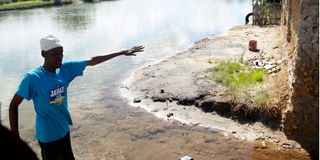
Every few weeks, when he can spare some money, Charo Chome returns to the edge of his land with local masons, carrying blocks and adding another layer to a wall he knows may never be enough to stop the Indian Ocean from creeping into his compound.
The barrier rises slowly from seawater that has flooded what was once his farm of coconut trees at Mkokoni in Matsangoni, Kilifi County. It stands uneven, barely two feet above the water, and incomplete along its length.
The wall is not the work of engineers, but one man’s attempt to hold back the ocean from making him homeless. For years, Mr Chome has watched the sea move closer. He is now convinced that it is only a matter of time before it gets into his compound if he does not get a permanent solution soon.
“The ocean is taking over my land. In the past, the water never reached this place,” he says, standing near the wall.
A trail of destruction at Tana River Lodge, which was once a popular luxury hotel built on Sand dunes at Kipini, Tana River County in this photo taken on May 13, 2026.
Photo credit: Kevin Odit | Nation
What began as occasional encroachment in places closer to the shoreline has, in his own words, become a relentless advance. Saltwater has already swallowed fields that once supported farming and steadily destroyed land that had sustained his family for decades.
“I used to grow coconut trees, but they were all ruined by saltwater. I am trying to stop the water, but I do not have the financial means. Whenever I get a little money, I extend the wall. For now, it is not complete,” he says in desperation.
The effort is physically demanding and uncertain, with heavy financial costs. Yet, abandoning it would mean accepting that the sea has won.
From where he stands at the edge of his compound, Mr Chome points to places that once marked the boundaries of his land. He says that nearly three acres have already disappeared beneath advancing tides, and areas that were once productive have become unusable.
He recalls that the situation began around 1979 with seasonal encroachment about three kilometres away from his land. Today, he often finds underground water in his pit latrine, which is located beside his house, raising his fears.
“From the way I see it progressing, in another five years the toilet will be broken,” he says.
Fishing boats at Kipini area in Tana River County in this photo taken on May 13, 2026.
Photo credit: Kevin Odit | Nation
Several families can no longer produce anything on their farms, which are either flooded or damp with salty conditions. One of the residents decided to turn his land into an artisanal saltpan by filtering and evaporating seawater in small batches to earn a living.
“Around five homesteads have been affected on the farmland. The water has not yet reached the houses, but we fear that if this continues, it eventually will. I hope the wall will help,” Mr Chome adds.
Charo Chome, who has tried to build a sea wall to block the salty water from invading his farm at Mkokoni, Matsangoni area in Kilifi County in this photo taken on May 12, 2026.
Photo credit: Kevin Odit | Nation
Ms Saumu Tunje, a resident, describes how the movement of tides increasingly shapes daily life. She points to a stretch of land where flooding spreads inland from the ocean, changing access routes and isolating communities.
“This is a section of the ocean where, when the tide rises, the water spreads inland and pushes further into the area,” she says.
During certain periods of the lunar cycle, she adds, the flooding becomes severe. The tides rise so much that some villages are turned into islands.
Researchers say the flooding intensifies during spring tides, which occur twice a month during the New Moon and Full Moon phases when the Earth, Moon and Sun align, producing exceptionally high tides.
In low-lying coastal areas like Mkokoni, these tidal peaks pose serious risks because the area borders the Mida Creek network, which lacks shielding from river outflows.
Across the flooded section of Mkokoni lies Chambuko village and beyond it, a fish landing site. Access to these places depends on the tides.
“One of the impacts we experience as villagers is that the route becomes blocked and people cannot use it. There are also pits in this area and when the water rises, people are unable to cross on foot,” she explains.
The Malindi Beach in Kilifi County in this photo taken on May 12, 2026.
Photo credit: Kevin Odit | Nation
What troubles her most is how dramatically the landscape has changed in a relatively short time. In the past, there were times when the sea retreated completely after the lunar cycle, but nowadays those moments are rare, if they occur at all.
“In 2015, this area had many coconut trees, but now there is nothing left,” she says, pointing at a vast flooded field.
According to the Kenya Meteorological Service Authority, sea levels along Kenya’s coastline are continually rising, with increasingly frequent episodes of unusually high tides. In its recent State of the Climate 2025 report, the authority notes that there were increased periods when the 2025 daily high waters approached or exceeded normal levels.
Mr Omar Bakari Mohamed, popularly known as Omar Juju, says rising sea levels have reshaped nearly every part of life for people residing at Kitangani in Mokowe, Lamu County.
Part of the destruction caused by the rising sea levels at Kitangani in Mokowe, Lamu County in this photo taken on May 14, 2026.
Photo credit: Kevin Odit | Nation
While accessing this village located off the Garsen-Witu-Lamu highway, only the murram road gives an indication that one is not entering a seabed. One side of the road has mangrove trees, while the other, where a few residents still live, is slowly being overtaken by the sea.
Mr Mohamed and his neighbours have learnt to live with crabs in their sandy compounds as the situation continues to make their land vulnerable. His semi-permanent house is full of holes that he says were caused by seawater intrusion, and there are clear marks of recent flooding that rose nearly halfway up the house.
“The seawater affects us greatly. Many times, we are forced to relocate. Children have to move, disrupting their education, and livestock die. The sea keeps finding its way inland. Houses are damaged and threatened with collapse, forcing us to rebuild all the time,” he says.
Behind his house, the flooding keeps increasing. What started as a small strip of flowing water has now expanded into a seawater pan more than 15 metres wide, complete with fish from the ocean.
He says that children sometimes come there to swim or catch fish, unaware of the impact that the situation has had on the people who once lived there. For now, Mr Mohamed has dug a ditch to divert the floodwater away from the remains of his compound, but he knows this is only a temporary solution.
“Many people have moved away because of the conditions. We are left with only one neighbouring household. My own wife and children don’t stay here. I had to rent them a house elsewhere because sometimes when you come out of bed in the morning, you land in water, unaware that the house got flooded overnight. It isn’t safe,” he said.
He has lived in the area for 38 years and says conditions were different in the past and were seasonal, just like in Kilifi. Now a father of eight, he says the uncertainty is exhausting.
“In the past, the water would come but not this severely. One possible solution is to build a seawall, but the ocean eventually returns to its natural path,” he says. “Perhaps we should also be helped to relocate elsewhere.”
A fisherman at Kipini Beach in Tana River County in this photo taken on May 13, 2026.
Photo credit: Kevin Odit | Nation
Across the road, concrete electricity poles have not been spared either. A keen look at the poles shows that continued saltwater intrusion is slowly eating away at their base.
The crisis extends into neighbouring Tana River County. The most affected area of the county is Kipini, where some hotels have collapsed and communities displaced.
The most visible destruction is at the site of the Tana Lodge Hotel, which had more than 10 buildings, including cottages, before it was completely destroyed by rising sea levels.
What was once a hospitality investment in the early 1990s worth more than Sh60 million by Roberto Macri, an Italian businessman, now stands as a constant warning to the Kipini community.
The site where the hotel was constructed appears to have been highly vulnerable. It resembles a cliff, a hospitality investor’s dream for a resort overlooking the ocean, but mostly consists of sand dunes.
Today, around seven years after the last permanent cottage collapsed, leaving only two small staff houses and a store. Strong winds have formed mounds of sand dunes more than eight feet high on the remaining parcel of land. While some rubble litters the eroded shoreline, residents say that most of the collapsed structures are now completely submerged.
“After the buildings collapsed, someone tried to construct something here,” Mr Hanson, a resident, explains, pointing at a construction project that stalled at the foundation level. “They found out that it was untenable; it was going to be a loss. The ocean is moving in fast.”
Kipini is one of the points where River Tana empties into the Indian Ocean. Unlike other beaches at the coast that have blue water, Kipini’s is brown.
For first-time visitors, the point where blue ocean currents and brown river flows meet is spectacularly visible from afar. But to locals, the convergence is a source of fear.
Some farming communities living nearby have been forced to move elsewhere in recent years after saltwater invaded their land. Locals say officials from both county and national government agencies have made several visits to Kipini, with solutions such as constructing a seawall being floated, but nothing has materialised to date.
Further south in Mombasa, one of the clearest signs of coastal erosion is at Fort Jesus, the iconic Portuguese-built fortress that now stands directly exposed to the Indian Ocean. Rising sea levels eroded the shoreline to the point where waves were reaching the base of the centuries-old structure, causing cracks to emerge in its foundation.
This pushed the National Museums of Kenya to construct a seawall in 2018 to reinforce the site and slow further erosion.
While this helped stabilise the fort, and communities exposed to sea invasions are calling for similar interventions, experts warn that seawalls alone may not offer a lasting solution to the growing threat posed by climate change along Kenya’s coastline.
The experience in Lamu illustrates these limitations. Despite sections of Lamu Island being protected by seawalls, increasingly powerful tides continue to push flooding beyond the barriers during extreme conditions.
Scientists and environmental experts argue that long-term coastal protection will require a combination of measures, including restoration of mangroves and coral reefs, stricter protection of natural coastal buffers, better land use planning and stronger climate adaptation policies for vulnerable settlements.