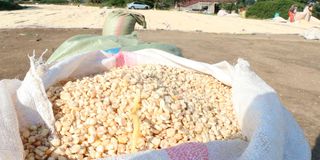
The government has deployed a team of scientists to assess the extent of maize crop failure reported in parts of the North Rift, in a move to safeguard the country’s food security and avert a possible shortage next year.
This is according to Principal Secretary for Agriculture Paul Ronoh, who said the ministry is closely monitoring the performance of maize planted during the long rains between January and June.
Speaking during an engagement with newly elected directors of Kenya Tea Development Agency (KTDA) factories, he noted that preliminary reports indicate that some maize fields have performed poorly.
This prompted the ministry to commission experts to assess the extent of the losses and recommend appropriate interventions to address the issue.
“We have established that some of the maize crops have failed, especially in parts of the North Rift. We have put together a team of scientists to determine the extent of the failure so that the ministry can come up with mitigation measures. Our priority is to ensure the country does not face hunger,” he said.
The PS said the government is determined to maintain maize production and guarantee an adequate supply next year, adding that once the technical assessment is completed, the ministry will determine whether local production will be sufficient to meet national demand.
Should the report indicate a significant production deficit, PS Ronoh said the government will consider importing maize to bridge the supply gap and stabilise the country’s food reserves.
Beyond maize production, PS Ronoh said the government is intensifying efforts to expand high-value cash crops to improve farmers’ incomes and boost export earnings.
He noted that the ministry aims to increase the country’s annual coffee production from the current 50,000 metric tonnes to 150,000 metric tonnes within the next three years through farmer support programmes and the expansion of acreage.
The PS said more counties are embracing coffee farming, noting that farmers have responded positively to government initiatives aimed at reviving the sector.
“This year we are likely to record the highest coffee volume and the best prices. Coffee is becoming a critical cash crop in transforming our economy, and we are encouraging farmers to grow both food crops and cash crops,” he said.
On the tea sector, PS Ronoh said the government is implementing wide-ranging reforms aimed at improving governance, operational efficiency and farmers’ earnings in factories managed under KTDA.
According to PS Ronoh, the induction of newly elected directors is aimed at strengthening leadership, improving strategic marketing and reducing inefficiencies within tea factories.
He added that about 19 factories have been identified for infrastructure upgrades to enable them to shift towards specialty tea production and enhance value addition.
PS Ronoh said reforms allowing factories to sell tea directly to international buyers have opened new opportunities for Kenyan tea, while diplomatic engagements by the government have secured additional export markets, including China, where Kenyan tea enjoys duty-free access.
“The total infrastructure improvement programme is estimated at about Sh4.5 billion, with the government already allocating nearly Sh1 billion to begin upgrading priority factories,” he said.
The PS noted that tea auction prices have improved significantly, rising from less than one US dollar per kilogram in previous years to more than 2.2 US dollars per kilogram, with prices edging closer to three dollars due to improved quality and stronger demand.
He urged tea factories to invest in packaging and branding to ensure more tea is exported as a finished Kenyan product rather than in bulk for blending abroad.
“Our tea is the best in the world, just like our coffee. We want consumers to buy tea made in Kenya so that farmers earn better returns,” he said.
According to the PS, the government is investing in hydroelectric power projects for tea factories to lower energy costs, alongside the introduction of improved tea varieties that are high-yielding, disease-resistant and better adapted to climate change.
Ronoh urged tea farmers to work closely with researchers to replace ageing tea bushes with improved varieties capable of sustaining production in the face of changing weather patterns.