The discontinuation of Koko Networks Limited in Kenya could jeopardise progress in the clean-cooking sector and threaten the generation of carbon credits that are crucial for global climate efforts.
Although clean-cooking solutions are gaining momentum as a means of reducing deforestation and improving health outcomes, the company’s exit could delay key emissions reductions and undermine climate targets and international commitments.
The World Health Organisation estimates that household air pollution from traditional cooking fuels causes over 600,000 premature deaths annually in Africa each year through inhaling charcoal fumes, as well as other harmful environmental, climatic and social impacts.
Cooking fuels and technologies are classified as “clean” if their emissions comply with the WHO's Air Quality Guidelines, and include electricity, LPG, biogas and ethanol.
Although various clean cooking alternatives exist, many remain unaffordable for low-income consumers, making Koko Networks’s bio-ethanol cooking fuel a gamechanger, with a litre selling at Sh100, half the market price of Sh200. The initiative has been serving more than 1.5 million customers across eight urban networks in Kenya, providing cleaner cooking options for low-income households.
The liquid bio-ethanol is produced from sugarcane and other agricultural by-products, a process that involves extracting sugars and fermenting them with yeast to produce ethanol, and then refining the fuel to make it safe for household cooking. The organisation has been using smart technology and carbon finance to make its solution more competitive with charcoal, filling the gap left by the absence of government subsidies for clean energy alternatives.
Now, the clean energy start-up has folded operations in the Kenyan market due to financial challenges. With the closure, approximately 1.5 million households now face the risk of reverting to polluting fuels, such as kerosene and charcoal, which would exacerbate health and environmental issues.
Koko directly employed over 700 people and partners with thousands of agents managing more than 3,000 automated refuelling machines, playing a vital role in the local economy. With the company’s closure, these workers and partners face an uncertain future.
According to sources who spoke with Climate Action, the organisation’s management informed staff of the closure on Friday, January 30, instructing them not to report to work the following day.
A board member and an employee, both of whom requested anonymity in order to speak freely, told Climate Action that the decision followed two days of meetings at the company's Nairobi offices. During these discussions, executives considered their options following the Kenyan government's rejection of a vital Letter of Authorisation (LoA), which forms the basis of Koko's business model of selling biofuels to low-income households.
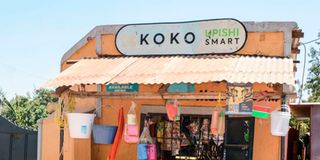
A shop in Wachara, Kisumu, on February 4, 2026. The outlet had been selling Koko's bio-ethanol cooking fuel.
Photo credit: Alex Odhiambo | Nation Media Group
“It’s been two days of intense deliberations,” said the board member. “We were facing bankruptcy because selling carbon credits is central to our business model.”
The start-up sells cooking stoves and fuel at subsidised prices, offsetting its losses by selling carbon credits. The airline industry is eager to purchase millions of carbon credits, such as those provided by Koko, as part of a programme managed by the International Civil Aviation Organisation (ICAO).
These credits are priced at around Sh2,580 ($20) each, up to 10 times more than those traded on the frequently criticised voluntary carbon markets.
The credits are generated by estimating the reduction in deforestation and, consequently, carbon emissions, when low-income households switch from cooking with charcoal to using bio-ethanol. The credits are certified by the Gold Standard, an independent verification organisation.Besides the bio-ethanol, Koko also sells stoves for Sh1,500, which is significantly lower than the market price of Sh15,000.
However, the company can no longer afford these subsidies following the rejection of the LoA that had previously secured funding from carbon credits.
Koko argues that its methodology is robust and that, in the absence of government subsidies, selling carbon credits to the compliance markets is essential to transitioning from charcoal cooking.
In June 2024, the Kenyan government signed an investment framework agreement with Koko that will enable it to sell credits into compliance markets under Article 6 of the UN Paris Agreement.
This setback comes just a year after the business secured a guarantee of $179.64 million (Sh23.18 billion) from the World Bank to support its expansion in Kenya. The guarantee, provided through the Multilateral Investment Guarantee Agency (MIGA), was designed to protect the company against political risks such as civil unrest and expropriation. It also protects these credits should the host governments fail to uphold the Paris Agreement, and their contract spans 15 years and covers “risks of expropriation, war and civil disturbance, transfer restriction, and breach of contract.” (Impact Investor).
At the time, Koko had ambitious plans to reach three million customers by 2027, helping to advance Kenya’s push for cleaner cooking fuels. Founded in 2013 by Greg Murray, the company has raised over $100 million (Sh13 billion) in debt and equity financing from a diverse group of investors, including Verod-Keppel, South Africa’s Rand Merchant Bank, Mirova and the Microsoft Climate Innovation Fund.
The closure of the clean energy start-up raises uncomfortable questions for policymakers about how climate finance mechanisms are governed and whether current frameworks are robust enough to support private-sector innovation on a large scale.
President William Ruto’s economic advisor, David Ndii, has cited various economic reasons for the closure of Koko Networks in Kenya.
“Koko’s case is uniquely multidimensional: These include the Paris Agreement itself, the veracity of cook stove carbon credits, our investor-unfriendly NDC regime and carbon market regulations, and the transparency of Koko’s business model, as well as diplomatic meddling,” he said.
He was also asked if the state would intervene, given that Koko provided cooking solutions for thousands of people and job opportunities.
A man holds a refillable Koko bottle at a refill shop in Riat/Airport Market, Kisumu on February 4, 2026,.
Photo credit: Alex Odhiambo | Nation Media Group
“It's too late. Even good doctors lose patients,” said the economist.
With Koko’s closure, the ripple effects will be tangible. Thousands of families now face a sudden need to revert to charcoal or kerosene, reversing years of progress on indoor air quality, cost savings, and forest conservation.
Customers received a brief “Samahani” (sorry) text message on Saturday morning, January 31, informing them that the company had closed down.
Most of the Koko fuel filling stations have now closed. In Nairobi’s Mathare informal settlement, one shop owner wondered what would happen to the equipment and their customers, who were mainly women.
“I’ve been selling the fuel to many women here for almost 10 years now. Things changed when they introduced Koko jikos, but the company has not supplied me with fuel since December. They had promised to refill it in January, only to hear that they had closed. A lot of people here will suffer, and they will go back to using kuni and makaa, which is not good for their health,” said Benjamin Okelo, who runs a refilling station in Mathare Area 4.
In Dandora, women complained of being unable to refill their cans. “I have been forced to start cooking with charcoal again. I’ve used Koko jiko for the last eight years. After I started using this jiko, my children stopped getting sick now and then, because when I was using charcoal, the fumes would affect them and I saved a lot on medication, and because the jiko has two banners, I would cook quickly. I’m begging the government to bring back the fuel for us as our children will suffer,” said Sospeter Mwikali, who lives in Dandora phase 3 and used to buy her fuel at Mlembe stage.