Each year, vast stretches of Kenyan forest vanish under the pressure of unauthorised logging and continued reliance on traditional fuels. As climate impacts intensify, demand for clean renewable energy keeps rising.
Eco-Charge Limited, established by Mary Nyambura, transforms crop residues into environmentally safe biomass briquettes.
These eco-friendly briquettes enable organisations to replace traditional fuels, cut greenhouse gas emissions, and adopt locally managed, cost-effective approaches to climate resilience.
“Seeing families suffer from smoke inhalation and forests disappear drove me to take action,” she says.
Experimenting with cow dung and charcoal remnants deepened her interest in green energy and revealed how a practical business could address both environmental degradation and energy scarcity.
“Rising fuel costs and widespread deforestation point to the urgent need for affordable, locally produced renewable energy in Kenya.”
She says they operate as a social business delivering impact through clean energy, women’s empowerment and environmental stewardship.
“Our approach prioritises gender inclusion, local sourcing and sustainable practices, linking renewable energy production with job creation in rural communities, especially those historically underserved,” she explains.
The company transforms agricultural waste—such as sawdust, bagasse, macadamia shells, coffee husks, and other residues—into high-quality biomass briquettes.
These climate-friendly briquettes are now replacing firewood and charcoal in institutions across the region.
All inputs are sourced from sawmills and factories in Kajiado County and surrounding regions. Nurturing supplier relationships and maintaining a staggered collection schedule ensures a steady supply while supporting local livelihoods.
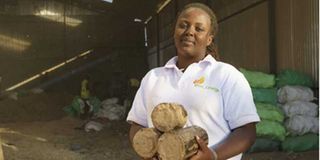
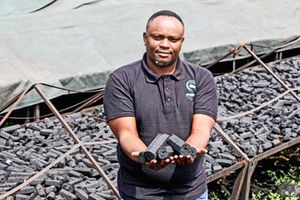
Mary Nyambura, founder and CEO of Eco-Charge Limited, an African-led renewable energy company converting agricultural waste into eco-friendly biomass briquettes.
Photo credit: Pool
To ensure top performance, the team rigorously checks the composition and moisture levels of all input materials.
Rather than allowing agricultural residues to rot and emit methane,-a powerful greenhouse gas, these leftovers are converted into compact, clean-burning fuel blocks.
“These briquettes last longer and produce far less smoke than conventional wood or charcoal. Indoor air quality improves, and carbon emissions drop substantially,” she notes.
Utilising by-products also eases the environmental impact of farming operations. The procedure starts with gathering and sun-drying materials to lower the moisture content.
Once ready, the mixture passes through a briquetting press, shaping it into 90mm cylindrical logs. Finished units are then bagged in 50-kilogram sacks for delivery.
Monthly output fluctuates between 100 and 200 tonnes, while institutional customers, mainly industrial clients, collectively consume more than 1,000 tonnes.
Eco-Charge also customises briquettes for clients with high energy demands. Bulk supply agreements allow organisations to reduce long-term expenses compared with frequent wood fuel purchases.
“Institutions that adopt our briquettes often cut fuel costs by 15 to 30 per cent. A school in Kajiado, for instance, lowered its monthly cooking expenses by Sh20,000,” she says.
Ms Nyambura adds that beyond the savings, kitchens become cleaner, staff morale improves and the overall environmental impact decreases.
So far, the company has collaborated with more than 10 institutions. She says that each ton of briquettes replacing firewood protects roughly 88 trees from being felled.
“This contributes to forest preservation, which maintains vital carbon sinks, safeguards biodiversity and prevents soil erosion. Efficient combustion also reduces particulate emissions and greenhouse gases,” she explains.
Even with these achievements, the company continues to navigate challenges such as inadequate road networks, limited public awareness and strong cultural ties to traditional fuels.
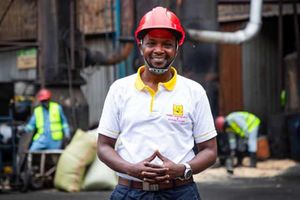
Mary Nyambura, founder of Eco-Charge and her employee Ian Kiambuthi in Kajiado. The company turns agricultural waste into clean briquettes
Photo credit: Pool
“We engage communities through sensitisation workshops and employment opportunities. We believe in inclusive growth, so we involve them not just as suppliers but also as partners in creating impact,” she adds.
The enterprise currently employs a team of 10 and contributes directly to Sustainable Development Goal 7 through initiatives that curb forest loss and advance renewable power.
Eco-Charge also supports Kenya’s Nationally Determined Contributions under the Paris Agreement, targeting a 32 per cent reduction in greenhouse gas emissions by 2030.
Despite operational challenges, prospects are bright. Kenya’s focus on clean energy, supportive policies, and rising corporate sustainability initiatives is creating a welcoming market for innovative solutions like Eco-Charge’s.
A transformative partnership has emerged through the Kenya Climate Innovation Centre’s SWIFT Programme, which equips waste-management enterprises with technical guidance, business support, and a platform for national policy dialogue.
For Eco Charge, this collaboration has become a turning point, positioning the company as one of Kenya’s most compelling examples of social inclusion, women’s empowerment, and green industrialisation.
Its rise has been significantly accelerated through support from the Kenya Climate Innovation Centre (KCIC).
“Through the SWIFT Programme at KCIC, we gained mentorship and training that strengthened our products and broadened our impact,” she explains, noting that the partnership has elevated the company’s profile and reinforced its role in Kenya’s green transition.
KCIC’s involvement has been comprehensive. Its technical experts helped enhance briquette quality, optimise drying processes, and improve production engineering.
Simultaneously, business mentors supported the team in building stronger leadership and internal systems, while capital-expenditure funding allowed Eco Charge to expand its production capacity.
KCIC also connected the company with national clean-energy stakeholders through policy engagement platforms and boosted its visibility as it prepared for investor engagement.
Ms Nyambura notes that the organisation did not just refine their product but helped strengthen the entire company. Their technical and financial support has set Eco Charge on a new trajectory toward regional expansion.
With such strategic partnerships driving its progress, the company now stands on the cusp of significant regional opportunities.
“We are building connections throughout East Africa while investigating licensing and distribution models in Tanzania and Zambia, for responsible expansion that maintains product excellence and strengthens community engagement.”
Ian Kiambuthi uses a moisture meter to ensure agricultural waste used for making briquettes meets quality standards.
Photo credit: Pool
Eco-Charge is actively raising capital to support entry into Tanzania, where demand for accessible, environmentally friendly cooking fuel is rising among schools, hospitals, and industrial clients.
The country presents a strategic opportunity due to its continued dependence on coal and firewood, mirroring Kenya’s energy challenges.
The enterprise is pursuing collaborations with development organisations, impact investors, and commercial buyers focused on sustainable energy.
Beyond financing, technical assistance for mechanised production and working capital support is essential for efficient scaling.
The company expects to become the region’s leading clean cooking fuel supplier, reaching more than 10,000 institutions and helping avert millions of tons of CO₂ emissions.
Additional plans include establishing satellite facilities to streamline supply chains and create employment locally.
To boost output, the company is testing advanced briquetting equipment, precise moisture sensors, faster drying systems, and a solar-powered production hub.
Upgrades in infrastructure, including an on-site weighbridge, she says, will strengthen quality assurance and support operational growth.
It operates intentionally as a social enterprise, creating meaningful and dignified jobs in a region where formal employment is scarce.
Paying wages above the national minimum supports household stability and long-term economic empowerment, while generating green jobs that protect the environment and sustain livelihoods.
Women are placed at the centre of the value chain, supported through financial literacy programmes, including chamas, and flexible work arrangements for young mothers.
The centre will support mothers with infants, employees raising children with special needs, and women who struggle to balance work and childcare.
“For the first time, rural mothers working in manufacturing will be able to focus on their jobs knowing their children are in safe care just steps away,” she says.
Ms Nyambura adds that the daycare is expected to improve employee productivity, reduce absenteeism, increase workforce retention, support young mothers entering the green economy, and strengthen families both financially and socially.