For years, a popular street in Kabarnet Town, Baringo County, carried a name that spoke volumes – ‘Zombie Street.’
It is not its official name, but a label born out of frustration and lived experience, a place where drugs and alcohol addiction, crime, violence and public disorder converged in plain sight.
Today, however, that same street is showing early signs of change.
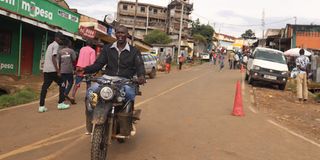
The Nation recently visited the area on a Monday afternoon, and found that the atmosphere was completely different to last year.
A young mother sat quietly by the pavement, balancing business and motherhood as she sold boiled eggs and sausages to passers-by while cradling her toddler as business continued around her.
Locals and traders go about their business in the once-dreaded 'Zombie street' in Kabarnet town, Baringo Central on May 11, 2026.
Photo credit: Florah Koech | Nation
Nearby, small garages buzzed with activity as mechanics worked under raised vehicles on the roadside and traders lined the roadside with spare parts and small goods. Pedestrians walked freely, unafraid and uninterrupted by the pickpockets, drunkards and drug peddlers that used to dominate the street.
The street is undergoing a striking transformation driven by police crackdowns and community action, with traders cautiously returning to business.
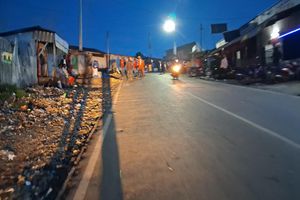
It was very different from the street’s recent past as captured by Daily Nation in October last year. Only months ago, the street was widely described by residents as a no-go zone.
Before its transformation, the street symbolised moral decay and many locals lived in constant fear as it collapsed into open disorder.
Drunkards, intoxicated by cheap second-generation alcohol, staggered along the road day and night. Drug peddlers operated in the open. Criminals lurked in corners, waiting to pounce on unsuspecting passers-by. Sex workers openly fought over clients amid loud quarrels and chaos, which dominated the neighbourhood.
Residents had likened the street to the biblical Sodom and Gomorrah, where lawlessness and vice thrived openly. Once darkness fell, nobody wanted to use it due to the high risk that one of being robbed, raped, or attacked.
The growing wave of crime and insecurity crippled legitimate businesses, forcing shop owners to close early, while potential customers avoided the area altogether. Criminal gangs also took advantage of the disorder, preying on anyone using the route.
The presence of addicts, who had evidently lost touch with normal life, abandoning their homes and families to live on the streets, led residents to nickname it ‘Zombie Street’.
Locals and traders go about their business in the once-dreaded 'Zombie street' in Kabarnet town, Baringo Central on May 11, 2026.
Photo credit: Florah Koech | Nation
No, however, the story has dramatically changed, thanks to intensified police patrols, crackdowns on drug peddlers, and the arrest of criminals, drunkards and idlers. The wines and spirits outlets that once operated recklessly throughout the day and night remain closed.
The streets are cleaner, calmer and safer. The disorderly crowds have disappeared, replaced by hardworking traders focused on rebuilding their livelihoods.
The crackdown that reset the street
The turning point, according to residents and authorities, came with sustained security operations: crackdowns, arrests, patrols and enforcement of liquor laws. Police intensified day and night patrols, targeting drug peddlers, habitual drunkards and criminals.
Public drinking spaces were cleared, and wines and spirits outlets that once operated without restriction were shut down or forced to comply with strict trading hours.
The result, residents say, has been a visible shift: fewer idlers, reduced street-level crime and a return of legitimate economic activity.
Locals and traders go about their business in the once-dreaded 'Zombie street' in Kabarnet town, Baringo Central on May 11, 2026.
Photo credit: Florah Koech | Nation
According to Community worker Dorothy Jebet, schoolchildren were exposed to vices before the crackdown. “There was drug abuse, alcoholism and prostitution everywhere. But regular patrols and raids have changed the situation completely.”
Mr Kelvin Kosgei, a resident of Kabarnet town, said the change is evident in daily life.
“In the past, sex workers lined the dark corners while drug peddlers hid nearby. Drunkards fought, slept by the roadside and insulted pedestrians,” he said.
“Now the street is safe. You can now walk without fear. You don’t find idlers like before. I even used to drink there and was arrested twice for being drunk and disorderly. That changed me. I am now working at a construction site.
“Even those who used to sleep on the street are now working. If you are found idling, you are arrested.”
Mr Mohammed Rajab, from nearby Bondeni village, said fear has been replaced by routine movement and commerce.
“We used to fear even passing here during the day. Now people walk freely. Garages that once suffered theft now operate openly on the roadside,” he said.
Mr Rajab added that certain areas on the street and near the local stadium were once criminal hideouts, but the changes forced the criminals out.
“Those who used to sleep on the street are now working in town. If you are found idling, you are arrested,” he said.
Ms Nancy Kiptoon, a trader who had previously avoided the area due to insecurity, says she can now buy goods on the street without fear.
“I have even brought my car for repair at a garage here,” she said.
Ms Kiptoon recalls being robbed of her mobile phone in the past and said the current environment feels transformed.
“This is no longer a ‘Zombie Street’; it should be renamed. Business is returning,” she added.
County Police Commander Macharia Wanjau said the transformation is the result of coordinated enforcement involving security agencies, county authorities and the public. He said the operation began after stakeholder consultations, which recommended collective effort to tackle crime in the area.
“We enforced liquor laws, including opening and closing hours, and carried out raids targeting offenders,” he said.
Support from the Office of the Director of Public Prosecutions and the courts ensured that repeat offenders faced tougher penalties, according to the county commander. More than 10 suspected drug dealers and over 900 people arrested for being drunk and disorderly have been arraigned in court, he said.
Among those arrested were women found with young children while engaging in illegal activity. The children were taken to rescue centres.
“The street was once a no-go zone. It is now calm,” he said.
Locals and traders go about their business in the once-dreaded 'Zombie street' in Kabarnet town, Baringo Central on May 11, 2026.
Photo credit: Florah Koech | Nation
On Mother’s Day, May 10, dozens of women made an impromptu appearance at Kabarnet Police Station, turning it into a scene of song and dance as they celebrated Kabarnet OCS Shamsa Abedi, popularly known as “Suluhu”. They said the OCS played a big role in restoring order to the town’s once-feared ‘Zombie Street’.
Draped in pink lessos and white T-shirts printed ‘Happy Mother’s Day’, the women sang, ululated, and praised Ms Abedi.
“This change is not just on paper; it is visible on the ground. We can now move freely without fear,” said Ms Janet Cheburet, a trader in Kabarnet town. “We no longer see the chaos that used to define that street. It has completely changed.”
The women said the transformation is deeply felt at the household level – families were previously torn apart by addiction, traders forced to close early, and parts of Kabarnet considered no-go zones.
Now, they say, residents can move freely, husbands previously lost to alcohol are returning home, and communities are slowly rebuilding trust and stability. They described the OCS as ‘Suluhu,’ meaning ‘solution,’ for what they see as the town’s renewed sense of safety and hope.
“For years, we lived in fear, but today we can finally breathe again. Even our families are coming back together,” Ms Cheburet said.
Mr Mohammed Rajab, a resident of nearby Bondeni village, said, “What we are seeing today is peace. People walk freely and the fear is gone. We used to fear passing through that street even during the day. Now it is peaceful and business is returning.”