A high-stakes power struggle has erupted between the Independent Electoral and Boundaries Commission (IEBC) and Parliament over who holds the ultimate authority to approve the Election Campaign Financing Regulations, 2026.
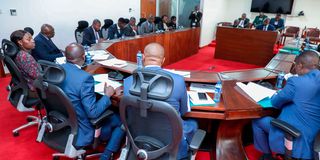
The jurisdictional clash, as the country readies for the August 2027 General Election, came to the fore at a meeting of the National Assembly Committee on Delegated Legislation and the IEBC.
The House committee, chaired by Ainabkoi MP Samuel Chepkong’a, insists that the legislature maintains the statutory right to vet, alter, or reject the newly introduced campaign spending limits before they can take effect.
The IEBC gazetted the new election expenditure limits on August 7, 2026, introducing stringent expenditure ceilings for various elective posts to limit disproportionate spending for the 2027 general election; however, the High Court stayed them following a petition.
The Independent Electoral and Boundaries Commission Chairperson, Erastus Ethekon.
Photo credit: File | Nation
But in a swift counter - response, IEBC Chairperson Dr Erastus Ethekon, backed by a court order, firmly rejected Parliament's oversight role.
Dr Ethekon argues that the Constitution and the Election Campaign Financing Act gives the commission an independent and absolute mandate to gazette and enforce the spending caps without requiring parliamentary green light.
The latest power struggle between the IEBC and Parliament threatens to throw the financial regulatory framework for the 2027 General Election into deeper legal uncertainty.
“You gazetted but never remitted to Parliament for a review. Anything that has a consequence of the law must pass through parliament,” said Mr Chepkong’a, citing Article 94 (5) of the constitution.
The Article states that “no person or body, other than Parliament, has the power to make provision having the force of law in Kenya except under authority conferred by this constitution or by legislation.”
“We intended that everything must go through Parliament,” said Mr Chepkong’a.
Article 88 (4) (i) of the Constitution mandates the IEBC to regulate the amount of money that may be spent by candidates and political parties during an election, to promote equity in electoral competition, curb undue financial influence and safeguard public confidence in electoral outcomes.
For instance, the maximum spending limit that a candidate for the presidential election may spend during an expenditure period has been capped at Sh6.11 billion, and for county elections at Sh181.31 million.
However, Dr Ethekon told the committee that the matter of whether the regulations need the approval of Parliament before they come into force has since been settled by the court.
“The law does not require parliamentary approval. It is self-executing,” said Dr Ethekon.
In December 2021, Katiba Institute and Africog petitioned the High Court, challenging the National Assembly’s resolution annulling the gazetted expenditure limits ahead of the 2022 general election.
On January 7, 2022, Transparency International (TI) and Mr Phillip Gichana Nyakundi lodged a further petition on the status of the regulations.
The High Court, among others, held that the regulations are statutory, not constitutional instruments.
That section 29 (1) of the Election Campaign Financing Act requiring parliamentary approval before gazettement is unconstitutional “in so far as it requires Parliament to approve the regulations before publication.”
Further, the court established that sections 12, 18 and 19 of the Act do not require parliamentary approval but “must be subjected to appropriate public participation.”
“It was this directive that the current regulations and the accompanying public participation exercise were intended to satisfy,” reads an IEBC document presented to the committee.
“This side (MPs) is aggrieved. We are seeing the regulations for the first time. Maybe you need to consider the public participation exercise on people who represent the electorate next time in the spirit of fairness,” Mr Chepkong’a said.
Ainabkoi MP Samuel Chepkonga.
Photo credit: File | Nation Media Group
This, as Dr Ethekon reminded the committee chairperson, “this time we tried very hard based on the resources we had.”
In an attempt to have the regulations shot down, Mr Chepkong’a had accused the IEBC of failing to remit them to Parliament, but Dr Ethekon told him that all the documents were presented to the National Assembly, including the public participation report, among others.
However, the court order staying the implementation of the new spending rules presented an opportunity for the committee to disembark from an exercise the members felt they were not involved.
“It will be a zero-sum game for us to consider the regulations that have been stayed by the court,” the Ainabkoi MP said as he adjourned the meeting.
The active conservatory order effectively halts any immediate parliamentary deliberations or regulatory enforcement ahead of the 2027 general election.
Because these positions share identical geographical boundaries, they share identical caps within their specific region, scaling dynamically based on the regional matrix.
For instance, the high-geographic sprawl baseline – Turkana and Marsabit had different limits.
“The spending limits that a candidate for County Elections may spend during an expenditure period in Turkana County shall be Sh142.1 and in Marsabit County Sh127.02 million.”
This means that the spending limits that a candidate for county elections may spend during an expenditure period in Vihiga County shall be 37 million and Sh28.7 million for Lamu County.
The Third Schedule outlines individual caps for the 290 constituencies, highlighting extremes such as North Horr Constituency capped at Sh100.42 million and Wundanyi constituency capped at Sh15.43 million.
The Fourth Schedule sets localized ward caps, noting examples like Turbi Ward in Marsabit County at Sh22.1 million and Ziwani/Kariokor Ward in Nairobi City County at Sh3.63 million.
Campaign expenses may only be incurred for approved purposes such as campaign venues, publicity materials, advertising, personnel, transport, and other administrative costs.
But the implementation of these caps was challenged in a suit by the Republican Liberty Party and the Grassroots Development Party.
The petitioners contested the omission of transparency and audit processes on the basis that the commission
The failure to enforce source disclosure was also questioned. The petitioners noted that the regulations create a loophole for illicit and unmonitored "dark money" to flood the electoral system.
“The IEBC failed to strictly require political aspirants to disclose the sources of their campaign donations.”
The petitioners argued that without stringent safeguards, monitoring systems and digital spending controls, unregulated finances will inevitably be deployed for widespread voter bribery and buying influence ahead of the 2027 polls.
Campaign finance regulations trace back to the 2005 recommendation of the Constitution of Kenya Review Commission (CKRC) and the 2008 Kriegler Commission findings that the absence of campaign finance legislation left the electoral body unable to check the influence of money in elections.
These concerns culminated in Article 88 (4) (i) of the constitution and, subsequently, the Election Campaign Financing Act, 2013.
A Bill before the National Assembly seeks to create an umbrella entity called the Kenya Teachers Training College, to manage all TTCs.
Photo credit: File | Nation Media Group
Parliament rejected attempts to operationalize the Act through regulations in 2016, and in 2017 the implementation of the ECF Act was deferred to the 2022 general elections.
On August 5, 2021, the commission submitted the ECF Regulations, 2020 to the National Assembly for approval ahead of the 2022 General Election.
On August 9, 2021, the commission gazetted Campaign Contribution and Spending Limits for the August 9, 2022, General Election.
On September 28, 2021, the National Assembly, acting on the recommendation of the committee on Delegated Legislation, annulled the gazetted limits and resolved that the commission de-gazette them.
In October 2021, the commission de-gazetted the Contribution and Spending Limits, pursuant to the National Assembly resolution.
The regulations prescribe the period during which campaign finance controls apply, thereby defining the timeframe within which all campaign contributions and expenditures must be received, incurred, recorded and reported.