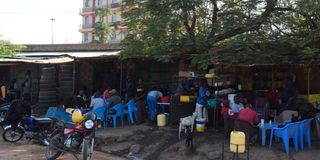
Customers enjoy their meals under a tree at Margat Trading Centre in Baringo County on September 04, 2026. Such eateries have become common in Marigat town.

At 7am on a Friday morning, Marigat town in Baringo South is already wide awake and buzzing with activity.
Under the broad canopies of trees lining the roadside, dozens of customers sit on plastic chairs around makeshift tables, eating githeri, kata kata and chapati while others sip hot tea before beginning their day.
Boda boda riders pull up for breakfast. Traders sit in small groups, while farmers heading to the Perkerra Irrigation Scheme stop for a meal before going to their farms.
Here, some of the busiest places to eat have no walls, fancy décor or enclosed kitchens. They operate beneath broad roadside trees, with plastic chairs and tables, charcoal jikos and food prepared in full view of customers. And that simple set-up is proving to be big business.

Customers enjoy their meals under a tree at Margat Trading Centre in Baringo County on September 04, 2026.
The open-air eateries have become a distinctive part of Marigat’s food culture, attracting boda boda riders, traders, farmers, travellers and government officials from as early as 5am.
For many residents and visitors, this has become a normal way of eating in Marigat. Customers say they come for the affordable food and generous portions, but also for the fresh air, shade and the reassurance of watching their meals being cooked.
The setting matters. Marigat is hot and semi-arid, making the shade and natural ventilation under the trees an attraction in itself.
In a town where temperatures can rise sharply during the day, the trees also offer something conventional hotels may not - shade and natural ventilation.
The eateries also operate for long hours and serve freshly prepared food, with some operators saying the day’s food can sell out by mid-morning.
Customers say part of the appeal is being able to sit in the shade, enjoy the breeze and watch their food being cooked right in front of them.
They also say they like being able to see their food being prepared, something they do not get in conventional hotels where the kitchen is hidden from view.
For Mr Daniel Kaplich, a Marigat trader who runs a honey business, breakfast at one of the roadside eateries has become part of his daily routine.

A customer enjoys a meal at Tangulbei Café at Margat Trading Centre, Baringo County on September 04, 2026.
He was having githeri, chapati and tea when he explained why he keeps returning - the combination of fresh food, open space and convenience.
“I get good service, and just sitting on the plastic chair, I can see the fresh food being prepared. In conventional hotels, the kitchen is hidden and you cannot know whether the food is fresh,” he says.
The setting is just as important.
“These hotels are under trees and, considering that this is a semi-arid area and very hot, the open air comes in handy. You get fresh air, and the hotel is also along the roadside. I eat here regularly because I know the food is fresh,” he says.
Mr Ken Lekidogo, another regular, says the open-air setting makes a significant difference, particularly during the hot hours of the day.
“The food here is very fresh, and I can confirm that because I see it being cooked and served. I have also fallen in love with the open air because this area is usually very hot. If you go to conventional hotels, you will sweat a lot,” he says.
The eateries also fit neatly into the routines of a town where many people start their day early.
“They open very early in the morning and operate until late at night. It is also affordable, and you have plenty of fresh air,” Lekidogo says.
A kitchen in full view
For Mr Abib Tulia, a local driver whose work begins early, the eateries fit neatly into his routine.
He starts work early and says the roadside outlets are convenient for people who need food before the day's activities begin.
The demand can be so high that some operators exhaust their first batch of food within hours.
“Sometimes the food is depleted as early as 10am and they start cooking another portion,” he says.
Many customers are farmers working at the Perkerra Irrigation Scheme, who stop for breakfast before heading to their farms.
“They can get fresh food early in the morning before they go to the farm. Here it is open and you can see the food being cooked. I love eating here anytime,” he says.
That visibility has become one of the biggest selling points.
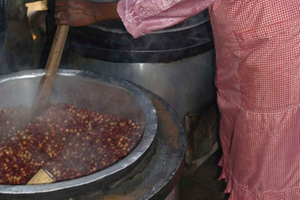
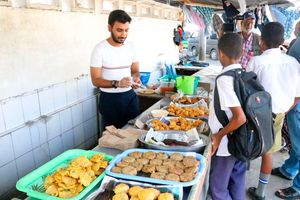
At the eateries, there is little separation between the kitchen and dining area. Customers can watch as dough is rolled out and chapatis are cooked, beans are stirred and tea is prepared.
For the operators, however, keeping food preparation in the open also comes with the responsibility of maintaining cleanliness.

Amina Wako (right), the proprietor of Tangulbei Café, an eatery at Margat Trading Centre in Baringo County, presents a plate with food to a waitress to serve a customer on September 04, 2026.
Ms Amina Wako, who has run one of the eateries since 2020, says she is conscious that customers are watching everything they do.
“We strive to maintain cleanliness because we do not want to lock horns with the public health department,” she says.
She says the open setting has worked so well for her business that she has no plans to move into a conventional hotel.
“I have loved cooking here more than in a conventional hotel. My clients are also used to this set-up. If I relocate to a conventional hotel, I fear I will lose my customers,” she says.
Ms Wako’s business illustrates how the under-the-tree model has grown beyond a simple roadside food stall. She moved to Marigat from Mogotio after losing her husband and was trying to start over while raising her two young children.
She initially ventured into selling clothes, but the business struggled.
“At the time, I had relocated from Mogotio town after losing my husband and came to Marigat town to start over. I started by selling clothes, but the business did not pick up. Sometimes we could sleep without food,” she says.
With little capital to set up a conventional hotel, she started small, buying a packet of wheat flour, making chapatis and cooking beans in the open air.
Her first customers were few. But then the word spread. She initially had about five customers a day.
Today, she says she prepares food in tens of kilogrammes. At its busiest, Ms Wako's eatery serves more than 200 customers a day and employs eight workers, up from the two she started with.
Other eateries have since sprung up beside hers, creating a small cluster of under-the-tree food businesses.
Her working day begins before sunrise long before most of her customers arrive.
“We open at 3am and close at 10pm,” she says.
By mid-morning, much of the food is already gone.
“By 10am, all the food will be finished and we start cooking the second batch,” she says.
She says the business model is partly driven by the demand for freshly prepared food.

A cook prepares chapati at Tangulbei Café at Margat Trading Centre, Baringo County on September 04, 2026.
“No food is kept in the fridge because all of it gets depleted. I think that is why the eateries have become popular, the food is fresh and customers can see what we are cooking,” she says.
For Ms Loice Limo, the journey into the food business followed a similar path of starting small.
She initially sold watermelons and other fruits from a stall near her current eatery.
When the Covid-19 pandemic hit, business declined and she began looking for other ways to earn a living.
She started selling herbal drinks, commonly known as ‘dawa’, which became popular.
In 2022, she began preparing food alongside the drinks, starting with just a kilogramme of githeri. The business gradually expanded as more customers began coming for meals.
The business has since grown to tens of kilogrammes of food and attracts more than 200 customers a day.
“I extended the eatery by buying more chairs and tables, which are placed under the tree. Locals like it because it is open and they can see what is being cooked,” she says.
Her former fruit stall now serves as the counter and storage area for utensils, while customers eat beneath the trees. The business has grown from one worker to more than five.
“We wake up around 5am and close at 10pm. All the food gets finished and the next day we start cooking fresh food. That is another advantage people like about the eatery,” she says.
Follow our WhatsApp channel for breaking news updates and more stories like this.