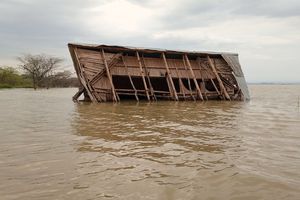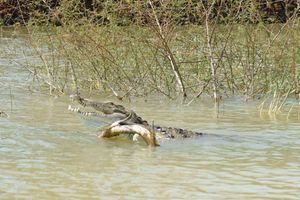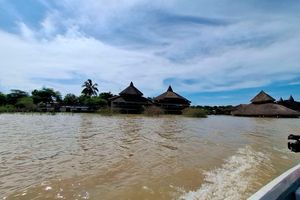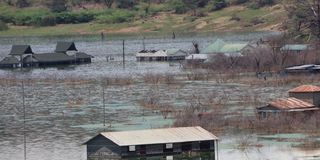
Some structures at Lake Bogoria submerged by rising water levels, which have brought crocodiles and hippos to the alkaline lake, once renowned for its flamingo population.

For generations, the sight of thousands of pink flamingos sweeping across the waters of Lake Bogoria has defined the beauty of the saline lake in Baringo County.
However, a different spectacle is unfolding along its shores. Tens of crocodiles bask in the afternoon sun, while pods of hippos, some accompanied by their young ones, emerge from the water and roam the surrounding areas. Fish and other aquatic life, which residents say were previously absent, have also been spotted in the lake.
The unexpected arrival and growing numbers of the animals have left residents puzzled, raising questions about whether one of Kenya's most famous alkaline lakes is undergoing a fundamental ecological transformation.
For people living around Loboi, Kamoskoi and other neighbouring villages, the phenomenon has also introduced new dangers to communities that depend on the surrounding land for farming, livestock keeping and other livelihoods.
Jonathan Tireito, a resident of Loboi village, said they first noticed the unusual presence of crocodiles and hippos in small numbers around 2022, when the lake was expanding rapidly.
“In the past, this lake had only flamingoes. But now it is a puzzle that crocodiles and hippos are living here, alongside some fish. We suspect that the rising water levels, possibly linked to climate change, have reduced the lake’s alkalinity, allowing these animals to survive,” said Mr Tireito.
He said the animals were particularly concentrated around areas where freshwater from Rivers Loboi and Waseges enters the lake. Crocodiles could be seen in large numbers along the shores, while hippos had established themselves in sections of the lake and surrounding wetlands.
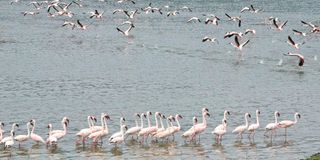
Flamingos at Lake Bogoria in Baringo County.
He said the animals were particularly noticeable around Kutwe and Kaprong'uno, where residents had reported frequent sightings.
“The crocodiles are now in the hundreds, while the hippos are in the tens. Some have even given birth, and we are seeing their young ones. This is something we have never experienced before,” noted Mr Tireito.
Walter Kimaru, another resident, said the changing composition of wildlife coincided with the expansion of the lake, which has submerged land previously used for farming, grazing and settlement.
He recalled that flamingoes were once the dominant attraction, with the lake occasionally hosting millions of the birds.
Harrison Komen, a resident of Loboi, said the crocodiles were particularly visible during the afternoon, when hundreds could be seen basking along sections of the shoreline.
“In the afternoon, you will see many crocodiles basking on the shores. These animals were never here before. At night, we are also careful when walking because hippos come out of the lake, move around the villages and destroy crops,” said Mr Komen.
He said they first saw a few of the animals around 2022, but their numbers had gradually increased.
Lake Bogoria Senior Warden James Kimaru said the phenomenon could be linked to changes in the lake’s water chemistry following increased freshwater inflows.
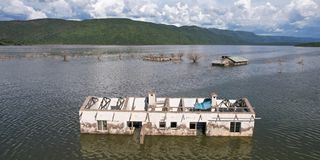
Loboi Dispensary which has been submerged by rising water levels at Lake Bogoria. The rising waters have also brought crocodiles and hippos to the alkaline lake
He explained that during periods of heavy inflows, the northern section of the lake receives substantial amounts of freshwater, temporarily altering the characteristics of the water in that area.
He noted that a permanent source of freshwater, particularly River Loboi, could be contributing to the changing conditions even during periods when rainfall is limited.
He said the freshwater inflows were also creating conditions that support food sources for the animals, including fish, frogs and birds.
“You may find crocodiles in the northern part because of the inflow of freshwater. When a lot of freshwater enters the lake, it changes the water chemistry by reducing the salinity. The crocodiles have come because of these freshwater inflows,” said Mr Kimaru.
Climate expert Koimbori Kinyanjui, who has followed the changes in the two lakes, said the increasing presence of freshwater-dependent wildlife could point to changes in the lake’s ecological conditions.
The senior circular economy and climate change coordinator said the appearance of hippos and crocodiles, coupled with concerns over declining flamingo numbers, raised questions about whether the lake was becoming less alkaline.
“This could be a sign that the water chemistry is changing. Hippos and crocodiles are generally associated with freshwater environments, and their increasing presence in a lake known for its alkaline waters should prompt further investigation,” said Dr Kinyanjui.
He cautioned that water samples needed to be collected and analysed to establish the lake’s current alkalinity and determine the extent of the changes.
He also raised concerns about the possibility of an underground connection between Lake Bogoria and Lake Baringo, arguing that water could already be mixing through underground channels and aquifers even before the two lakes physically merge.
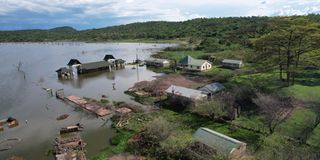
The main gate and curio shops at Lake Bogoria submerged by rising water levels. The rising waters have also brought crocodiles and hippos to the alkaline lake, once renowned for its flamingo population.
Scientific water analysis is needed to establish whether Lake Bogoria and Lake Baringo are connected underground. Rising water levels and freshwater inflows threaten Bogoria’s alkaline ecosystem, particularly the Arthrospira fusiformis algae that sustain lesser flamingos. A 2024 Current Biology study and Kenya Wildlife Service observations link changing lake chemistry to declining flamingo feeding grounds.
Lake Bogoria has expanded from 34 square kilometres in 2013 to 45 currently, swallowing homes, farms and infrastructure and costing the reserve more than Sh100 million annually in lost tourism revenue.
The distance to Lake Baringo has narrowed to less than three kilometres, raising fears of saline water mixing with freshwater and threatening aquatic life and dependent communities. A 2024 hydrology study linked rising lake levels to changing rainfall patterns and increased intense rainfall.
Follow our WhatsApp channel for breaking news updates and more stories like this.