The Ministry of Agriculture has deployed a team of experts to assess maize performance across the North Rift, the country's main grain basket, amid growing fears that this season's harvest could decline sharply.
Prolonged dry spells, shortages of top-dressing fertiliser and disease outbreaks have damaged thousands of hectares of maize, raising concerns over Kenya's food security.
Agricultural officers are visiting farms across the region to collect crop performance data and estimate expected yields to guide agricultural planning and food security interventions.
“The assessment aims to evaluate the 2026 long-rains maize crop, estimate expected production and generate information on food security," the Ministry of Agriculture said in a notice circulated to farmers in major maize-growing areas.
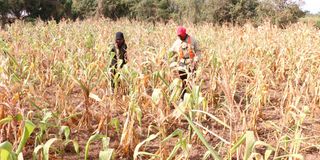
A failed maize crop in Mirera, Naivasha, Nakuru County, on July 12, 2026.
Photo credit: Boniface Mwangi| Nation Media Group
According to Uasin Gishu County Agriculture Executive Sammin Kipkemboi Kottut, farmers are required to grant the assessment teams access to their farms and provide the information needed to determine the expected harvest.
“The two-week maize performance assessment exercise, running from July 13 to July 27, will guide projections on the expected harvest and inform food security intervention measures,” Mr Kottut said.
The North Rift produced about 44.8 million bags of maize during the 2024 season, contributing to the country's bumper harvest of between 67 million and 70 million 90-kilogram bags.
This year's harvest, however, is expected to decline by as much as 30 per cent due to prolonged dry weather, shortages of top-dressing fertiliser and the resurgence of the destructive fall armyworm.
In Uasin Gishu County, the pest has already been reported in parts of Soy, Moiben and Kapseret sub-counties, according to the county's Department of Agriculture.
“The fall armyworm has been reported in some parts of the county and we are encouraging farmers to report outbreaks so that we can help them access agrochemicals for control. The invasion of the pest has been worsened by irregular rainfall,” Mr Kottut said.
He warned that depressed rainfall had caused widespread wilting of both food and cash crops, threatening to reverse gains made in the agricultural sector.
“The situation is likely to worsen further because of the fall armyworm outbreak, which has attacked maize in several areas,” he added.
Agricultural experts warn that the pest poses a serious threat because it attacks both young and mature maize plants, making it difficult to contain once established.
Adult fall armyworm moths are capable of flying up to 30 kilometres in a single evening, allowing infestations to spread rapidly across farming regions.
Farmers inspect their failed maize crop in Mirera, Naivasha, Nakuru County, on July 12, 2026. Agriculture Principal Secretary Kipronoh Rono said the government has deployed a team of scientists to assess the extent of maize crop failure reported in parts of the North Rift following a prolonged drought.
Photo credit: Boniface Mwangi| Nation Media Group
Agronomists also warn that increasingly erratic weather patterns are likely to further reduce yields.
“The unpredictable rainfall spells doom for many farmers who are yet to recover from repeated disease outbreaks, including fall armyworm, head smut, recurring Maize Lethal Necrosis (MLN) and erratic weather,” said Eldoret-based agronomist Edwin Lang'at.
Most maize-growing areas across the Rift Valley have experienced erratic rainfall since March, affecting crop growth and maturity.
In the South Rift, hopes for another bumper harvest have also been dampened by uneven rainfall during the growing season.
Across the larger Trans Mara region of Narok County many farmers were unable to plant on time because of prolonged drought, a situation expected to push maize prices higher later this year.
In Narok West, Narok East and Narok North, poor rainfall distribution affected crop development, with farmers now projecting significantly lower yields.
“We are staring at losses this season because the maize cobs did not fully develop. Although the crop did not completely fail, the harvest will barely enable us to recover our investment in land leasing, seed, fertiliser, weeding and pest control,” said Festus Kiprono, a farmer from Ololulunga.
Peter Masharen, a farmer from Ntulele in Narok County, urged the government to cushion maize farmers against the anticipated losses, just as it supports coffee growers.
Similar conditions have been reported in Rongai and Mauche in Nakuru County, Kipkelion in Kericho County and other maize-producing areas across the South Rift.
Agriculture Principal Secretary Paul Kipronoh Ronoh acknowledged the widespread crop failure and said the government had established a team of scientists to assess the situation.
“Farmers planted maize between January and June, but we have established that there is crop failure, especially in the North Rift and parts of the South Rift,” Dr Ronoh said.
Farmers inspect their failed maize crop in Mirera, Naivasha, Nakuru County, on July 12, 2026.
Photo credit: Boniface Mwangi| Nation Media Group
He said the findings would guide government interventions. Dr Ronoh said the government was prepared to import maize if the assessment shows that production will fall short of national food requirements.
“We have constituted a team of scientists to investigate the causes of the crop failure so that the ministry can develop appropriate mitigation measures. If we establish that the situation is likely to negatively affect food security, the government will move ahead and allow the importation of maize to avert hunger," he said.
The assessment comes against the backdrop of persistent complaints by farmers over difficulties accessing subsidized fertiliser.
Farmers accuse cartels of buying up subsidized fertiliser from government outlets, repackaging it and reselling it at inflated prices.
While the government sells a 50-kilogram bag for Sh2,500, the repackaged fertiliser is reportedly sold for between Sh5,000 and Sh6,000 through private dealers after artificial shortages are created at National Cereals and Produce Board depots and other government distribution centres.
President William Ruto has maintained that the digitisation of agricultural services has significantly reduced fraud in fertiliser distribution.
Speaking in Naivasha in May, he said digitising farmer records had enabled the government to allocate subsidised fertiliser more accurately.
“When I formed the government in 2022, we faced challenges identifying genuine farmers for fertiliser allocation. We therefore decided to digitise the data of all our farmers. Today we have 7.2 million registered farmers. We know how many grow sugarcane, coffee, tea and maize,” he said.
According to the President, the digital agriculture database allows fertiliser to be allocated based on verified acreage, helping curb fraud and dismantle cartels that had previously manipulated the subsidy programme.