For Rael Kibor, every dark cloud carries a warning, as the sound of rain hitting her iron-sheet roof is enough to disturb her sleep.
She does not like rivers or rain and she says she will never return to Kasegei village where she lost her children and mother in one of the worst disasters to hit Kerio Valley.
A teary Rael Jepkosgei Kibor, a mudslide survivor who lost her mother and her three children after mudslides swept away their house at Chesongoch in Elgeyo Marakwet on the eve of November 1, 2025.
Photo credit: Jared NyatayaI Nation Media Group
Yet nearly a year after the November 1, 2025 landslide, she remains in the disaster-hit area, living in a small rented room at Chesongoch shopping centre because she cannot afford to start again elsewhere.
Her one-room house is some distance from the river and, in her view, safer than the village she fled. But it is not home.
On Tuesday morning, she sat alone on a stool inside the sparsely furnished room.
There was no child running through the doorway, no little voice asking for food and no one helping with household chores.
Babra Jepng'etich, 11, Gibson Kemboi, nine, and Alan Kipruto, one year and seven months, were swept away when the landslide tore through Kwenoi village. Her mother was also killed.
“I sometimes tell God why He spared me. He could have taken me with my mother and children that fateful night,” Ms Kibor said, fighting back tears.
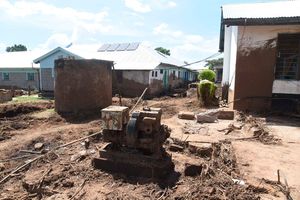
A view of mudslide deposits at Chesongoch in Elgeyo Marakwet on September 27, 2026, which occurred on the eve of November 1, 2025, killing several people.
Photo credit: Jared NyatayaI Nation Media Group
Her story captures the predicament facing survivors of the Chesongoch disaster who are caught between the fear of another landslide and the harsh reality of having nowhere else to go.
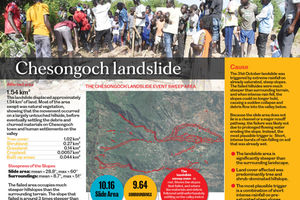
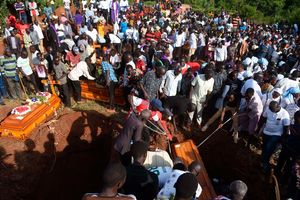
The disaster killed more than 39 people in Kwenoi, Kasegei, Kaptul and Kipkirwon villages, left nine others unaccounted for and injured 32. More than 600 families were displaced.
Large boulders still sit in farms that once carried homes and crops, while scars on the slopes mark the path taken by mud, rocks and debris that November night.
A view of mudslide deposits at Chesongoch in Elgeyo Marakwet on September 27, 2026, which occurred on the eve of November 1, 2025, killing several people.
Photo credit: Jared NyatayaI Nation Media Group
But for many survivors, the biggest challenge is no longer escaping the disaster. It is finding somewhere affordable and safe to live.
After the landslide, displaced families sheltered at Chesongoch Primary School and in temporary accommodation. When schools reopened, some rented houses at the shopping centre.
But rent, food and other household expenses soon became unaffordable.
One by one, families began returning to the villages they had fled.
Monica Biwott, a mudslide survivor at Kwenoi village in Chesongoch, Elgeyo Marakwet County, on September 27, 2026, outside a house belonging to a friend.
Photo credit: Jared NyatayaI Nation Media Group
A Daily Nation spot check found the family living on a steep, precarious slope, just metres from the area affected by the disaster. Large boulders surround the house and the terrain is sharply sloping.
“More than 53 families were considered in the first phase of the construction, but the other remaining families are still waiting, including me. We went back to the same villages because we have no capacity to rebuild and nowhere else to go,” she said.
Monica Biwott, a mudslide survivor at Kwenoi village in Chesongoch, Elgeyo Marakwet County, during an interview on September 27, 2026, about the incident which occurred on the eve of November 1, 2025, killing several people.
When it rains, the fear returns.
“When it rains, I fear the rocks will fall and we usually run for our lives,” she said.
Ms Biwott remembers waking up after the November disaster to find a transformed landscape. Houses had disappeared, neighbours were dead or missing, large boulders had landed in compounds and the Enoo River had changed course.
Her own house was not completely destroyed, but the river now runs close to it.
“I am the first one among the remaining houses. Just in case the landslide strikes again, I will be the first one,” said the mother of four.
“Every cloud trembles us and we cannot sleep. If possible, they should not even tell us that there are El Niño rains because every cloud trembles us and we cannot sleep,” she said.
For Ms Kibor, returning is not an option.
Months before the disaster, she had left her matrimonial home in neighbouring Kasegei to care for her sick mother and had taken her three children with her.
That evening, there had been light rain, but nothing suggested what was coming.
“We took supper early and retired to bed with my three children and my aging mother. There was little rain at the time, but there was no signal of an impending disaster,” she recalled.
Hours later, she found herself rolling downhill with the house and water.
“The debris struck us first and swept us downstream while we were asleep. I don't even remember a single thing apart from seeing myself rolling with the house downhill,” she said.
She was buried under the debris, with only her neck above the rubble. Locals found her unconscious and took her to Chesongoch Health Centre before she was flown to Moi Teaching and Referral Hospital in Eldoret.
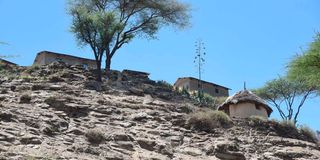
A view of an escarpment facing Chesongoch in Elgeyo Marakwet on September 27, 2026, where people live dangerously. Mudslides occurred on the eve of November 1, 2025, killing several people.
Photo credit: Jared NyatayaI Nation Media Group
Her mother's body was recovered about a week later, trapped among huge rocks.
“When I start thinking about the incident, I start thinking about a lot of things, my three missing children, my mother. It is very painful,” she said.
She now pays Sh1,500 in monthly rent.
“If I was in my house, I could be vending for myself. Living here is very expensive. There is no work to do to pay the rent and even get food,” she said.
“I will never step into that dreaded village in my lifetime. When I see those rocks and the cut-off rivers, I don't want those memories at all,” she said.
“I don't want to live near a river because it traumatises me most. I better stay in this rented house because it is a bit far from the river and the waterway,” she said.
The experiences of Ms Kibor, Ms Biwott and other survivors expose a gap in the resettlement programme launched after the disaster.
Initially, 151 households were identified for assistance.
A view of houses on an escarpment facing Chesongoch in Elgeyo Marakwet on September 27, 2026, where people live dangerously. Mudslides occurred on the eve of November 1, 2025, killing several people. There is fear that the anticipated El Niño rains could cause more devastation.
Photo credit: Jared NyatayaI Nation Media Group
The reconstruction programme, supported by the Government and professionals who mobilised more than Sh60 million, has provided some families with new houses. However, the houses are yet to be occupied because construction is still in its final stages.
Even where houses have been built, the larger question of land remains unresolved.
At Murkutwo shopping centre, some newly constructed houses are close to waterways, a concern acknowledged by the county's disaster management officials.
Margaret Kiptoo, one of the 53 beneficiaries, is living in one of the unfinished houses. But her experience shows just how complicated resettlement has become.
Margaret Kiptoo, a mudslide survivor who lost her son Linus Kipkeu Kiptoo after mudslides swept away homes at Chesongoch in Elgeyo Marakwet, on the eve of November 1, 2025.
Photo credit: Jared NyatayaI Nation Media Group
Ms Kiptoo lost her last-born son, Linus Kipkew Kiptoo, 12, in the landslide. She also lost her home and livelihood and, after suffering severe injuries, had her leg amputated in August.
On the night of the disaster, she was sleeping with her son in Kasegei village when a loud bang jolted her awake.
Water began entering through the window and part of the wall. Within moments, the house was swept away.
“I was rolling with the house and didn't see where my son went,” she recalled.
She was taken to Chesongoch Health Centre and later transferred to Moi Teaching and Referral Hospital, where she spent more than five months.
Her injured ankle developed an infection despite treatment, eventually forcing doctors to amputate the leg.
“My leg has been amputated and I cannot run in case of another disaster,” she said.
Following the amputation, she found it difficult to move around the crowded shopping centre where she had been renting, so she appealed to those overseeing the construction to allow her to move into the unfinished structure.
For her, it is a lifeline.
“When dark clouds gather, my heart skips. I recently slept and wailed that water was carrying me, yet there were no rains, just nightmares,” she said.
The landslide swept away her two houses and 11 mango trees. She lost her son and could not attend his burial because she was in hospital.
In June, her husband died after a long illness.
“I used to rely on no one and could fend for my family. I am suffering from a lot of trauma. I lost my son, whom I didn't get to bury, lost my husband to sickness some months later and also lost my leg to injuries from the landslide,” she said.
Elgeyo Marakwet Chief Officer in charge of disaster management Lawrence Mutwol says the county is aware of the risks.
He said residents have been warned about anticipated heavy rains through local administrators, radio announcements, churches, public barazas and the media.
Those living in exposed areas have been urged to move to safer locations and avoid crossing swollen rivers.
But the county faces a fundamental problem: telling people to leave is easier than finding them somewhere to go.
Mr Mutwol confirmed that 151 families were initially identified for resettlement, but only 53 were covered in the first phase, leaving 98 vulnerable.
“If we get a partner, we may resettle the remaining families. They are also expected to identify land in a safer place where they can be moved,” he said.
The official also acknowledged a more troubling reality: some of the houses constructed for displaced families may themselves be exposed.
“All of this area is unsafe,” he said.
“In my view, they should not have been rebuilt there, especially those at Murkutwo shopping centre,” he said.
The problem, therefore, is bigger than warnings.
It is a question of land, livelihoods and the cost of starting again.
Mr Mutwol said some residents have moved towards the hills and escarpment, believing higher ground offers protection from flooding and landslides. But some of these areas are extremely steep and unstable.
The county has mapped several high-risk areas stretching from the Kocholwo escarpment to Chesegon in Marakwet East, an area estimated at about 157 kilometres.
Kipchumwa Location in Embobut has also been identified as highly exposed, with rivers flowing towards Kaben. Other areas include Emsoo, Soi North, Soi South, Aroor and Sambirir in Endo.
Authorities have used radio announcements and public meetings to urge residents to move, but Mr Mutwol acknowledges that relocation is complicated by people's attachment to ancestral land.
“Sometimes it is difficult to evacuate people from the community. They have a magnetic attachment to their ancestral land,” he said.