The constitutional limits on Parliament’s power to remove an elected Deputy President are at the centre of former Deputy President Rigathi Gachagua’s impeachment appeal, with legal expert Prof Migai Akech arguing that the process violated safeguards designed to protect the country’s top two leaders.
In his application to join the appeal as an 'amicus curiae' (friend of the court), Prof Akech says Kenya’s 2010 Constitution adopts a “bad actor” model under which a President or Deputy President may be removed for serious misconduct, but only after a fair process that tests allegations and protects the officeholder’s right to respond. He contrasts this with a “political reset” model, which allows removal from office to resolve political deadlock.
The University of Nairobi law professor says Parliament turned Mr Gachagua's impeachment into a tool for cutting short an elected leader’s term over political disagreements. The dispute followed the breakdown of relations between President William Ruto and his deputy, culminating in Parliament’s October 2024 proceedings.
Prof Migai Akech during his inaugural lecture at the University of Nairobi on April 26, 2024.
Photo credit: Pool
Kibwezi West MP Mwengi Mutuse introduced a motion containing 11 allegations. They included claims that Mr Gachagua made divisive remarks about sharing public jobs and resources according to voting patterns, undermined government policy, attacked a judge, amassed wealth through corruption and money laundering.
Mr Gachagua denied the allegations and explained that his statements had been taken out of context, that he had not undermined the President or the government, and that his actions did not amount to constitutional violations or gross misconduct.
The National Assembly invited public views on October 4, 2024, and gave Mr Gachagua two hours to defend himself before MPs on October 8.
Prof Akech says MPs did not first investigate MP Mutuse's allegations or hold a hearing to establish whether evidence supported them. The House debated and voted on the motion that day, sending it to the Senate.
The Senate heard the case in plenary rather than appoint a special committee. It heard the National Assembly’s case, including witnesses, before Mr Gachagua was due to present his defence. Proceedings were interrupted after he fell ill and was taken to hospital.
The Senate declined to adjourn pending his recovery and voted on October 17, upholding five allegations and removing him.
Prof Akech says Parliament failed to provide safeguards central to the “bad actor” model, including proper investigations, adequate preparation time, an opportunity to challenge evidence and time for impartial deliberation.
“All in all, due process safeguards were largely missing in the impeachment of Gachagua," he says.
Prof Migai Akech during the interview at his office in Nairobi on March 3, 2026.
Photo credit: Lucy Wanjiru | Nation Media Group
He also disputes public participation conducted by the National Assembly, saying citizens had less than 48 hours and were not given Mr Gachagua’s response or supporting evidence.
The High Court’s June 8, 2026 judgment upheld the impeachment but found that the Senate violated Mr Gachagua’s fair-hearing rights by refusing to adjourn when he was absent.
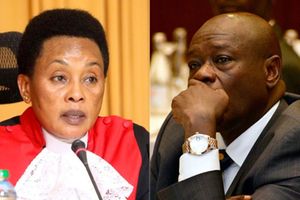
Justices Eric Ogola, Anthony Mrima and Freda Mugambi said the process created a “procedural imbalance, with the scales of participation tilted in favour of” the National Assembly. They awarded him Sh50 million in constitutional damages.
“Constitutional absurdity”
The bench said the breach of rights did not invalidate the Senate’s decision. It reasoned that nullifying the resolution would return Mr Gachagua to office after Parliament had approved Prof Kithure Kindiki as his successor, creating a “constitutional absurdity” through dual incumbency. The judges also found the National Assembly’s public participation adequate and rejected claims that MPs’ public positions alone proved bias.
But Prof Akech differs with the judges' reasoning and findings. He argues that Article 2(4) requires an unconstitutional decision to be treated as invalid. He says the High Court could not recognise a fair-hearing violation yet leave the removal intact, and should have examined whether the charges were properly investigated and supported.
“A court cannot, therefore, interrogate whether the accused’s constitutional right to a fair hearing has been violated without examining the process by which Parliament arrived at the impeachment charges and decided to remove the concerned individual from office,” argues the lecturer.
Prof Akech says nullifying the Senate’s resolution would leave Mr Gachagua as the only lawful Deputy President, not create two officeholders.
He proposes applying the “de facto officer doctrine” to protect official acts performed by Kindiki under an apparently valid appointment, even if it were later found defective.
“The de facto officer doctrine confers validity upon acts performed by a person acting under the colour of official title even though it is later discovered that the legality of that person’s appointment or election to office is deficient," he says.
Then Deputy President Rigathi Gachagua during his impeachment hearing at the Senate in Nairobi on Wednesday, October 16, 2024.
Photo credit: Dennis Onsongo | Nation Media Group
Prof Akech argues that Gachagua’s impeachment risks normalising the use of parliamentary majorities to remove elected leaders over political or policy disagreements, weakening the voters’ mandate and destabilising governments.
He says it could also undermine the Deputy President’s constitutional role as a counterweight to the President, encourage divisive politics and weaken coalition stability by making impeachment a substitute for resolving internal political disputes.
“The danger with this approach is that political disagreements that cannot be resolved due to ineffective coalition agreements will be used as a basis for impeaching presidents or their deputies, thereby making governments and the country unstable," he says in the Amicus Curiae brief.
The Deputy President is elected on the same ticket as the President and has a direct mandate from voters. Prof Akech says this arrangement was intended to share executive power and provide a counterweight to the President. He argues that impeachment should not settle coalition disputes.
Prof Akech wants the Court of Appeal to allow his participation in the case as a friend of the court, overturn the High Court’s decision and nullify Mr Gachagua’s impeachment, holding that Parliament’s violations of constitutional due-process safeguards invalidated the entire removal process.
He believes that the appellate court should reject the argument that reinstating Mr Gachagua would create two Deputy Presidents, and apply the de facto officer doctrine to preserve official acts performed by Prof Kindiki while serving under an apparently valid appointment.
“The only remedy for unconstitutional acts is nullification, not allowing subsequent political actions to sanitize them," he states.
The Senate is also disputing the finding that it denied Mr Gachagua a fair hearing and said it is challenging the Sh50 million award. The appeal is pending hearing.