On August 25, Mohamed Aden Sedow walked into Dadaab Police Station with two other worried parents and reported that their children had disappeared four days earlier.
There had been no word from them since August 21.
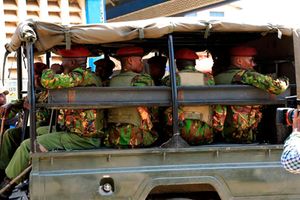
The report set off a multi-agency operation involving regular police, Anti-Terrorism Police Unit and DCI officers who acted on a security tip-off and drove to Block D2 of Ifo Refugee Camp, about seven kilometres from the police station.
Inside two houses, officers found five teenagers locked up.
Two suspects Farah Gele Osman and Gamano Ibrahim Aden were arrested and the five teenagers were rescued and later reunited with their families.
The incident offered a glimpse into a trafficking network that security agencies say continues to operate across Garissa, targeting young people with fake job offers, promises of education and opportunities abroad.
Despite repeated crackdowns by police, chiefs and non-governmental organisations, the networks have proved difficult to dismantle with recruiters adapting their methods and exploiting WhatsApp, boda bodas and porous routes to move victims.
In Garissa town, Ms Hodhan Omar is struggling to bring her first-born son home after he allegedly fell into the hands of traffickers.
Her Grade 10 son Abdighafar Hassan disappeared in December 2025 while in Nairobi where he had gone to spend the holidays with his aunt.
Months later, Ms Omar learnt that her son was being held by traffickers who were demanding ransom from the family.
“I was a struggling single mother trying to raise my children when my son went missing. I eventually learnt that he was being held for ransom. I was so overwhelmed because I didn’t know where I would get this kind of money,” she said.
She turned to relatives, friends and social media sympathisers for help and eventually raised Sh2.3 million.
The money was paid in instalments through a network spanning several countries, she said.
Ms Omar sent $1,000 (Sh129,250) to Dubai and another $3,500 (Sh452,375) to Istanbul, Türkiye while some of the money was sent through Somalia.
The payments were made through hawala, an informal money transfer system commonly used in the region.
Her son was eventually released but is now stranded in Egypt where he is being hosted by a Somali family.
“My son is free but stranded in Egypt. I am seeking help to have him back in the country. I am yet to get any response from the government on how and when my son will be repatriated,” she said.
Her case illustrates how trafficking networks operating in Garissa can extend well beyond the county and the country.
A source at the Garissa regional security offices said the syndicates operate through a chain involving recruiters, transport agents and intermediaries who contact families to demand ransom.
The networks operate across several countries with families often instructed to send money to different destinations.
Garissa Township Sub-County criminal investigations boss Paul Lang’at said many missing person cases were being handled by the Anti-Terrorism Police Unit.
“We have many reports of missing persons that are reported by families and we treat all these as terror related incidents. We have all these dealt with under our Anti-Terrorism Police Unit because of their nature,” he said.
Mr Lang’at said security agencies had put measures in place to combat the networks but recruiters continued to exploit the porous border with Somalia and high youth unemployment in the region.
At Iftin Primary School, three girls disappeared in May after allegedly being lured by a trafficking syndicate.
Security officials say traffickers often target school going children with promises of free travel, educational opportunities or a better life in Europe.
Instead, victims are allegedly handed over to criminal groups that detain them and demand money from their families.
Recently circulated videos showed one of the three girls, a 16-year-old, lying on the ground with her hands tied behind her back and her legs bound with heavy chains and padlocks.
Her family was later contacted and asked to pay $18,000, equivalent to about Sh2.3 million for her release.
“My mother is diabetic and we have been struggling with her medication. Where are we going to get the Sh2.3 million they are asking for?” her sister said.
At County High School in Garissa town, a Grade 10 student has also become the subject of distressing videos sent to his sister.
“Per day, they send me two to three videos of him in very bad shape. In the video clips, they torture him badly. At times, they video call me showing him tied to a tree and whipping him while naked,” she said on condition of anonymity.
The family has managed to raise about Sh1 million from relatives and friends but still needs another Sh1 million. It has also lost its only camel in the effort to raise money for the boy’s release.
Many families whose children remain captive are reluctant to speak publicly fearing that doing so could put their loved ones at greater risk.
Families also say traffickers warn them against disclosing the purpose of the payments instructing them to describe the money as “family support” rather than ransom.
Sheikh Hassan Abdi, the Supkem secretary-general in Garissa, said the situation was worryin noting that families often approach mosques seeking help with fundraisers.
A security source blamed delays in reporting missing person cases for allowing traffickers to move victims beyond the reach of local authorities.
“We have these cases reported after about three days when already the victims have been moved out of Garissa and even the country. Let parents come to report immediately they realise or suspect their children are missing,” the Anti-Terrorism Police Unit source said.
The source also cited poor parental guidance and lack of care as factors contributing to the problem.
“We have a community that does not care about the whereabouts of their young ones. These incidents can be reduced by the community getting responsible,” the source said.
The networks have multiple players, operate across borders and have adapted to technology, making cooperation between police, schools, families, religious leaders and communities critical.
“We have in the past arrested suspects and arraigned them in court and rescued victims. We only need cooperation from the community in terms of timely reporting of incidents and any suspicious character in their midst,” the security source said.