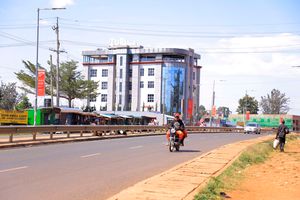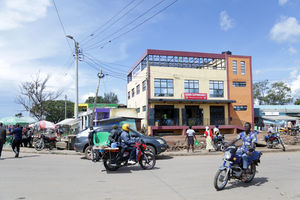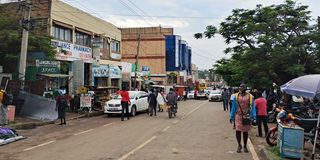
A street in Homa Bay Town on March 18, 2026. The town does not have a designated parking area.

Every day of the week, motorists, boda boda riders and food vendors jostle for space along the busy streets of Homa Bay Town, each vying for a foothold in an ever-tightening urban maze.
It is a quiet contest of arrival and occupation. Whoever claims a spot first holds it, until they leave, and another swiftly takes their place. Nowhere is this more evident than along the stretch from the post office junction to the Homa Bay–Rongo road, where order yields to improvisation.
In front of Shivling Supermarket, private motorists pull up to buy fresh produce from the municipal market or step into the store itself. But the simple act of parking becomes an exercise in negotiation.
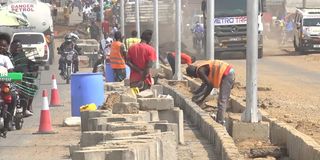
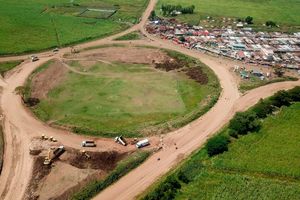
Road construction work on a street in Homa Bay Town on March 18, 2026.
There are no designated parking bays, neither for the supermarket nor for the neighbouring shops, and so drivers resort to leaving their vehicles wherever space permits, often in the middle of the road, so long as they pay the requisite county fees.
The street, originally designed to accommodate two-way traffic, is frequently reduced to a single functional lane, one side surrendered to makeshift parking. The opposite side is no refuge either; it is crowded with boda boda operators waiting for customers, leaving little room for pedestrians to pass.
Amid the congestion, food vendors, selling boiled eggs, fried chicken, sausages and chips, add yet another layer to the already crowded streets. The result is a street that resembles an open-air market, vibrant but disorderly, alive yet constrained.
Homa Bay is poised to attain city status within the next decade. However, it is feared that with such persistent disorder, that aspiration risks slipping further from reach.
At times, the chaos deepens when animals such as cows, donkeys and goats, wander into town, slowing traffic and adding to the disarray.
The challenges are not confined to the Shivling area. Bank Road tells a similar story. A wholesale shop, built with its entrance facing the main road, lacks a designated parking or loading zone. When lorries arrive to restock goods, they park at the entrance, obstructing other motorists and compounding congestion.
Nearby banks face the same predicament. With no parking facilities for their customers, motorists are forced to leave their vehicles by the roadside, often blocking traffic as they conduct their business.
Designated parking spaces
Efforts by the county government to restore order have so far proved arduous.
Homa Bay Municipal Manager Sigar Agumba acknowledges that the town lacks a formal parking system, a gap he attributes to financial constraints.
“We asked for a budget to set up parking areas, but it was not possible in the current financial year. However, it remains part of our plans,” he said.
Mr Agumba also pointed to hawkers and food vendors as contributors to the congestion, noting that his office has engaged traders in efforts to decongest the streets. He further blamed traders who have erected temporary structures on designated parking spaces within the Homa Bay Municipal Market.
Originally, the market design included an area reserved for loading and unloading goods, as well as for vehicle parking. That space has since been overtaken by informal stalls, leaving no room for vehicles to access the market. The county government has directed traders to vacate these areas.
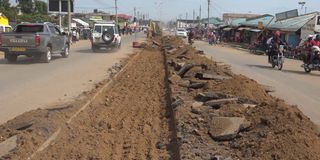
Road construction work on a street in Homa Bay Town on March 18, 2026.
“We are also considering relocating mechanics along garage road to Arunda, where the dumpsite is currently located. This will be done once the dumpsite is moved, and we shall undertake public participation in the process,” Mr Agumba added.
As a longer-term solution, the county government plans to establish a central parking facility at the former water and environment compound, an expansive site capable of accommodating hundreds of vehicles.
“We want to bring order to the town. Motorists will leave their vehicles in the designated parking area before attending to their business,” he said.
Beyond the town centre, a broader concern lingers, the absence of a shared civic discipline. Walkways are increasingly encroached upon by traders displaying their wares, while some erect temporary stalls atop drainage systems, engaging in a perpetual game of cat and mouse with enforcement officers.
Such practices have slowed ongoing infrastructure projects, including the dualling of the Homa Bay–Rongo and Homa Bay–Kendu Bay roads.
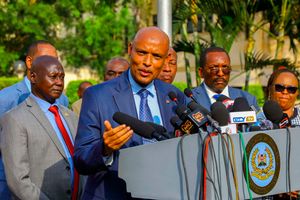
County Commissioner Ronald Mwiwawi warned that encroachment on road reserves is hampering contractors and delaying progress. He also urged motorists to refrain from parking in unauthorised areas along the construction corridors.
Matatu operators, he added, are among the chief offenders.
“Leaving vehicles in the middle of the road delays the progress of these projects. The ongoing works are meant to ease congestion and spur economic growth, yet some drivers continue to create unnecessary obstacles,” Mr Mwiwawi said.
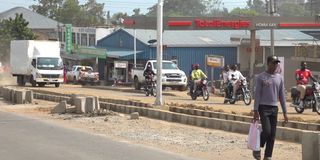
Road construction work on a street in Homa Bay Town on March 18, 2026.
The dual carriageway project stretches from Kodoyo junction in the Arujo area through the central business district and extends to Rangwena along the Homa Bay–Kendu Bay road. Phase one is now 76 per cent complete and is expected to be finalised by May, with phase two set for completion by November, 2026.
Beyond easing traffic, the project promises to enhance the town’s aesthetic appeal and connect it to the newly rehabilitated Homa Bay Pier, unlocking opportunities within the blue economy.
“There are over 400 kilometres of road projects underway in Homa Bay, all being upgraded to bitumen standards. These developments are expected to open up tourism potential and strengthen the blue economy in the county,” Mr Mwiwawi said.
Nevertheless, for all the promise of progress, the daily reality on Homa Bay’s streets tells a more urgent story, one of a town straining to keep pace with its own ambitions.
Follow our WhatsApp channel for breaking news updates and more stories like this.