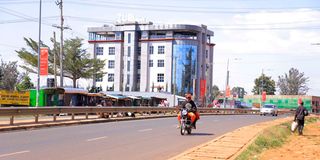
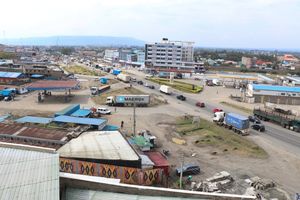
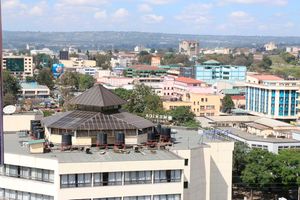
To the first-time visitor, it would be easy to mistake Oyugis Town for the capital of Homa Bay County. Bustling with activity and marked by rapid development, the town stands in striking contrast to the official county headquarters.
Nestled along the Ahero–Isebania Road, Oyugis is among the fastest-growing urban centres in the region. New buildings rise steadily, the streets pulse with commerce, and its residents enjoy a modern way of life that is, in many ways, more advanced than that of Homa Bay Town itself — where iron-sheeted homes and broken water pipes still characterise daily life.
Serving as the commercial and financial heart of Rachuonyo South, Oyugis has become a thriving economic hub that not only caters to residents of Homa Bay County but also attracts people from neighbouring Kisii and Kericho counties.
A business complex in Oyugis Town, Homa Bay County on September 25, 2025.
Photo credit: George Odiwour | Nation Media Group
Its meteoric rise has had a real impact, even displacing some government officials from their designated offices. While Kosele remains the official administrative seat of Rachuonyo South and houses the Deputy County Commissioner, many government offices, including that of the Sub-County Police Commander, have relocated to Oyugis Town in pursuit of better infrastructure and accessibility.
At one time, former Kasipul Member of Parliament (MP) Ong’ondo Were advocated for the full relocation of key government services, such as the registration of identity cards, births and deaths, from Kosele to Oyugis. There was even a proposal to make Oyugis Town the new county headquarters, though these efforts ultimately stalled.
Two decades ago, the transformation that Oyugis has undergone might have seemed implausible. But long before its modern emergence, the town had already carved out a reputation as a centre of opportunity — offering employment, trade and connection.
According to Joshua Ondayo, a 79-year-old elder and long-time resident, Oyugis began as a simple market established in pre-colonial times.
“This area was once all farmland and bush. People from neighbouring villages came to trade. It was a man named Oyugi, from a nearby village, who first set up a local market here. The market became known as ‘Koyugi’, meaning ‘belonging to Oyugi’,” he recalls.
That ancestral name survives in the lineage of many, including Homa Bay’s Deputy Governor, Oyugi Magwanga.
The town’s strategic location, at the crossroads linking Kisii and Kisumu, made it a natural hub for transport and trade. In the past, while roads to Homa Bay Town would end abruptly in Kendu Bay, the Ahero–Kisii route through Oyugis market remained navigable, encouraging travellers and traders to stop, refuel and do business.
“In time, more people came for trade. Business flourished,” Mr Ondayo says.
Employment and economic stimulation
The town’s thriving markets, held twice a week on Tuesdays and Fridays, draw traders from as far as Sondu, Rangwe and Kisii. A dual carriageway constructed under the administration of former President Uhuru Kenyatta has helped to decongest traffic and reinforce Oyugis’s importance as a commercial hub. It remains the only such road in the county, though a similar one is under construction in Homa Bay Town.
Further infrastructural development, including direct links to Kendu Bay and Rangwe, has reinforced the town’s accessibility. But it is not just roads that define Oyugis’s promise.
Agriculture plays a central role in the local economy. Surrounding villages supply the town with a bounty of fruits, vegetables, sweet potatoes and dairy products. The constant inflow of produce has sparked the growth of micro and small enterprises (MSEs), providing both employment and economic stimulation.
Wholesaler Noringtonne Otieno observes that high food production has created a steady circulation of money.
“Traders here know they’ll make sales and profits. That certainty encourages more business,” he notes.
A business complex in Oyugis Town, Homa Bay County on September 25, 2025.
Photo credit: George Odiwour | Nation Media Group
A modern market adjacent to the main bus park boosts these gains, offering travellers the chance to shop before heading to their destinations. It’s an ecosystem where everyone — from the smallest vendor to financial institutions — finds opportunity.
Banks and Saccos, some of which do not operate elsewhere in the county, have set up branches in Oyugis, drawn by the town’s economic dynamism.
According to Municipal Manager Oyugi Ongere, Oyugis generates up to Sh5 million in monthly revenue, significantly contributing to Governor Gladys Wanga’s target of Sh1 billion in annual county collections. In the last financial year, Homa Bay County raised Sh1.2 billion, with Oyugis playing a key role.
“Our revenue comes from business permits and daily levies. Traders use a cashless system, remitting payments via mobile to the county treasury,” Mr Ongere explains.
For residents, Oyugis Town is not just a commercial hub; it is a desirable place to live.
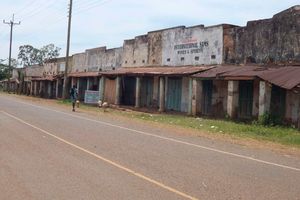
Nelson Ochieng recalls his childhood in a town of mud huts and grass-thatched roofs. “But as trade expanded, businesspeople began building modern structures,” he says.
The town’s transformation owes much to the investment of Indian, Somali and other entrepreneurial communities, who brought capital and a desire to trade in a vibrant, structured environment.
Today, streetlights illuminate the town centre, allowing businesses to operate well into the night.
“Elsewhere, shops close by 7pm. Here, you’ll find people still working past 10,” Mr Ochieng notes.
The town’s growing population has also sparked a housing boom. Fortunately, nearby brick production keeps construction costs low.
A new hotel in Oyugis Town, Homa Bay County on September 25, 2025.
Photo credit: George Odiwour | Nation Media Group
“I bought bricks at Sh5 each, while others pay three times more due to transport,” says homeowner Mary Omwanda.
Jobseekers now view Oyugis Town as a place of opportunity. Among them is Dismus Resa, a retired Kenya Forest Service officer, who recently found work as a hotel security guard.
“I was looking for something to do after retirement. People told me Oyugis had many opportunities. I came and found one,” he says.
Mr Resa had choices, including a job at a gold refinery, but chose the security post for its stability. He now lives in the town and returns home to Kakelo on his days off.
Despite its many strengths, Oyugis faces its own share of challenges. The town lacks a public cemetery—a pressing issue for the growing population.
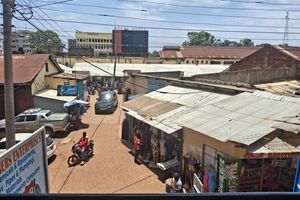
A dual carriageway in Oyugis Town, Homa Bay County on September 25, 2025.
Photo credit: George Odiwour | Nation Media Group
“We currently rely on a private piece of land donated by a resident. A public cemetery is urgently needed, not just for Muslims but for all residents,” says Nuhu Masoud, Secretary of the Supreme Council of Kenya Muslims.
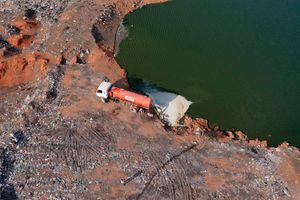
Waste management is another concern. Roadsides often bear the unsightly evidence of illegal dumping.
Mr Ongere acknowledges the issue, explaining that the county currently leases land for waste disposal.
“We are paying a fee to the landowner, but we are seeking a more sustainable solution,” he assures.
Plans are underway to further modernise Oyugis Town through the Kenya Urban Support Programme, a World Bank-funded initiative focused on strengthening urban infrastructure and governance.
“We aim to upgrade feeder roads to bitumen standard and expand the market to accommodate the growing number of traders,” Mr Ongere says.
What began as a modest market founded by a man named Oyugi has now become an economic jewel in the crown of Homa Bay County.