According to history, Chemelil was once occupied by the ‘Kapmelilo’ (the place of Melilo), a section of the Nandi who inhabited the vast windswept grassland that formed an excellent pasture country for their livestock.
For historians, the place acquired the name from the dance known in full as Chemelilit.
It was a place designated for entertainment and the Kapmelilo would hold their dances there, an important cultural activity for the community then, and this went on for years until the town collapsed.
In the year 1900, the railway descended the highlands on its final stretch to the lake and they were forced to leave their abode in 1906.
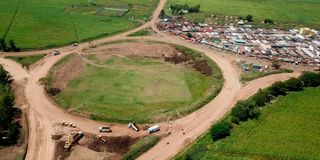
An aerial view of Chemelil roundabout, the town centre, and the expansive sugar nucleus estate surrounding Chemelil Sugar Factory on July 1, 2025.
Photo credit: Alex Odhiambo | Nation Media Group
The Nandi were forced to abandon their habitations in Chemelil, Muhoroni, Miwani, Kibigori, Kibos, Koru, Kapere (Kopere) following a move by the British administration to resettle them.
In the aftermath of this, prominent Luos purchased large-scale European farms in the area and, for this, the Nandi always felt aggrieved since few could afford to buy.
Settlement schemes established brought in small-scale Luo farmers and industrial concerns such as Chemelil Sugar also attracted migrant (Luo) workers, as did Miwani Sugar and Homa Line.
Many years later, the town located 40 kilometres east of Kisumu, the county capital, became one of the prominent towns owing to its vibrancy because of the Chemelil Sugar Company.
The factory’s presence led to the establishment of schools, stadiums, entertainment joints, members’ clubs and improved road infrastructure that attracted public service vehicles.
With a thriving economy, the small town which was decades ago home of dancing lived up to its expectations until the early 2000s when it started fizzling out.
Mr Allan Sienya has been a butcher since 2001, at a time when the Chemelil factory was operational. This, he said, led to thriving business then because of the number of workers who were at the factory and loved meat.
This, he says, however changed around 2008 when the factory started experiencing numerous problems. This, he added, worsened nine years later in 2017.
“We used to have very many customers from the factory. I used to sell Sh20,000 worth of meat in a day which came from more than three cows. As you can see, I can barely sell one cow in a day. I am only making about Sh4, 000, only if I am very lucky,” said the butcher.
Mr Sienya told the Nation that the only way to revive the economy of Chemelil was for the factory to operate like it did decades ago.
The factory had been the backbone of the town’s economy, employing thousands of workers and supporting countless small businesses that thrived on the spending power of factory employees and farmers delivering sugarcane.
When the mill stopped operating, the economic ripple effects were immediate and devastating.
Because of its history, Chemelil used to be popular for bars, pubs and clubs too.
Dilapidated facilities and stalled machinery at Chemelil Sugar Factory, on June 17, 2025.
Photo credit: Alex Odhiambo | Nation Media Group
This changed over time and some of the local joints were forced to reduce stock because of fewer revellers visiting their premises.
He recalls how back in the day there used to be an influx of customers and they used to have good sales and steady cash flow.
He however laments that things have changed with some businessmen opting for other more vibrant towns like Koru and Muhoroni.
“We used to have matatus being washed here and at that time the drivers and conductors would eat, drink and sleep here, leaving that cash to businesses, but many have changed route to the Awasi side or through Koru, affecting us,” said Mr Otieno.
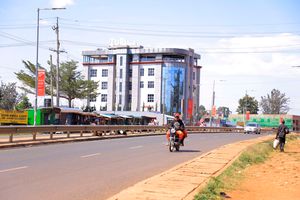
A view of Chemelil centre in Kisumu Countyon July 1, 2025.
Photo credit: Alex Odhiambo | Nation Media Group
He added that he used to target the middle and those in the lower cadre with his alcoholic drinks which were beer and spirits and could make Sh20,000 to Sh30,000. This he can barely hit at the moment.
“I used to make up to Sh30,000 back in the day, but now I can barely hit Sh5,000 on a normal day yet they are the same customers. You can just imagine that those people who used to frequent bars and buy crates of beer have now resorted to taking chang’aa owing to the changing economy of the town,” said Mr Otieno.
On a good day he may go home with Sh10,000.
Some businesses however closed, families moved away in search of opportunities elsewhere, and the once vibrant trading centre slowly faded into near abandonment.
For a while now, infrastructure has deteriorated as economic activity dwindled, leaving the once thriving sugar town resembling a ghost town.
John Omollo, an octogenarian who owns one of the shops in the town, also recalled the early days when Chemelil was a thriving commercial hub driven by the sugar factory.
“Chemelil used to have a 24-hour economy. Since the factory was operating, the population in the town was high and business was very good. We could even sell our goods at night because people were always around,” Mr Omollo said.
Closure of Chemeili Sugar Factory
He believes that had the factory remained operational over the years, the town would have developed significantly.
“If things had remained constant, we could be having several storey buildings here in Chemelil,” he said.
According to Mr Omollo, the closure of the factory marked the beginning of the town’s decline.
“When the factory collapsed, the town collapsed with it. The booming business disappeared and many employees relocated with their families to other towns. Now we only depend on the few individuals who are still around,” he added.
“If it were not for a few matatus going to Eldoret, Chemelil would just be an ordinary rural centre. As we speak, you can barely even get a matatu after 7pm going to Awasi on the way to Kisumu. This is just like a village now,” he said.
However, residents believe that change is on the horizon.
Hope has been rekindled following the construction of the 63-kilometre Mamboleo–Miwani–Chemelil–Muhoroni–Kipsitet Road (C674), part of a larger 122-kilometre corridor cutting across Kenya’s sugar belt.
The road is currently undergoing a major upgrade as part of the government’s continued investment in modern road infrastructure across the country.
Once completed, the road will provide a seamless connection between Kisumu, Nandi and Kericho counties, significantly improving regional transport and trade.
Residents say the improved connectivity, combined with the revival of the Chemelil sugar factory, could restore the town’s lost economic vibrancy.
Joan Akinyi, a resident who manages rental houses in the town, says she is already planning to invest in improving her property in anticipation of better days ahead.
“My husband owned some of the rental houses in Chemelil. After he died in 2012, I took over as the landlady. I am currently planning to take a loan to improve the structures because I’m optimistic that the town is headed in the right direction,” Ms Akinyi said.
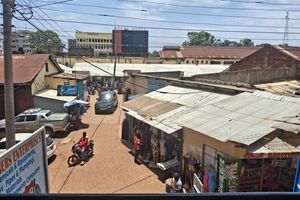
A view of Chemelil centre on July 1, 2025. Several shops stand vacant after being abandoned due to low cash circulation.
Photo credit: Alex Odhiambo | Nation Media Group
Mr Jacob Jagero, Head of Corporate Affairs at Chemelil Sugar Company 2025 Ltd, confirmed that the factory has resumed operations.
“The milling is operational. We have minor breakdowns occasionally, which is normal for such operations, but the factory is working,” Mr Jagero said.
For many residents, the return of the factory signals a potential turning point.
Mr Kevin Akumu, a boda boda rider in the town, believes improved infrastructure and a functioning factory will attract investors and revive economic activity.
“Investors always look for places where there is business and good roads. Even in the boda boda sector, we are planning to bring in more motorcycles because we expect more people to start coming here,” Mr Akumu said.
According to him, the town has long suffered from its poor accessibility and location deep within sugarcane plantations.
“Many people avoided coming to Chemelil because they called it a village hidden inside sugarcane plantations. Tell me who would want to ride on a bad road inside a sugarcane plantation? But once the road is complete and the factory is running well, people will definitely come back,” he added.