At first, it was presented as a medical facility where Americans exposed to Ebola would be airlifted to a new facility at Laikipia Airbase.
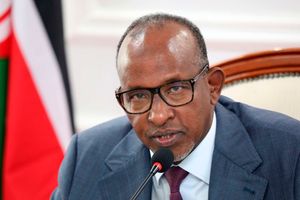
Health Cabinet Secretary Adan Duale says the Nanyuki facility is only one of 23 centres planned across the country to prepare Kenya against the deadly disease.
Yet Kenya has never recorded an Ebola outbreak. That fact alone raises the first troubling question: why here, why now, and why inside a military airbase?
Then came President William Ruto’s own admission that he had approved the offloading of American Ebola-exposed patients into the Nanyuki facility.
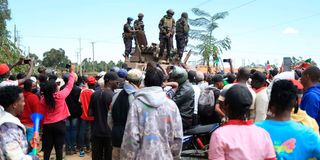
A demonstrator jumps over a barricade of burning tyres during a protest against a US-backed Ebola quarantine plan to establish a 50-bed facility at a Kenyan air force base, to host Americans exposed to Ebola in Nanyuki town, Laikipia County on June 1, 2026.
Photo credit: Reuters
With that statement, the controversy changed. This was no longer merely about Kenya preparing for a possible epidemic. It was about whether Kenya was being asked to receive a risk that America did not want to keep within its own borders.
But as history has shown, public health is also political. Kenyans should remember Pakistan where during the hunt for Osama bin Laden, the CIA used a fake vaccination campaign in Abbottabad to obtain DNA evidence from people connected to the compound where bin Laden was believed to be hiding.
The reported cover was a hepatitis B vaccination programme. In Pakistan, militants and suspicious communities later pointed to that episode as proof that medicine could be a mask for espionage.
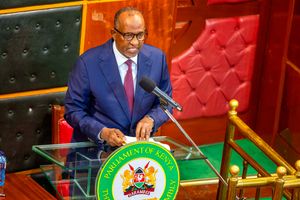
That is why the Laikipia question cannot be reduced to whether Ebola is dangerous. The real issue that most people are asking is on the secrecy. Duale has already said that there will be no public participation on the exercise.
But why should a foreign medical facility be placed inside a Kenyan military airbase? Who will command it? Which law will apply there? Who will inspect it? Who will bear responsibility if something goes wrong? Why should Kenya host exposed Americans when Kenya has no Ebola outbreak of its own?
The history of America’s military and intelligence agencies in medical projects is no longer hidden. It has been documented by American commissions, Senate hearings, declassified files, lawsuits and official apologies.
It is a history in which the language of medical research, military preparedness and national security has sometimes concealed experiments on human beings who did not fully understand what was being done to them.
In June 1975, the Commission on the Central Intelligence Agency (CIA) Activities within the US, commonly known as the Rockefeller Commission, reported on secret drug experiments. It noted that many records had been destroyed. One case stood out.
“LSD (a powerful hallucinogenic drug) was administered to an employee of the Department of the Army without his knowledge while he was attending a meeting with CIA personnel working on the drug project,” the report said.
The man, Dr Frank Olson, was later told that he had been drugged and developed serious side effects, was taken to New York for psychiatric treatment, and several days later fell from a tenth-floor hotel window and died.
Dr Olson was a civilian scientist working with the US Army’s biological warfare laboratories at Fort Detrick, Maryland. His death became one of the darkest windows into the hidden world where medicine, biological warfare, psychology, intelligence and secrecy overlapped.
Demonstrators march in Nairobi on June 2,2026 to protest against a planned US backed Ebola facility at a Kenya Air Force base in Nanyuki, Laikipia County.
Photo credit: Evans Habil | Nation Media Group
For years, his family was told an incomplete story. Only after investigations into CIA abuses did the public learn that Olson had been secretly dosed with LSD by CIA personnel during a retreat.
If such a thing could happen to an American scientist inside America’s own security establishment, what safeguards should a small country like Kenya demand before hosting a foreign-controlled medical facility on its soil?
The Senate hearings revealed that MKULTRA, as the programme was known, had 149 subprojects. Some involved universities, hospitals, prisons, private foundations, doctors and research institutions.
The moral scandal was not simply that the CIA experimented with drugs. It was that the state concluded that national security could suspend the ordinary rules of consent. It is the same secrecy that continues within Nanyuki where Kenyans are demanding accountability.
In Guatemala, between 1946 and 1948, US public health researchers exposed prisoners, soldiers and psychiatric patients to sexually transmitted infections in experiments linked to penicillin research. Decades later, the US apologised. But the apology came after the damage had been done.
This is why secrecy, like the one about the quarantine centre, is never a minor administrative detail. Once agreements are hidden, citizens are asked to trust without seeing. Once medical projects are placed behind military gates, the public is told to accept assurances instead of evidence.
This is the background against which Kenyans are now being asked to trust the proposed Laikipia Ebola facility. The issue is not that every American medical project is sinister.
That would be false. America has produced some of the world’s finest medical science, hospitals, vaccines, emergency systems and humanitarian responses. But America has also produced a record in which medical projects have sometimes served military and intelligence objectives. Both truths must be held together.
For Kenya, the Laikipia matter is, therefore, not only about Ebola. It is about sovereignty. It is about whether Kenya is being treated as a partner or as a convenient territory. It is about whether African land is being asked to absorb a risk that a richer country would rather keep away from its own citizens.
But there is also a wider pattern that Kenyans should not ignore. When America has a problem, it does not want to confront within its own legal, political or moral boundaries, it has often looked for an offshore space, a third country, or a weaker economy on which to place the burden. Guantanamo Bay became the most notorious symbol of this logic.
After September 11, the US created a detention system on Cuban soil, outside the ordinary visibility of American civic life, to hold men it did not want to process through normal courts.
That same logic appeared in the CIA’s rendition and black-site programme, where terrorism suspects were moved across borders, hidden in foreign facilities, or handed to governments where harsher interrogation could occur away from American public scrutiny. This way the moral burden was exported as victims disappeared into an offshore system. The American public was told that security was being protected.
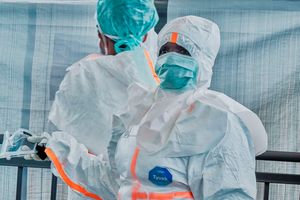
Red Cross workers disinfect after handling the body of a person who died of Ebol in Bunia, Ituri province in the Democratic Republic of Congo, May 21, 2026.
Photo credit: Reuters
This is not limited to prisoners. It is also visible in the political economy of waste and surplus. America and other wealthy countries export enormous quantities of second-hand clothing to African markets.
In Kenya, mitumba has created livelihoods and supplied cheap clothing to millions. But it has also carried a darker symbolism: the surplus of rich societies arriving as the wardrobe of poorer ones, while local textile industries struggle to compete. What America no longer wants is baled, shipped and sold to us as opportunity.
This is why the proposed Ebola facility at Laikipia should be read within a larger history of offloading. Prisoners can be moved offshore. Interrogations can be outsourced. Used clothes can be dumped into poorer markets.
Medical risk can also be relocated under the language of partnership. In each case, the powerful country keeps the core of its comfort intact while the weaker country absorbs the discomfort, the stigma, the waste, the suspicion or the danger.
The question, therefore, is not whether Kenya should cooperate with America. It should, where cooperation is transparent, lawful and mutually beneficial. The question is whether Kenya is once again being asked to become the place where another country places what it does not want near its own citizens. That is the sovereignty issue at the heart of Laikipia.
If the facility is truly a public health facility, why is it inside an airbase? If it is meant to serve a global emergency, why does the discussion appear centred on exposed Americans? If it is safe, why was the public not briefed from the beginning? If Kenya is a sovereign partner, why should Parliament, county leaders, doctors, residents of Nanyuki and civil society have to demand details after the fact?
It appears that the government is not willing to table all agreements before Parliament and its treating concerns by residents living near the base as noise.
The questions are simple. Who will command the facility? Who will inspect it? Who will transport patients? Where will symptomatic patients be taken? How will medical waste be handled? What happens if a Kenyan worker is exposed? Who pays compensation? Will Kenyan courts have jurisdiction? Will Kenyan health officials have unrestricted access? When does the facility close?
While there is no evidence that Laikipia is another MKULTRA, another Tuskegee, or another Abbottabad vaccine ruse, history proves that secrecy itself is dangerous and especially when it involves the US military, intelligence agencies, disease control, and foreign soil. The issue is not to manufacture panic, but to insist that public health cannot be built on hidden agreements, military silence, and after-the-fact reassurances.
That is why Kenya must not treat the Laikipia facility as an ordinary medical camp. If the project is safe, Duale should let the documents speak. If it is lawful, let Parliament examine it. If it is purely humanitarian, let Kenyan doctors, county officials, independent scientists, and affected communities see the protocols. If there is nothing to hide, there should be nothing to conceal.