When you land on Mfangano Island from a major town, the first thing you notice is what you do not see: cars.
There are no traffic jams, no hooting matatus and no petrol station with a glowing signboard, except for one filling station at Sena that is almost always without fuel.
If you brought your own vehicle, you would have had to load it onto a ferry at Mbita Town for the one-hour crossing to the island.
For most residents who own cars, that is unnecessary and expensive. They leave their vehicles on the mainland before boarding water vessels to cross to Mfangano.
On the island, people either walk, paddle traditional canoes from one beach to another or ride boda bodas.
It is perhaps one of the few places in Kenya where a motorcycle is not merely an alternative means of transport but the dominant form of motorised transport.
There is no official tally of the number of cars permanently stationed on the island, but residents say they can be counted on one hand.
A handful of government utility vehicles used for security operations, together with a tractor, are among the few vehicles seen on the island.
The last time residents saw many vehicles at once was when President William Ruto launched the construction and improvement of the 53-kilometre Mfangano Island Ring Road on October 7, 2023.
After the ceremony, the convoy was driven back to the ferry and returned to the mainland.
Historically, Mfangano had virtually no cars because of its isolation and lack of paved roads.
The first car driven on the island is said to have arrived in February 2007 for a brief government road-launch ceremony that never materialised into tarmac.
Nearly two decades later, dilapidated infrastructure continues to keep the island’s car population low.
It is cheaper to leave a car in Mbita, cross to the island and hire a motorcycle. That simple economic reality has shaped a unique transport economy.
Where there are few cars, there are few car washes, garages, petrol stations or vehicle rental businesses.
In most towns, a thriving boda boda industry would naturally support a petrol station alongside the cars already on the roads.
In Mfangano, however, entrepreneurs face the prospect of investing millions of shillings in a petrol station in a market with too few vehicles to guarantee enough customers.
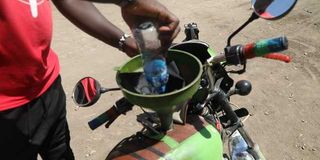
An attendant refills the tank of a motorcycle at the Sena Trading Centre on Mfangano Island in Homa Bay County on September 21, 2026. Fuel on the island is sold in plastic water bottles.
Photo credit: George Odiwuor | Nation
Some have found another way to keep boda boda operators moving, without investing in a conventional filling station.
Across trading centres on the island, from Sena to Wakula, petrol is not sold from a pump. It is sold in plastic water bottles.
On wooden tables by the roadside, rows of 500ml and one-litre water bottles filled with yellowish petrol sit alongside darker bottles containing diesel, lined up almost like sodas in a kiosk.
Boda boda riders stop, pick a bottle, pay and pour the fuel directly into their tanks.
“It is normal here. We have grown up seeing it. You just call the seller and he brings you fuel in a bottle,” said Wycliffe Otieno, a rider.
For riders such as Mr Otieno, it is convenient.
For safety authorities, however, it is a disaster waiting to happen.
Using ordinary single-use plastic water bottles to sell, buy or store petrol is an extremely dangerous practice and is widely prohibited by the Energy and Petroleum Regulatory Authority (EPRA) and law enforcement agencies.
Thin plastics are entirely unsuited to volatile petroleum products. They can generate static electricity, leak, melt or even burst into flames.
But on Mfangano, the practice persists not out of defiance, but necessity.
With only one petrol station that frequently runs dry, the bottle has become the island’s makeshift filling station.
Fuel used on the island is sourced from Mbita. Vendors buy it in bulk from the mainland, transport it in jerrycans on wooden boats and repackage it into bottles, selling it to riders at a small margin.
An attendant refills the tank of a motorcycle at the Sena Trading Centre on Mfangano Island in Homa Bay County on September 21, 2026. Fuel on the island is sold in plastic water bottles.
Photo credit: George Odiwuor | Nation
Robert Ochieng is one such vendor at Sena trading centre. When he needs fuel, he calls his supplier in Mbita and informs him of the quantity he wants.
“I take 20-litre jerrycans to the beach and wait for a boat that goes to Mbita. The containers are loaded as I tell the supplier the quantity I need and send him the money by mobile phone cash transfer,” the vendor said.
Such products are prohibited from the ferry and water bus, which are considered the most efficient and safe means of transport.
Although no accidents have been reported involving boats carrying petroleum products, ferrying jerrycans of flammable liquid alongside passengers remains a considerable risk.
People involved in the water transport business appear to have little choice but to accept the risk.
Mr Ochieng argued that the containers are tightly sealed to prevent leakages that could lead to an explosion.
At the moment, the vendor buys Super Petrol at Sh215 a litre and diesel at Sh218.
“I sell the same at Sh230 per litre. This is Sh15 more, which covers the cost of transporting it to the island and the profit I get,” he said.
Riders say the cost rises the further one travels into the island, as vendors factor in additional transportation expenses.
According to operators in the business, boat owners charge Sh50 for every jerrycan transported from Mbita to Sena, the closest beach to the mainland.
Riders in the interior parts of Mfangano therefore pay more, as vendors there incur higher costs to transport the fuel.
At Mr Ochieng’s shop, riders find fuel already packed in bottles of different sizes.
The funnel helps prevent spillage, while the cloth traps foreign material, including particles of sand and small stones that may have found their way into the bottles.
Riders can also carry a bottle of fuel with them, although this is not recommended because they may not have a funnel to help them safely refuel their motorcycles.
“We have a filling station at Sena, but the owner complains of high transportation costs. He says operators of the private ferry charge a lot and he struggles to make a profit,” the vendor said.
On a good day, a vendor can sell up to 70 litres of fuel to riders.
H15A0906(6)
Photo credit: George Odiwuor | Nation
Mfangano Ward Boda Boda Association Secretary General Bonface Ocholla said some vendors sell a litre of fuel for as much as Sh240, depending on how much they spent sourcing it from the mainland.
When EPRA determines maximum fuel prices in Kenya on the 14th day of every month, vendors in Mfangano also calculate how to adjust their prices without making losses.
Mr Ocholla said riders normally pay close attention to the announcement to ensure they are not charged exorbitantly.
“We understand that prices on the island are determined by several things, including the cost of boat transport. But we always tell the vendors not to increase prices to a level that riders cannot afford. If the boat owners charge more, then prices on the island also increase sharply,” he said.
He said riders operating on the island must know where they can next get fuel to avoid being stranded when their tanks run dry.
Even then, some riders do not make it to their destinations. Some run out of fuel along the way when their engines can no longer run.
Michael Omondi, a rider, said fuel is also sold from homes, locations that boda boda operators must know if they want to avoid being stranded.
Those who run out of fuel are forced to leave their motorcycles by the roadside and search for fuel.
“We just explain the situation to our customers. Those in a hurry to get to their destinations board another bike, or they can wait as I look for fuel,” the rider said.
In order to remain profitable, taxi drivers on the island charge higher fares than their counterparts on the mainland.
A journey that would cost Sh50 in Mbita can cost twice as much on Mfangano because of the high cost of fuel.
Mfangano Development Forum Chairman Daniel Rakoro said most people who need to use their cars on the island have to fuel them on the mainland before making the journey.
He said motorists put as much fuel as possible into their vehicles in Mbita, where it is cheaper.
“Paying an extra Sh15 to Sh20 per litre on the island is expensive, so most people ensure their vehicles have enough fuel before they move to the island. But it is even cheaper to leave the car on the mainland and use a motorbike on the island,” he said.
Mr Rakoro acknowledged that selling fuel in water bottles poses a major safety risk that requires urgent intervention.
“Fuel is very flammable. If you are storing it in things like plastic bottles, definitely security is a major concern. Of course, maybe nothing bad has happened so far, but it is a serious security risk that should be checked,” he said.
According to Mr Rakoro, the best solution would be to have an additional petrol station on the western side of the island to serve residents of Wakula, Ugina, Wasamo and other areas.
An attendant refills the tank of a motorcycle at the Sena Trading Centre on Mfangano Island in Homa Bay County on September 21, 2026. Fuel on the island is sold in plastic water bottles.
Photo credit: George Odiwuor | Nation
He appealed to the government to consider setting up a National Oil outlet on the island, noting that private investors consider several factors before committing their money.
He said the ongoing construction of the 53-kilometre Mfangano Island Ring Road would increase vehicle activity over the next six to seven months once tarmacking is complete, making an additional fuel station even more critical.
“There will be enhanced vehicle activity after the project, so an additional petrol pump or even two would be the best solution,” he added.
There are hopes that the situation will change as construction of the 53-kilometre ring road continues.
Riders are optimistic that the road will finally open up the island and enable more vehicles to operate, creating a viable market for investors to establish proper petrol stations.
They hope the era of the “bottle station” will eventually end as more vehicles make their way to the island and investment in petrol stations becomes commercially viable.
Until then, Mfangano will continue to run on two wheels.