A month ago, Maguje Village in Homa Bay Town was a quiet place where cattle grazed lazily in open fields and farmers tended their green crops during the rainy seasons.
The only hint of industry was the occasional lorry rumbling through the village to collect murram from quarries where earth was excavated for construction materials. That quiet is gone.
Today, Maguje is loud, dusty and restless, transformed almost overnight by a discovery that residents believe could make them rich.
It began as a rumour and then word spread like bushfire that gold had been discovered in the village. Within two weeks, the sleepy farming community had become almost unrecognisable.
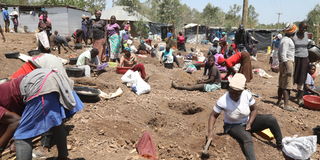
Residents of Maguje Village search for gold at a mining site on September 3,2026.
Photo credit: George Odiwuor | Nation
Hundreds of people have poured in; young men and women armed with picks and shovels, middlemen carrying large sums of cash, lorry drivers, machine owners and other traders, all drawn by one mineral, gold.
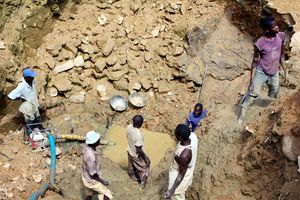
At the quarries that once supplied murram, the landscape has changed dramatically. Where excavators previously scooped reddish-brown soil in neat layers, men now dig frantically by hand and machine, opening deep trenches in search of ore-bearing rock.
Others form human chains, hauling sacks of excavated stones on their backs before loading them onto motorbikes and lorries.
Some of the stones are not processed in the village. They are transported to refineries elsewhere, where crushing machines and extractors separate the gold from the rock.
The rush has spawned an entire economy around the pits.On the edges of the quarries, women who only a month ago sold vegetables and fish in other towns or ran small kiosks have abandoned their old businesses.
They now rise before dawn to prepare chapati, beans and tea for miners who work for hours without respite.
John Okello, who was appointed chairperson of the mining site, said the discovery was made after residents noticed a woman picking rocks from the quarries.
At first, her activities attracted little attention.
Mr Okello said the woman collected rocks for about five months before some villagers began questioning where she was taking them. “She would put them in sacks and pay riders to take the rocks to an unknown location. She later revealed that she was taking them to a gold processing site,” he said.
Word of the gold quickly spread across the village. For residents who had never seen gold in their lifetime, the discovery initially sounded like a hoax. Their scepticism faded when they began seeing people arriving in large executive vehicles.
Some were experienced in the gold trade and were searching for new mining sites. Others took rock samples away for testing before returning to invest in machinery.
Mr Okello said that within a week, temporary structures made of iron sheets and polythene had sprung up.
Inside them, traders installed machines that crush large, gold-bearing rocks into smaller pieces or fine powder, allowing the trapped gold to be extracted.
The machines run on diesel generators, turning the once-quiet village into a cacophony of engines and grinding metal.
While some miners dig out rocks and take them for crushing, others collect the stones and ferry them to processing sites elsewhere.
A sack of rocks sells for between Sh2,000 and Sh5,000, depending on the results of tests conducted on samples from the mining site. According to operators, the test determines how much a buyer is willing to pay.
The sudden flow of cash has convinced many residents that they may have been sitting on a fortune all along.
By Friday last week, gold extraction had begun at one corner of the site, where a group of women were processing crushed rock. They poured water over soil made from crushed rocks along a slope, using gravity to separate heavier gold particles from lighter sediment.
Mr Okello said women involved in the work receive instant cash payments. Even elderly women who would otherwise depend on their children for survival are trying their luck at the mines, often crushing rocks with hammers.
“Some of the women are involved in ferrying rocks. They are equally being paid cash on top of some pieces of rocks which they can also use to get gold,” he said.
Initially, many of the areas now being mined had been excavated for murram and left virtually useless. Families who owned the land considered it to have little or no value.
Residents of Maguje Village load sacks containing rocks believed to have gold deposits onto a motorcycle before taking them to buyers on September 3, 2026.
Photo credit: George Odiwuor | Nation
Owino Opiyo owns one such parcel. In 2022, while working as a security guard on a modest income, he sold murram to a road construction company whenever he needed money to pay school fees.
The company brought in excavators, dug up the ground and hauled away the soil in lorries.
What remained on his compound was a layer of soil incapable of supporting farming. Now, the very ground he once regarded as worthless is turning into what could be his escape from poverty.
After seeing how fiercely people were pursuing the gold, the committee formed to oversee the site introduced rules to regulate operations. Among them is a requirement that miners pay landowners Sh50,000 before digging begins. Mr Opiyo is among those benefitting from the arrangement.
He has allocated different sections of his land to miners in exchange for cash. Each plot measures about 20 metres by 20 metres.
“Extraction happens up to my doorstep. This has affected my privacy and now I consider leaving this area for a different location,” he said.
Some of his neighbours, who are yet to establish whether their own land contains gold, now regard him as a potentially wealthy man.
“I have suddenly made friends with people I do not know. They have a common interest. They want to get space on my land so that they can extract the mineral,” he said.
All murram mining sites in the area are now being eyed as potential gold fields, with extraction areas steadily expanding.
For landowners, the discovery is both a blessing and a dilemma. A farm that once produced a few bags of maize can now generate more money from gold in a week than it would in an entire season - but at the cost of gaping holes, damaged land and environmental degradation.
Construction workers are among the main beneficiaries, with demand for their services soaring as gold traders put up structures to house machinery. Construction crews are also digging reservoirs to store the large quantities of water needed for gold processing.
Kennedy Oywa has worked at the site for two weeks without a break, putting up structures using iron sheets.
“I would previously walk to construction sites as I look for work. Today, sometimes I would go back home without finding anything to do,” he said.
John Opiyo, a mason, has worked at the site for the past week. He constructs reservoirs by laying bricks around holes dug into the ground before plastering them to make them watertight. He said he no longer struggles to find work.
Melvin Akoth previously sold fish, buying her stock from Mbita and reselling it in Homa Bay Town.
When she heard about the mining site, she decided to test whether she could make a living selling food to the workers.
“I discovered that food selling business in an area like this has more profit than the business I was engaged in earlier. I just need a few adjustments before I become stable,” Ms Akoth said.
It is estimated that more than 3,000 people had gathered in the village by Friday last week.
The sudden population surge is straining basic amenities, particularly toilets and water supplies.
Some landowners who have leased out their property for mining allow workers to use their household toilets, but the facilities are inadequate. Others relieve themselves in nearby thickets.
Chris Omulo, a resident, said that while the discovery could stimulate economic growth in the region, the mining activities needed to be regulated.
He warned that the influx of people, including children, could encourage some pupils to drop out of school and join the gold rush.
“We are also concerned about health and sanitation. Having hundreds of people within the same area and a limited number of toilets can lead to the spread of diseases,” Mr Omulo said.
Beyond health concerns, he is worried about safety.
Within days of the mining beginning, three people were reportedly involved in an accident after slipping and falling into a pit. They suffered cuts and bruises and were rushed to hospital for treatment.
Women engages in artisanal gold mining at Maguje Village in Homa Bay Town East Ward in Homa Bay County on September 3,2026.
Photo credit: George Odiwuor | Nation
“We have heard of stories of people dying in quarries when mines collapse. Maguje village will not be an exception. Currently, digging in some sites is being done unprofessionally as people are frantically looking for gold,” he said.
One resident who previously worked as a mason also abandoned his trade after hearing about the discovery and immediately joined the rush for gold. He now spends his days digging for the precious mineral.
Government officials are yet to officially confirm the scale of the gold deposit or regulate the activities, even as concerns mount over safety, land disputes and the possible exploitation of local residents by well-connected dealers.
National Environment Management Authority (Nema) director Jacob Asmbo visited the mining site for an inspection but said he was met with hostility.
“I have asked the security team to stop mining at the site. The operation is not approved and it is disorderly,” Mr Asembo said.