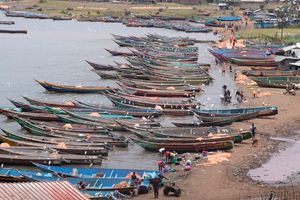
The sound that greets you at Kolunga Beach on Rusinga Island, Homa Bay County, is a sharp rhythmic hammering of wood.
It echoes along the shores of Lake Victoria, where the ancient art of boat making still thrives.
Here, master craftsmen transform raw timber into vessels that feed families, brave storms and keep the local economy afloat, preserving a generations-old craft against the changing tides of time.
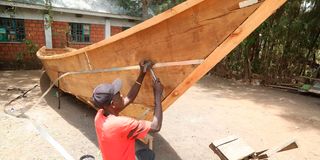
John Otieno is bent over the skeleton of a boat, his shirt soaked with sweat. Around him lie strips of rubber and galvanised iron sheets waiting to be fitted onto the wooden frame.
His task is simple, ensuring that no water finds its way into the boat his team is assembling.
Building a wooden fishing boat involves piecing together different sections of timber. Unlike metal vessels whose joints can be tightly sealed through welding, wooden boats have an inherent weakness: water can seep through the tiny spaces where pieces of wood meet.
“I ensure the space is tightly sealed by using rubber to cut off any water flow into the vessel. A thin piece of corrugated iron sheet is put on top of the rubber to make it firmly bonded to the wood,” Otieno says.
The painstaking process of nailing and sealing the hull to keep water out is among the most critical stages of assembly. Painting comes last and the job can be done by anyone.
At the beach, it is sometimes offered to women who walk to the boat assembly point looking for work.
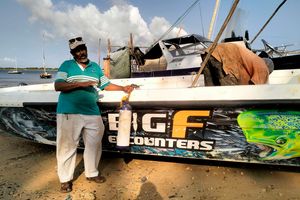
Fishing boats docked offshore at Litare Beach in Rusinga Island, Homa Bay.
Photo credit: File | Nation Media Group
But long before a boat reaches this stage, a complex chain of activity involving people from different countries is already under way.
Otieno says that whenever a new boat is needed, he calls sources in Uganda where he sources timber. Sometimes the wood comes from the Democratic Republic of Congo. The price of timber depends on its length.
“We normally buy 14 feet of timber at Sh10,000. There is another type that costs Sh7,000 for the same length. Two trees can be used to make one vessel,” he explains.
Nicholas Odhiambo is also part of the boat-making process. For years, the craftsman and his apprentices have built boats by hand, giving fishermen the means to venture into the lake in search of a livelihood.
“We help people build boats used for fishing. Fishermen buy them from us before using them in the lake,” he says.
“Young men come to learn. We have students who learn how to build boats here,” he explains.
About 145 kilometres away at Kenya Shipyard Limited (KSL) in Kisumu, a very different kind of craftsmanship is taking place.
There, staff from the Ministry of Defence are also involved in boat-making.
But instead of hammering nails into timber, they work quietly assembling Glass Reinforced Plastic (GRP) boats, commonly known as fibre boats.
The vessels are made from a strong composite material consisting of woven glass fibres combined with liquid plastic resin.
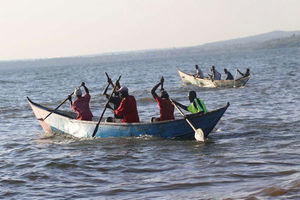
Fishermen on a fishing expedition near Rusinga Island in Homa Bay County.
Photo credit: George Odiwuor | Nation Media Group
The technology requires less physical labour than traditional boat building. More importantly, the vessels are considered safer, stronger and more durable.
Besides offering greater stability in rough waters, the boats are designed with environmental conservation in mind.
Each vessel is made from three resins, fibre and textile, eliminating reliance on wood in boat construction.
The shipyard’s management considers the vessels climate-smart artisanal boats, with an official at the agency saying the vessel was designed following research and development, taking into consideration the activities and conditions along both the coastal strip and lake regions.
KSL developed a boat that is safe, cost-effective and can be constructed within a short period.
During construction, several layers of fibre and resin are combined to form the bow of the boat.
Once cured, the layers form a thick, hard surface that remains lightweight while developing a high level of resistance comparable to steel. The construction also gives the boats greater buoyancy and strength.
The modern vessels are designed to enable fishermen to endure longer trips on the lake, with KSL hoping that fishermen and traders providing transport services on Lake Victoria will adopt them.
The cost of fibre boats varies depending on specifications such as length, horsepower and whether the vessel is fitted with a canopy.
Different boats are designed for different purposes, ranging from fishing to luxury cruising.
According to KSL Business Development Manager Edward Omol, the cost of a fibre boat can rise to Sh1 million.
Omol, however, defended the price, saying vessels from the agency can be insured and registered with the Kenya Maritime Authority, ensuring that owners are compensated in the event of an accident.
John Otieno assembles a fishing boat at Kolunga Beach in Rusinga Island in Homa Bay County on September 25, 2026. Kenya Shipyard Limited encourages fishermen in Lake Victoria to use vessels made from fibre as a means of discouraging deforestation. Wood used to make boats at the beach is sourced from Uganda.
Photo credit: George Odiwuor | Nation
“The benefits outweigh the costs. We encourage fishermen to join cooperative societies through which they can purchase the vessels,” Mr Omol said.
The agency is exploring ways of reducing the price to below Sh700,000, a figure Omol said would bring the cost closer to that of wooden vessels.
“We are lobbying for a waiver so that the cost of the vessel can come down. We look forward to a time when there will be a mass transition from wooden boats to GRP boats, just as it happened during the transition from bicycles to motorcycles when the cost was reduced,” he said.
But back at Kolunga Beach, the environmental argument has not been lost on the craftsmen.
In Homa Bay, forest cover stands at just 3.1 per cent and each wooden boat consumes one or two mature trees and lasts only about four years before it rots and is discarded.
Yet on the beaches of Rusinga, the craftsmen are not ready to let go.
Odhiambo says obtaining wood from within the county has become difficult because of restrictions imposed by the Kenya Forest Service.A wooden boat has the long plank at the bottom that forms the keel, the side planks and the top frame as the three main parts. Each person at the assembly yard has a specific role in putting the sections together.
Once the boat is assembled, it is pushed into the lake and put to work.
Depending on a fisherman’s pocket, they can choose a small vessel capable of carrying 300 kilogrammes or a larger one with a capacity of 800 kilogrammes.
Some of the timber supplied to them breaks when it is bent over the head of the vessel to form the bow.
“When it breaks, you have to get another timber to finish assembling the vessel,” he explains.
In Rusinga, fishermen and boat builders have heard about fibre boats. But to many of them, the vessels remain distant, expensive and unfamiliar.
He says he does not want to see fishermen operating as they did in the past, when people went fishing in unseaworthy vessels and sometimes found themselves caught up in accidents.
Wooden boats absorb water, become heavy and can eventually sink.
Fibre boats, meanwhile, have foam-filled benches that make them virtually unsinkable.
A wooden boat built at Kolunga Beach costs between Sh25,000 and Sh35,000 and can be completed within a week.