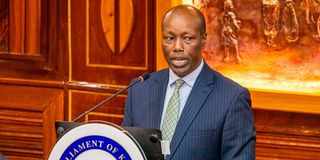
Trade Cabinet Secretary Lee Kinyanjui has revealed that the Sh23.5 billion county industrial parks programme was started without feasibility studies, and only relied on President William Ruto’s meetings with ‘mama mbogas’ and ‘hustlers’ demands during Kenya Kwanza’s 2022 manifesto process.
On Wednesday, Mr Kinyanjui appeared before the Senate and claimed that the meetings Dr Ruto held with sections of the electorate, before becoming President, were equivalent to public participation on what members of the public wanted.
In justifying the move, the Trade CS added that former President Mwai Kibaki also started the Free Primary Education (FPE) without a feasibility study and succeeded.
“I want to confirm that there may be no elaborate feasibility studies that were done …. Sometimes nations bury themselves in big terms like feasibility and spend all our time doing feasibility on what we already know,” said Mr Kinyanjui.
His admission comes as lawmakers argue that some of the industrial parks have been built where they are not needed, while governors reveal that some have cost over the initial Sh500 million per development.
Senators have warned that the multi-billion shillings projects risk becoming white elephants, as most do not represent value for money.
This is after Auditor-General Nancy Gathungu, in a report on the programme, laid bare the absence of value for money for wananchi.
“How can a project cost the same across 47 counties? The cost will be different. The conceptualisation should not have talked about absolute figures but should have just set the ceilings. Let us call it for what it is – the conceptualisation began on the wrong footing,” said Kitui Senator Enock Wambua.
Each devolved unit was required to allocate Sh250 million, and the national government, through the State Department for Industry, Sh250 million. This implies that the two levels of government were each to allocate Sh11.75 billion.
Murang’a Senator Joe Nyutu decried how the CAIPs structures are being rolled out even in areas where they are not needed.
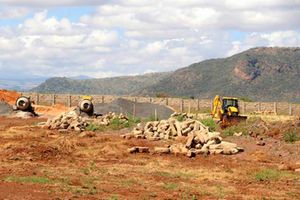
Uasin Gishu Senator Jackson Mandago said the rate of completion of the CAIPs is worrying, where the Senate Trade committee, during a recent visit to Kilifi County, found the contractor slashing the site.
“In my county, the project was procured above the recommended Sh500 million at Sh535 million, while the one in Wajir was procured at Sh601 million. So there are a lot of challenges.”
The revelations followed concerns raised by Busia Senator Okiya Omtatah on the lack of feasibility studies for the multibillion-shilling developments.
“My concern is that these CAIPs that have come up in several counties hardly have feasibility studies. I have not a single one. I have tried to get one for Busia, but there are none. I have also tried to get a spatial plan, but there is none, too,” said Mr Omtatah.
He said without such a study, it is difficult to gauge the viability of the projects, a critical step needed before public money is spent.
“Without a scientific study showing me the scope, what the project is going to do, and the ecosystem it is going to work in, it is hard to gauge the viability of the project. The ones in Ethiopia were not one-size-fits-all and had clear thematic areas and incentives,” he said.
The programme, marketed as one of President Ruto’s key job creation vehicles during and after the 2022 campaigns, was allocated Sh4.45 billion in the financial year ending June, 2026.
In the fiscal year ending June, 2025, the budget was Sh2 billion, but only Sh1 billion was disbursed. In the financial year ending June 2024, Sh1.15 billion was disbursed against a budget allocation of Sh4.5 billion.
In a past interview with the Nation , former Trade CS Moses Kuria said that some contractors had abandoned their construction sites.
Then Trade Moses Kuria (second right) with Siaya Governor James Orengo (second left) and Siaya Senator Oburu Oginga (right) as they are shown plans during the groundbreaking ceremony for the county aggregation and industrial park at Got Akara in Siaya on September 21, 2023.
Photo credit: File | Nation Media Group
Before the Senate, Mr Kinyanjui argued that the ‘mama mbogas’ and ‘hustlers’ that Dr Ruto met when the Kenya Kwanza coalition was crafting its manifesto demanded projects that would restore dignity in their work and markets.
“Is there unemployment? Yes. Do we need to create value and dignity to our people? Yes. And the people have spoken, and this is what we are trying to do. Therefore, to that extent, when he got into office, we could not have spent another three years doing feasibility studies.”
Phase one of the CAIPs project was to see 14 counties each get one of the developments. Phase two was to have 26 counties receive their aggregation and industrial parks, while phase three was to finish up in the remaining seven counties.
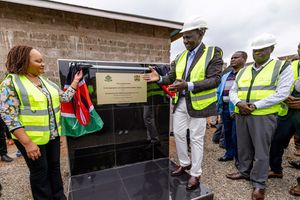
President William Ruto (second right) launches the Kirinyaga County Aggregation and Industrial Park in Sagana. On the left is Governor Anne Waiguru.
Photo credit: George Munene / Nation Media Group
Mr Kinyanjui alluded to a trial-and-error method, arguing that lessons picked from phase one of the programme will be implemented in subsequent phases.
“We agree they (the projects) are not perfect, but we are on a journey to perfecting them. That admission means that in our second batch, we will be able to correct where there was an omission,” said the minister.
“We don’t want to bury ourselves in too much jargon while our people are suffering by the roadside with their tomatoes and potatoes the whole day. I don’t think we need a feasibility study to confirm that potatoes or tomatoes will wither by the end of the day.”
Projected as one of Kenya Kwanza’s pet projects, pomp, colour and cutting-edge architectural designs dominated the groundbreaking for the first-ever CAIPs in Nasewa, Busia County, by the then Trade CS Moses Kuria more than two years ago.
Months before the launch, President Ruto had talked about the CAIPs programme, saying it is targeted at enhancing Kenya’s productivity as the country aims to prioritise consolidation, processing, and value addition of agricultural products.
The initiative was meant to drive value addition, reduce post-harvest losses by focusing primarily on the value chain, transport and logistics, storage, cold rooms and warehousing facilities.