On October 4, residents of Moto village in Molo woke up to a shocking incident after a Form student was found murdered in her family home.
The body of Joy Wangui, 18, a student at Molo Senior School, was found in the kitchen, while her severed head was discovered in the corridor near the bathroom.
An axe, a panga and two bloodstained knives were recovered at the scene and treated as possible weapons used in the killing.
Preliminary investigations established that the prime suspect was Joy’s boyfriend, who went into hiding after the killing.
The suspect, identified as Walter Kipkoech, 23, was arrested on October 6 at his hideout in Langwenda village, Kuresoi North, following a manhunt by detectives.
He was arrested by detectives from Molo alongside officers from the Crime Research and Intelligence Bureau (CRIB).
Joy Wangui, an 18-year-old Form Four candidate at Molo Senior School, was found decapitated inside her parents' kitchen by her brother, who returned from the family shop to find her lying in a pool of blood.
Photo credit: Pool
At the time of his arrest, Kipkoech was wearing a bloodstained pair of boxer shorts, a white T-shirt bearing the deceased’s name at the bottom, and black jeans with visible dried bloodstains.
He was later arraigned before a Molo court, where detectives filed a miscellaneous application seeking more time to detain him as they completed investigations into the killing.
The prosecution told the court that it needed time to conduct DNA tests on evidence recovered from the scene, carry out a postmortem examination on the deceased’s body and subject the suspect to a mental assessment. It also sought permission to conduct a forensic examination of his electronic devices.
The court granted the detectives 21 days, with the suspect expected to appear in court on October 27 for plea-taking.
Wangui’s murder has added to the reported cases of women and girls being killed in Nakuru County, with at least six cases reported this year alone. A total of 418 intimate partner violence cases were recorded across the county.
On August 23, a Grade Nine pupil went missing shortly after leaving her home in Gilgil, Nakuru County. Her body was later discovered in a thicket.
Grace Ngarua, 14, a pupil at Echareria Primary School in Mbaruk Ward, was found by residents in a thicket along the railway line.
A suspect was arrested at his hideout on September 3 and later arraigned before a Naivasha court, where detectives sought more time to detain him as they completed investigations.
The detectives were granted 30 days to collect DNA samples from the suspect for further examination.
Anita Mugweru who was brutally murdered at her house in Upper Hill Estate in Nakuru County on April 16, 2026.
Photo credit: Boniface Mwangi | Nation Media Group
Gilgil Sub-county Directorate of Criminal Investigations head Joseph Parsiat said detectives were still pursuing other suspects in connection with the incident.
“The suspect was arraigned in court on October 12 after the lapse of 30 days which we had initially been given, he was released on bail. We are waiting for DNA results which we had forwarded to the government chemist for analysis,” Mr Parsiat said.
On April 14, a Kenya Defence Forces (KDF) officer allegedly killed his wife in the presence of their four-year-old daughter following a confrontation at their home in St Mary’s Estate, Nakuru Town East Sub-county.
The victim, Anita Mugweru, later succumbed to her injuries while receiving treatment at a hospital in Nakuru.
The suspect, Captain Edwin Kaunga Muthomi, is alleged to have stabbed Anita following a domestic altercation. He was later arrested and arraigned before a court, where detectives were granted 13 days to detain him as they completed investigations.
On April 28, Muthomi appeared before Nakuru High Court Judge Patricia Gichohi for plea-taking. However, the proceedings were halted after the court ruled that medical findings indicated he was not in a stable mental state to plead to the charges.
Following a psychiatric assessment that found him unfit to stand trial, the court ordered that he be committed to Mathari National Teaching and Referral Hospital for treatment.
A week before Anita’s murder, 42-year-old Mary Njoki Mburu was found dead in her home in Kabatini, Bahati Sub-county.
Her partner, Paul Ndungu, had initially reported to Bahati Police Station, claiming he had been assaulted by Njoki. However, when police visited the scene, they found her dead.
According to police, the couple had allegedly quarrelled the previous night after the suspect reportedly found Njoki with another man.
Jackline Awuor, a 30-year-old security guard from Nakuru, was killed and beheaded.
Photo credit: Pool
On March 29, another woman, 30-year-old Jackline Awuor, a security guard, was allegedly murdered by her lover, Evans Abutu, 35, before he fled.
Her body was discovered in a quarry after she failed to report to work, prompting colleagues and family members to search for her.
Police later tracked down Abutu to Kakamega County, where he was arrested and returned to Nakuru. He reportedly led officers to the locations where he had dumped the victim’s head and the suspected murder weapon.
According to data from the Department of Gender, Social Services and Inclusivity covering September 2025 to August 2026, Nakuru East accounted for more than half of the intimate partner violence survivors recorded across Nakuru County.
Nakuru East recorded 219 of the county’s 418 intimate partner violence survivors. It also recorded the highest number of survivors who received trauma counselling and psychological support, with 1,069 cases out of the 2,012 recorded across the county during the period.
Naivasha recorded the highest number of survivors of sexual and gender-based violence, at 394, followed by Nakuru East with 350, Nakuru West with 273 and Molo with 194.
In neighbouring Nyandarua County, eight-year-old Tabitha disappeared in January while on her way home from school. Her body was later discovered on a farm.
The body of the Grade Two pupil at Ol Joro Orok Primary School in Ol Joro Orok Constituency was found after hours of searching when she failed to return home from school.
Tabitha’s father, Johanna Macharia, recalled the incident, saying the family had yet to recover from the loss.
“My daughter’s body was covered by leaves in a thicket; her jacket was also removed and was used to cover her body. I got closer and discovered the body was lifeless, her hands tied behind her back,” he said before becoming emotional and cutting short the interview.
The incident occurred less than two weeks after two other minors were sexually assaulted and attacked in the Kasuku area of the same constituency. The two were admitted to JM Memorial Hospital for several days.
Nyandarua County Commissioner Abdirisack Jaldesa said cases of killings of women and girls had reduced significantly following a multisectoral approach involving the Church, security agencies, village elders and the Office of the Woman Representative.
“We introduced a special team to investigate the incidents; the team fast-tracked the investigations, and all the suspects were timely arrested and charged in court. We also enhanced and fully supported gender desks in all our police stations,” the county commissioner said.
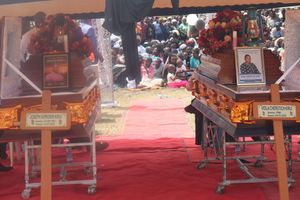
The headrest of a coffin containing the remains of Viola Cherotich Kirui, a primary school teacher in Bomet who was allegedly murdered by her husband, who subsequently took his own life. This photo was taken during the funeral service at Segerot village in the Kyogong location of Bomet County on October 13, 2026.
Photo credit: Vitalis Kimutai | Nation
In Bomet, the latest case involved primary school teacher Viola Cherotich Kirui, who was allegedly murdered by her husband, Joseph Kirui, who died shortly afterwards in an apparent suicide at Segerot village, Kyogong Location, Chepalungu Constituency, Bomet County, on October 8.
The incident shocked family members and residents, who said the couple had been seen together earlier that day in a jovial mood.
In the past six months, 40 cases have been reported in Bomet County, 26 of them involving direct threats to kill victims if they reported the abuse they had experienced.
Gender-based violence prevalence stands at 44.4 per cent, while defilement accounts for 34.9 per cent and murder for 11.1 per cent, according to statistics presented to Chief Justice Martha Koome when she launched the Alternative Justice System (AJS) Action Plan in Bomet County in August.
Justice Koome called for an end to gender-based violence, some cases of which have resulted in the killing of women and girls.
Counselling psychologist Faith Queen Chebet said femicide cases were often linked to unresolved disputes between couples.
“Cases of mental health challenges and mismanagement of emotional stress are some of the triggers of the high cases of femicide reported, with arrests and prosecution only masking the deeper issues affecting families,” Ms Chebet said.
Interior Cabinet Secretary Kipchumba Murkomen during the Mashujaa Day Champions Edition Breakfast Launch, attended by Governors, National Assembly Legislators, and Members of County Assembly from Nandi, Elgeyo Marakwet and Uasin Gishu counties, at EKA hotel in Eldoret City, Uasin Gishu County on September 20, 2026.
Photo credit: Jared Nyataya | Nation
Interior Cabinet Secretary Kipchumba Murkomen has acknowledged that femicide cases were becoming increasingly serious in the region.
Speaking in Bomet last month, Mr Murkomen said: “Families should not force couples to stay together if the issues keep arising or if the differences are irreconcilable. It is better to live separately than to be part of the statistics of death people in the society, in what could be avoided.”
Meanwhile, police in Kericho are investigating the murder of 40-year-old teacher Martina Chepkemoi Ruto, who was killed on August 26 by people suspected to have been known to her.
The former teacher at Lalagin Secondary School in Bureti, Kericho County, was found unconscious at Kimugu River with five stab wounds. She was taken to Kericho County Referral Hospital by police but was pronounced dead on arrival.
“Prior to her death, she had been reported missing, but the family did not identify the body until a week later, at the Kericho County Referral hospital mortuary,” said Kennedy Apindi, the Kericho East Sub-county Directorate of Criminal Investigations head.
The body of Martina Chepkemoi was found at the Kericho County Referral Hospital mortuary.
Photo credit: Pool
No one has been arrested in connection with the incident, and investigations are ongoing.
On January 10, 2025, President William Ruto appointed a 42-member task force to address the rise in femicide and gender-based violence (GBV).
The team, led by former Chief Justice Nancy Barasa, was mandated to assess the situation and recommend measures to strengthen the institutional, legal and policy response to GBV and femicide.
The Technical Working Group on GBV and Femicide in Kenya presented its report to President Ruto on January 26, 2026, recommending a range of policy and legal reforms, alongside other interventions, to address the problem.
The task force’s report highlighted serious legal and systemic failures hindering efforts to combat GBV and femicide.
For instance, the report says Kenya lacks a clear legal definition of femicide. This, it says, has led to inconsistent handling of cases and an inability to collect meaningful data for prevention, response and accountability.
Kenya’s Penal Code, Cap 63, criminalises murder but does not recognise femicide as a distinct form of gender-based violence.
“This gap limits the prevention, which fails to address structural causes of gender-based killings, including intimate partner violence and related abuse,” the report says.
The absence of a specific femicide law, or formal recognition of femicide as a distinct crime, is a gap compared with jurisdictions such as Mexico and Cyprus, where femicide is explicitly recognised and addressed.
The report says these gaps have subjected GBV survivors to retraumatising justice processes and uncoordinated, trauma-insensitive services, with frontline responders lacking appropriate training.
“Harmful cultural practices, including early childhood marriage, widow cleansing and beading, continue unabated, often rationalised as cultural rites despite years of awareness campaigns,” it says.
The report also says families and community actors often obstruct justice by resolving GBV and femicide cases informally through clan elders or traditional systems.
These processes frequently involve coercion, victim-blaming and the silencing of survivors, especially where bride price, family honour or kinship ties are involved, the report says.
According to the report, such practices have undermined formal legal processes and perpetuated impunity.
The Barasa-led task force recommended a range of interventions, including legal and policy reforms and the creation of community accountability mechanisms. Under the proposed framework, marital rape would be declared an offence under the Sexual Offences Act (Cap 63A).
The task force also proposed amending the Sexual Offences Act to criminalise femicide, setting a six-month timeline for the hearing and determination of GBV cases, and requiring mandatory compensation for survivors.
If adopted, the recommendations would introduce a national sex offender registry and a notification system for repeat GBV offenders, accessible to the public. Those found participating in family- or clan-led settlements or coercing survivors to withdraw complaints would face prosecution.
To address technology-facilitated gender-based violence (TFGBV), the task force recommended criminalising revenge porn, sextortion, doxing and cyber harassment with sexual intent.
The report also advocated stronger workplace sexual harassment policies and called on the Teachers Service Commission to track the implementation of disciplinary measures against people convicted of GBV.
Lawyer Steve Kabita said combating femicide required a holistic approach combining legal and policy reform, economic empowerment, stronger institutions and cultural change.
“To tame femicide we need to look at the problem in a holistic nature, including social triggers of femicide; we need to have cultural changes, for instance, to avoid FGM, economic vulnerability among others,” Mr Kabita said.
According to data from the State Department for Gender and Affirmative Action and the National Police Service, a woman is killed every day in Kenya in cases classified as femicide.
Between 2022 and 2024, police documented 1,639 female murders across the country, including 579 cases in 2024 alone and 129 in the first quarter of 2025.
The data indicate that current or former intimate partners, including husbands and boyfriends, account for the vast majority of perpetrators. Strangers account for roughly 22 per cent of cases.
The data also show that about 70 per cent of femicide incidents occur in homes or other private domestic spaces, making these environments a major site of risk for women and girls.
Women and young adults aged 18 to 44 make up the largest group of victims, according to the data.
Nairobi, Nakuru, Kiambu and Meru are among the counties that have recorded the highest numbers of reported femicide and gender-based violence cases over the past four years, according to the data.
Kenya Demographic and Health Survey (KDHS) data cited in Gender Ministry reports show that 34 per cent of women, compared with 27 per cent of men, have experienced physical violence since the age of 15. The data also show that 13 per cent of women have experienced sexual violence.
“Femicide should be declared a national crisis in Kenya. The government through the Ministry of Gender should institute legal reforms first to recognise femicide as a standalone offence and also to ensure faster handling of GBV and femicide cases, as well as enhance public awareness campaigns against the vice,” said George Morara, the Executive Director of Amnesty International Kenya.
Report by Mercy Koskei, Waikwa Maina, Eric Matara and Vitalis Kimutai