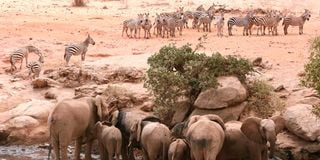
A fresh standoff is brewing between the Kenya Wildlife Service (KWS) and a section of Kajiado County leaders over the ongoing fencing of Tsavo West and Chyulu National Parks.
The leaders argue that the move could undermine wildlife conservation efforts and disrupt critical migration corridors, barely a month before Kajiado County formally takes over the management of Amboseli National Park under a landmark revenue-sharing agreement with the national government.
The dispute comes at a crucial moment for wildlife management in the region. On November 8, 2025, President William Ruto officially handed over the management of Amboseli National Park from the KWS to the Kajiado County Government under a 50:50 revenue-sharing arrangement, paving the way for the county to boost its own-source revenue by at least Sh300 million annually while enhancing community participation in conservation.
The Deed of Transfer seen by the Nation sets out key modalities of the transition, with the revenue-sharing arrangement taking center stage. The transferred park will be run by a semi-autonomous government agency, with the revenue-sharing framework to be implemented over three years.
The move was intended to empower local communities, promote sustainable stewardship, and ensure equitable sharing of ecological and economic benefits.
President William Ruto handing over Amboseli National Park management to Kajiado Governor Joseph Lenku on November 8, 2025.The park is to be managed by County government under revenue sharing formula with the National government.
Photo credit: Stanley Ngotho | Nation Media Group
The County Government and the National Government will begin sharing revenue in the forthcoming 2026/2027 financial year. However, the much-anticipated arrangement faces headwinds, with local leaders opposing the ongoing fencing of both Tsavo West and Chyulu National Parks, which extend into sections of Kajiado County.
According to KWS, the multi-million-shilling electric fencing around the two parks is critical to curbing human-wildlife conflict (HWC) and protecting local communities. The vast 49,611-square-kilometre Tsavo ecosystem hosts nearly 40 per cent of Kenya's elephant population.
Kajiado Governor Joseph Ole Lenku, who first broached the idea of handing over Amboseli National Park to county governments together with his Narok and Samburu counterparts in 2024, argues that fencing the two parks will not only interfere with migration corridors but also undermine the county's management of Amboseli National Park.
"After President Ruto handed over the management of Amboseli National Park to the county government, in the spirit of conservation, locals set aside a million acres of their community land as wildlife roaming spaces and migration corridors," said Governor Lenku.
"Fencing both Tsavo and Chyulu means hundreds of animals will be locked out from the parks into community land, further escalating conflict and, as a ripple effect, reducing tourist numbers and ultimately lowering returns."
He added: "The Amboseli ecosystem provides unique migration corridors for animals to roam freely across Chyulu, Tsavo West and Mt Kilimanjaro National Park. We know legally parks should be fenced, but our ecosystem presents unique challenges. Fencing the two parks means cutting off animals from Amboseli Park."
Amboseli National Park covers an area of 392 square kilometres, which is relatively small to sustain large wildlife populations, especially elephants with extensive migratory ranges. As a result, animals frequently roam through community and private lands.
Owing to shrinking grazing land and increased farming activities along migration corridors, human-wildlife conflict has intensified over the last five years, with lions and elephants bearing the greatest burden.
For instance, on January 7, 2026, six lions and 32 vultures were poisoned in the Amboseli ecosystem along the Kenya-Tanzania border in Kitenden Conservancy at a time when human-wildlife conflict had intensified due to shortages of pasture and water caused by the prevailing drought.
Kajiado Senator Samuel Seki has cautioned KWS to handle the sensitive matter carefully to safeguard both wildlife and communities that continue to bear the scars of human-wildlife conflict.
"The hardline position by KWS over the fencing might be counterproductive. Let KWS address the pertinent issues being raised by herders, who have coexisted with wildlife for years, with the urgency they deserve. They (herders) are opposed to the park fencing," said Senator Seki.
"Over the years, wild animals have roamed in both private and community lands. The fencing is not in good faith. There was no public participation. If KWS will not hear our cry, we will resort to killing the animals to protect ourselves and our property from roaming wildlife," said Kajiado South MP Samuel Parashina.
Mr Parashina told the Nation that he had been called by KWS Director-General Prof Erustus Kanga, who promised to temporarily halt the ongoing fencing to pave the way for dialogue. Public protests that had been scheduled for May 29 2026 were called off at the eleventh hour to create room for dialogue.
Mr Elijah Simel, a herder from Kuku Ward faulted the fencing project, saying it would lock animals out of the parks while leaving hundreds of others stranded on community and private land.
"It's a give-and-take relationship or nothing. We have coexisted with wild animals for years. Why fence the park now?" wondered Simel.
KWS head of communication Duncan Juma said the proposed fencing was not meant to block the existing the migration corridors saying the locals could have been misinformed.
Chyulu Hills where Shetani lava flow starts from in Tsavo West National Park. Photo | Pool
"As a conservation body we cannot block the existing wildlife corridors. We want to ensure the locals their grievances will be addressed to solve the stalemate but It’s illegal for herders to graze in the park,” said Juma.
However, KWS game wardens deployed at Tsavo National Park, speaking on condition of anonymity due to the sensitivity of the matter, told the Nation that strong resistance from local communities had forced park management back to the drawing board.
"Locals are a major pillar of wildlife conservation in this region. Such resistance is detrimental to tourism. No visitor will be willing to visit a hostile community."
The Kenya Wildlife Service is projecting its internal revenues from national parks to reach a record Sh11 billion to Sh12 billion ($85 million to $93 million) during the 2025/2026 financial year. This represents steady growth from the previous Sh7.6 billion, attributed to automation and upgraded facilities.