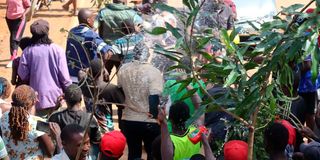
Three people were killed and six others injured on Thursday after police clashed with artisanal miners protesting against a mining firm at Isulu market in Kakamega County.
Western Regional Police Commander Issa Mahmoud confirmed that among the injured were two police officers—a man and a woman.
The confrontation erupted as miners opposed a government move to grant Shanta Gold Limited a mining licence covering sections of Ikolomani. The artisanal miners, who rely heavily on small-scale gold extraction, protested attempts to evict them from the gold-rich zone to pave the way for the multinational investor.
During the chaos, three people were shot dead, while several journalists, including NTV correspondent William Maina, sustained injuries. Some journalists had their equipment and mobile phones damaged or stolen after being attacked by a group of rowdy miners.
A public engagement forum involving locals, police, the National Environment Management Authority (Nema), the Ministry of Mining and the investor had just begun when it was violently disrupted. Witnesses said youths armed with wooden batons arrived in four Nissan matatus and stormed the meeting and began assaulting attendees as residents fled for safety.
When calm returned, three bodies lay on the ground, several people were injured and property of unknown value—including chairs—had been destroyed.
Tensions have been rising for weeks as locals voiced strong opposition to Shanta Gold's entry into Kakamega. Residents of Ikolomani have repeatedly staged protests vowing not to surrender their ancestral land amid fears of displacement and loss of livelihood.
Shanta Gold plans to set up a multi-billion-shilling mining operation in Isulu and Bushiangala, projected to run for eight years and produce an estimated 36,000 kilograms of high-grade gold worth Sh683 billion. The government, however, has said the Kakamega licence is still under review, with another public participation forum scheduled for today as part of the Nema certification process.
Similar resistance has emerged in Siaya County where residents of seven villages affected by the Ramula–Mwibona gold mine project have rejected the proposed operation, despite the government issuing Shanta Gold a licence.
A report released by Water, Irrigation, Environment, Climate Change and Natural Resources Executive Prof Jacqueline Oduol—read on her behalf by County Environment Compliance Officer Caroline Mboga—said the community remained dissatisfied with unresolved issues raised during the April 2, 2025 Nema public hearing.
“This resistance stems from unclear land compensation information, an incomplete Resettlement Action Plan (RAP), and concerns regarding environmental risks including air, water, noise, and land pollution,” the report stated.
Residents also questioned what they termed a hurried approval of Shanta’s Environmental and Social Impact Assessment (ESIA) despite “gaps in the decommissioning and mine closure plan and inadequate provisions for long-term environmental protection.”
The Ramula–Mwibona project will cover about 1,154 acres and require the relocation of an estimated 1,560 households—roughly 5,500 people—from seven villages in Siaya and two in Vihiga. Villages affected include Sianda A and B, Naya A and B and Eshitimi. While Siaya residents strongly oppose the project, their counterparts in Vihiga have welcomed it.
On Wednesday, the Ministry of Mining, Blue Economy and Maritime Affairs confirmed that Shanta Gold had been granted approval to begin mining in Siaya and Vihiga. Principal Secretary for Mining Harry Kimtai said the Mineral Rights Board issued the licence after Nema approved the impact assessemtn.
“As government, both at the national and county levels, we have a responsibility to provide a good enabling environment for investors,” Mr Kimtai said during a stakeholders’ workshop in Kisumu.
To guide the project’s rollout, the PS announced the formation of a joint county project committee for Siaya and Vihiga. The committee will oversee compensation and coordinate the mining venture.
“We want to allay fears from the public who think they might not be compensated. The government is behind this project, and compensation will be done adequately,” he said.
Mr Kimtai instructed Shanta Gold to ensure all affected families are compensated before mining starts in June 2026. Compensation will follow existing revenue-sharing frameworks: communities will get 10 per cent of mining royalties and one per cent of gross sales, county governments 20 per cent, and the National Treasury 70 per cent.
Jiten Divecha, Shanta Kenya General Manager, said the company will offer affected property owners a choice between a cash payout and land-for-land compensation, including replacement of housing structures.
The West Kenya Project—including the Ramula and Isulu–Bushiangala deposits—is estimated to contain more than 400,000 ounces of gold.
Public hearings for the Ramula–Mwibona project were held in April and May, with communities and civil society groups raising concerns about displacement, compensation, and environmental impacts. Approval of the project comes amid rising regional tensions over mining activities.