Students in public universities have borne the brunt of the two-week strike by universities staff that may now enter a third as lecturers on Thursday said they will not relent in their demands for better pay.
The students remain untaught and idle on campuses. They have complained of incurring living expenses and uncertainty over the dispute, calling on parties to resolve the matter.
“Even when lecturers are on strike, we still have financial obligations. The money we budget for when the semester is in session continues to be spent, and when learning resumes and the semester is extended, our financial needs become even more constrained,” said Remmy Osoti, a fourth-year student at Multimedia University.
The lecturers warned the government against imposing a return-to-work deal, vowing to sustain their nationwide strike after negotiations collapsed on Monday, with the dispute showing no sign of ending.
The staff unions have maintained that they will not accept terms imposed on them, insisting that any agreement must be negotiated and mutually agreed upon as the strike disrupts learning in public universities.
The strike has brought renewed attention to the challenges facing public universities, with the unions arguing that inadequate staffing and funding have undermined the quality of higher education.
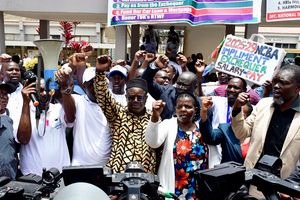
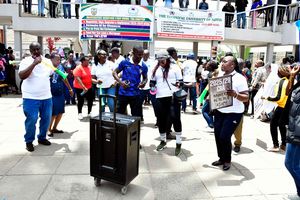
University Academic Staff Union’s Secretary General for the University of Eldoret Chapter, Dr Nyaberi Mogaka accompanied by Kenya University Staff Union officials at the university, other officials and members, during the launch of the nationwide lecturers' strike on October 02, 2026.
Photo credit: Jared Nyataya | Nation
“The government’s counter-offer is awfully inadequate, and we have rejected it. We will not relent. We will continue with this strike until next year if that is what it takes, until the money is in our pockets. You cannot impose terms on us. We are the ones who are supposed to sit at the negotiating table, and any agreement must be negotiated, not imposed on us,” said Universities Academic Staff Union (Uasu) Secretary General Dr Constantine Wasonga.
The union has rejected the government’s Sh12 billion counter-offer for partial payment, accusing the Salaries and Remuneration Commission (SRC) of giving misleading advice and frustrating negotiations.
Uasu is also demanding full payment of Sh7.9 billion in salary arrears accumulated under previous CBAs, including the 2017–2021 agreement.
Dr Wasonga said universities were struggling to meet the needs of a student population estimated at about 700,000 because of a shortage of academic staff.
“Universities are grossly understaffed, and this is affecting their ability to provide quality education to students. There are approximately 700,000 university students, yet the country has about 10,000 lecturers, of whom 1,000 are in administration. This leaves only 9,000 lecturers to teach and support the students, which is not sufficient to meet their needs,” said Dr Wasonga.
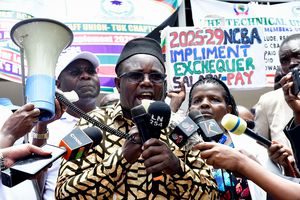
Universities Academic Staff Union (UASU) Secretary-General Dr Constantine Wasonga speaks during a press briefing at the union headquarters in Nairobi on September 24, 2026.
Photo credit: Bonface Bogita | Nation
The union wants the government to recruit additional academic staff, saying universities cannot adequately serve students while operating with insufficient lecturers. It is also pushing for part-time lecturers to be absorbed into permanent employment and for their remuneration to be negotiated to prevent exploitation.
“We want to negotiate rates for part-time lecturers, from certificate, diploma to degree. We don't want exploitation,” he said.
The lecturers are further demanding negotiations on workload, including how the 40-hour working week should be distributed among teaching, research and other academic responsibilities.
“We are going to negotiate workload. You will not impose workload on us,” he said.
Research funding is another issue the union wants addressed, arguing that lecturers should not be expected to finance academic research from their personal resources.
Why lecturers and university staff are on strike again
“You cannot expect lecturers to conduct research using their own money,” the official said.
The union called for dedicated government allocations for research, saying adequate funding would enable academic staff to undertake studies and contribute to knowledge development.
It also wants the government to provide funding for staff promotions and recruitment, arguing that lecturers should not remain in the same job grades indefinitely because of financial constraints.
“We are not going to stagnate in one grade forever,”
The union also wants the harmonisation of allowances, an issue the official said had featured in previous negotiations but remained unresolved.
Dr Wasonga accused the government of failing to make sufficient progress on the matter, warning that continued delays would make it harder to resolve the industrial dispute.
“We want the government to harmonise the allowances. We are not asking for anything out of the ordinary; all these issues are documented. However, when we went to the negotiating table in 2025, the government was unwilling to harmonise the allowances,” he said.
The three unions had submitted their proposals for the 2025–2029 CBA early last year, with Uasu submitting its demands on February 3, 2025, Kusu on February 13 and Kudheiha on March 5. The negotiations were conducted through IPUCCF under the Labour Relations Act and SRC guidelines on collective bargaining in the public service.
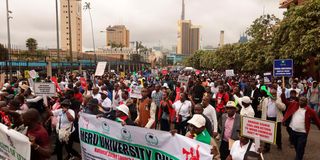
Universities Academic Staff Union (UASU) lecturers and staff participating in a demonstration in Nairobi streets on October 15, 2026 protesting the failure by the Government to implement the 2025–2029 Collective Bargaining Agreement (CBA).
Photo credit: Evans Habil | Nation
At the heart of the disagreement is the amount by which salaries should be reviewed during the four-year CBA period.
Uasu proposed basic salary increases ranging between 36 per cent and 68 per cent, depending on the grade. It also sought a 57 per cent increase in house allowance, a commuter allowance of up to Sh60,000 for grades 14A and 15A, and a Sh80,000 professorial allowance.
The union further proposed annual book allowances ranging from Sh65,000 to Sh90,000, depending on grade, annual leave allowances of between Sh50,000 and Sh70,000, and passage and baggage allowances ranging from Sh30,000 to Sh70,000. It also sought medical, dental and optical cover.
“Universities cannot negotiate on behalf of us. Allow us to negotiate. We want SRC to take our demand proposal, also get the recommendations from the employer, and then arrive at independent advice,” said Dr Wasonga.
“When you come up with a global figure which is final, what do you want us to do? Accept the figure? We are not allowed that. Allow us to negotiate,” he added
The employers’ position was considerably lower. The IPUCCF considered three possible salary scenarios: a two per cent increase across the board, which would result in an 8.25 per cent cumulative increase over the CBA period; a two per cent increase for grades 11–15 and three per cent for grades 1–10; and a three per cent increase across all grades, which would result in a cumulative 12.56 per cent increase.
“What do you mean by collective bargaining agreement? We agree collectively. But now, when a party comes with a final decision and you have already arrived at the figure of Sh9.76 billion, what do you expect from us? You want us to sign what you negotiated yourselves. You need to involve us,” said Dr Wasonga.