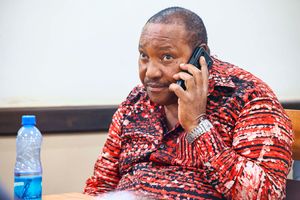
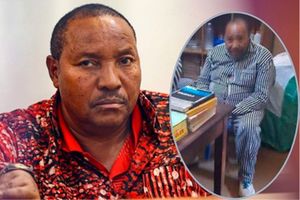
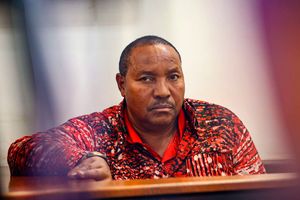
Former Kiambu Governor Ferdinand Waititu has suffered another setback after the High Court upheld his conviction and sentence in the Sh588 million corruption case.
His wife, Susan Wangari, and two co-accused were also dealt a blow after the court overturned their acquittals on money laundering charges.
The decision means Waititu returns to prison to continue serving the 12-year jail term imposed on him by a Milimani anti-corruption court.
Justice Rose Ougo dismissed appeals by Waititu and his co-accused, Charles Chege and Luka Mwahiya, upholding their convictions over the irregular procurement of road works in Kiambu County.
The judge also upheld the trial court’s order barring the convicted persons from holding public office for ten years.
Justice Ougo ruled that the prosecution had proved that the convicts were involved in the fraudulent award of the multimillion-shilling road contract.
Waititu was found guilty of corruptly receiving Sh25 million from Enterprise Testimony Limited, a company that had been awarded the Sh588 million contract by the county government.
Former Kiambu Governor Ferdinand Waititu (Centre) with co-accused Eng. Luka Mwangi(left) being escorted to Milimani Law Courts cells on March 26, 2025.
Photo credit: Billy Ogada| Nation Media Group
The judge dismissed Waititu’s appeal and allowed the State’s cross-appeal against the acquittal of Wangari and two other co-accused on money laundering charges.
The court set aside the acquittals and entered convictions against them, directing that they be returned to the Milimani Anti-Corruption Chief Magistrate’s Court for mitigation and sentencing.
The court further ordered Wangari to be remanded at Lang’ata Women’s Prison, while Chege and Mwahiya were directed to return to prison to continue serving their sentences.
The four were ordered to appear before the trial court on Monday next week for mitigation and sentencing on the money laundering charges.
Justice Ougo ruled that the fines and custodial sentences imposed by the trial court were lawful, dismissing the accused persons’ challenges to the penalties.
“The fines imposed by the court under the Anti-Corruption and Economic Crimes Act, being mandatory fines, were properly imposed,” the judge ruled.
The court said the law provides for additional mandatory fines calculated based on the financial benefit obtained from an offence or the loss suffered as a result of the criminal conduct.
Waititu had challenged the fines and prison terms imposed on him, arguing that the default imprisonment terms were unlawful.
However, Justice Ougo said an appellate court could interfere with a sentence only under specific circumstances, such as when it was illegal, based on erroneous legal principles, or manifestly excessive or inadequate.
On the money laundering charges, the judge said the matter had to return to the Chief Magistrate’s Court for sentencing because the High Court was not exercising original sentencing jurisdiction over those counts.
“The acquittals are set aside,” Justice Ougo ruled, before entering convictions against the accused persons on the respective money laundering counts.
She further directed that the sentences imposed on the money laundering charges run concurrently with those already imposed under the Anti-Corruption and Economic Crimes Act.
The ruling comes months after Waititu secured temporary freedom in February 2026, having spent months in custody over his failure to furnish a bank guarantee equivalent to the fine imposed on him.
The former governor was sentenced to 12 years in prison, with an alternative fine of Sh53 million, after being convicted of corruption on February 14, 2025.
The anti-corruption court found that he had corruptly received Sh25 million from Enterprise Testimony Limited in connection with the Sh588 million road tender awarded by the Kiambu County Government.
Waititu had made several unsuccessful attempts to secure his release on bond before his lawyers returned to court in January 2026 seeking a review of the conditions.
His legal team argued that, despite reasonable efforts, he had been unable to obtain the required bank guarantee, leaving his release dependent on an arrangement he could not meet.
As an alternative, Waititu proposed a Sh20 million cash bail or property-backed security.
His sister, Esther Njoki Waititu, also swore an affidavit stating that she owned land valued at Sh55 million and was willing to offer it as security for his release.
In a subsequent review of its earlier orders, the court considered his application in light of his reported deteriorating health and the demands placed on the Kenya Prisons Service by his continued admission to Kenyatta National Hospital.
Waititu had cited diabetes, hypertension, failing eyesight and serious kidney complications, for which he had undergone several surgeries.
He also maintained that his appeal had a high chance of success, arguing that the prosecution had failed to demonstrate that the Kiambu County Government suffered any financial loss.
His lawyers further claimed that the case was driven by unfounded public theories and politically motivated negative perceptions of their client.