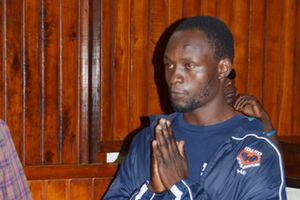
Can a murder conviction stand where the cause of death has never been conclusively established?
That is the question Robert Waliaula Kinisu wants the Court of Appeal to determine as he seeks to overturn the life sentence imposed on him for the murder of Mtwapa businesswoman Jacqueline Ngina Kitheka.
Waliaula was convicted of killing Jacqueline between May 3 and 6, 2021, at the Marina area within Mtwapa Township in Kilifi County. According to evidence presented by the prosecution, he killed the businesswoman, stuffed her body into a wardrobe and quietly walked away.
Jacqueline Ngina Kitheka whose body was found stuffed in a wardrobe at her home in Mtwapa, Kilifi County, in May 2021.
Photo credit: Brian Ocharo I Nation Media Group
As if the killing was not enough, he is also disposed of some of her household items, selling them to a shylock in a move that later provided investigators with a crucial lead that helped unravel the crime.
The evidence eventually led to his conviction and life sentence, and he is currently serving his term at Shimo la Tewa Prison. However, barely four months after his incarceration, Waliaula has returned to court, challenging both his conviction and sentence.
In sentencing, the court described the offence as deliberate and cruel, taking into account victim impact statements and a pre-sentence report that portrayed Waliaula as unremorseful and dangerous to society.
The court also noted his previous criminal history, recalling that in 2016 he had been linked to the violent robbery and killing of Mombasa based model Janet Adhiambo Asuna. In that case, he was initially convicted and sentenced to death by a magistrate’s court but was later acquitted on appeal by the High Court in 2019 after serving one year in prison.
The late Janet Adhiambo Asuna.
Photo credit: File
His current appeal marks his second attempt to overturn a conviction, following the earlier success in appealing against a magistrate’s court decision that had sentenced him to death before his eventual acquittal by the High Court.
In appeal documents filed before the Court of Appeal, he is asking the judges to determine whether a person can lawfully be convicted of murder where the cause of death has not been conclusively established.
He argues that the High Court erred in law and fact by convicting and sentencing him to life imprisonment despite what he terms as the prosecution’s failure to prove the cause of Ms Kitheka’s death.
“The learned trial judge erred in law and fact by failing to consider that the cause of death was not established,” Waliaula states in his appeal.
An analyst from the Government Chemist who testified during the trial told the court that tests conducted on the deceased’s organs revealed no toxic substances.
A pathologist further testified that the cause of death could not be anatomically determined due to the advanced state of decomposition.
During the trial, Waliaula maintained that without proof of the exact cause of death, the prosecution had failed to prove beyond reasonable doubt that he was responsible for the killing.
In his memorandum of appeal, he further argues that the trial judge erred in both law and fact by relying on a prosecution case founded entirely on circumstantial evidence that was not supported by proven facts.
He contends that the court failed to properly consider doubts surrounding the recovery of items allegedly linked to the offence, insisting that no cogent evidence was adduced to connect him to the recovered property.
The convict also maintains that the prosecution’s case was sketchy and riddled with material contradictions, which in his view, weakened the credibility of the evidence presented against him.
Waliaula faults the trial court for allegedly relying on matters that were not canvassed by prosecution witnesses during the hearing. He further argues that the prosecution failed to prove its case beyond reasonable doubt and that the trial judge failed to adequately consider his defence before arriving at a conviction.
Consequently, he has urged the Court of Appeal to allow the appeal, quash the conviction and set aside the sentence imposed by the High Court.
Robert Waliaula Kinisu in court when he was charged with robbery with violence on August 3, 2016.
Photo credit: File | Nation Media Group
His conviction for the murder of Ms Kitheka was anchored on a chain of circumstantial evidence that the High Court found compelling, despite the absence of an eyewitness account of the killing.
The court heard that Ms Kitheka was last seen alive on May 2 in the Marina area of Mtwapa Township, Kilifi County. She was later found dead under disturbing circumstances, her decomposing body concealed inside a wardrobe, with her head resting on the floor and her legs positioned upwards.
The court noted that the manner in which the body was concealed suggested an attempt to delay discovery and obscure the circumstances of her death. Investigators relied heavily on domestic items recovered during the probe, which became central to linking Waliaula to the crime.
Household goods belonging to the deceased, including an iron box, mosquito net, toaster, blender, juice mixer, bed covers and other utensils, were traced to different recovery points, including items that had been pawned at a Mtwapa-based shylock for small amounts of money.
A key witness, the shylock Hamisi Mohamed Kamau, told the court that a man had repeatedly brought household appliances belonging to the deceased in exchange for quick loans.
He further identified Waliaula in court as the person who had pawned some of the items, strengthening the prosecution’s case on possession and disposal of stolen property after the killing.
Waliaula’s former girlfriend, Scholastica Maghoha, also gave testimony that further strengthened the prosecution’s case and supported reliance on circumstantial evidence.
She confirmed that the convict brought several household items into their home very early in the morning, later identified as belonging to the deceased.
She testified that items such as an iron box and mosquito nets were in his possession before later disappearing.
She also recounted that on one occasion, he returned home in the early hours carrying a television set, fan and extension cables, and later hurriedly removed the items after police inquiries began.
Phone records, M-Pesa transactions under the name Brown Kipande, and lodge records further placed Waliaula within the chain of events, including at a hotel where a travel bag belonging to the deceased was recovered.
The prosecution maintained that the circumstantial evidence formed a complete and unbroken chain pointing to his guilt, a position the High Court accepted. The court found that he failed to provide any plausible explanation for being in possession of the deceased’s property.
Despite his denial of any involvement, the court held that his conduct after the disappearance of Jacqueline, combined with the recovery of her belongings and supporting witness testimonies, amounted to calculated actions consistent with guilt rather than coincidence.