When will you be sending the car?
That was the last text message businessman Isaac Kasim Jirow, popularly known as Sokoro, sent to Kilifi County driver Ms Eddlied Mandi Jilani before his badly mutilated body was found dumped in a thicket along the Mombasa–Malindi road in Kilifi County.
Jirow left Nairobi for Mombasa on March 7, 2018, to follow up on the position of Chief Officer, Devolution, Public Service and Disaster Management in the Kilifi County Government, a job for which he had applied and paid a hefty bribe to secure.
His journey, as investigators later pieced together, was driven by two goals: to recover his money if the deal had collapsed, or to claim the position he had been promised after seeing online posts congratulating Mr Adan Mohamed for securing the same role.
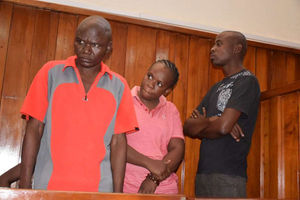
Eddlied Mandi Jilani (left ), Makonde Ruwa Buni and Ngira Karisa Charo when they appeared before Mombasa court on April 9, 2019. They are charged with the murder of businessman Kassim Jiraw, also known as Sokorow.
Photo credit: File | Nation
According to Chief Inspector Nicholus Ole Sena, the lead investigating officer, Jirow and Ms Mandi had known each other for some time.
“The deceased and Mandi had been in constant communication since his departure from Nairobi. He trusted her because she had promised to help him get the job,” Mr Ole Sena told High Court Judge Wendy Micheni.
Throughout his journey from Nairobi, Jirow kept in touch with Ms Mandi. He boarded the Standard Gauge Railway train, and upon arrival in Mombasa at around 8.30 p.m., he sent her a message: “I have arrived safely.”
The following morning, at about 9 am, he sent another message asking, “When will you be sending the car?” a text that would later become a crucial piece of evidence in the murder investigation.
Unknown to Jirow, Ms Mandi had allegedly set a deadly plan in motion.
Arrangements were in place to have him killed and his body dumped in a thicket. According to the investigating officer, the motive was to silence him so that he would stop pestering Ms Mandi about the money and the job that never materialised.
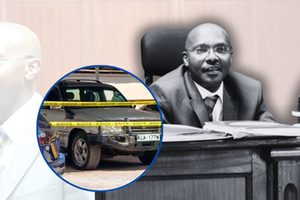
Businessman Kassim Jiraw aka Sokorow who was murdered after paying bribe to secure a chief officer job in Kilifi county.
Photo credit: Pool | Nation
At around 9 am that morning, Jirow received a call from an unfamiliar number registered under the name Mwenda Katana. Geolocation analysis later placed this number in Nyali, Mombasa, at around 2.42 pm on March 8, 2018.
Investigations revealed that the number and handset had been procured and registered in Nyeri, and were activated solely for the purpose of the crime.
“We believe this is the number used to lure the deceased into a car that had been arranged to pick him up in Nyali, Mombasa, for onward travel to Malindi,” Mr Ole Sena said, under the guidance of prosecution counsel Ngiri Wangui.
The car had two occupants, Buni Ruwa Makonde and Ngira Charo Karisa, who police later said were part of the elaborate murder plot. From the time Jirow met the two men in Nyali, evidence from the analysis of his phone showed that Ms Mandi ceased all direct communication with him through her registered mobile numbers.
“If she wanted to pass a message, she would do so through Charo’s phone,” said Mr Ole Sena.
When the group arrived in Malindi, Jirow finally met Ms Mandi. She told him they were to meet an influential Member of County Assembly who would convince then-Governor Amason Kingi to consider him for the position.
The journey to meet the supposed MCA then began. At this point, the seating arrangement in the car was changed. Ms Mandi took the front passenger seat, while Charo and Jirow sat in the back.
After driving for a while, the car stopped under the pretext of picking up another person who would take them to the influential MCA. The man who joined them was Charo’s brother, who carried a carton later found to contain fluoride acid, the chemical used to douse Jirow’s body after the murder.
Charo and his brother, who police said is still at large, sandwiched Jirow in the back seat. The journey continued, and after a while, they branched off from the main Mombasa–Malindi highway into a remote area. Ms Mandi then stepped out of the vehicle, claiming she needed to relieve herself.
That was the signal. At that moment, the court heard, Charo and his brother pounced on Jirow and strangled him to death.
“They then drove with the body still in the car and parked near a local hotel, waiting for nightfall. They were served dinner,” said the officer. Those who served the two men were among the witnesses who later testified in court.
Makonde Ruwa Buni, Eddlied Mandi Jilani and Ngira Karisa Charo at the High Court in Mombasa on September 17, 2018.
Photo credit: File | Nation
After dinner, they drove to a secluded area where they dumped the body in a thicket, poured acid over it to destroy evidence, and left the area at around 8.30 p.m.
Children herding cattle discovered the body days later and alerted a village elder, who in turn called the police.
On March 13, 2018, homicide detectives from the Directorate of Criminal Investigations (DCI) headquarters in Nairobi took over the case. They were handed key exhibits, including two bottles of fluoride acid, belt buckles, mobile phones, post-mortem reports and the police file. The team later visited Lango Baya, the scene of the crime, to reconstruct the events.
The first major breakthrough came when detectives summoned Ms Mandi for questioning. She arrived in a Toyota Mark X, and during a search, officers discovered three mobile phones hidden in the car boot.
“These phones were sent to the cybercrime unit for forensic analysis, including the extraction of emails, images and WhatsApp chats,” Mr Ole Sena told the court.
The extracted messages painted a picture of a man growing increasingly frustrated and desperate as his faith in Ms Mandi’s promises faded. One message from Jirow read: “There is no way Adan is celebrating on Facebook without information.”
In response, Ms Mandi feigned ignorance, asking: “On Facebook?” before telling him she was travelling to Malindi.
Other messages revealed Jirow’s continued confusion and frustration over the job he had been promised and paid for. He kept piling pressure and asking difficult questions, but Ms Mandi often ignored his messages or sent vague assurances that she was “working on something”.
Police investigations further revealed that Jirow had made several payments to Ms Mandi to secure the job. Bank and M-Pesa statements presented in court confirmed the transactions.
A deposit of Sh250,000 was made on September 15, 2017, followed by another Sh200,000 on November 23, 2017, and a final payment of Sh200,000 to Ms Mandi’s bank account on February 8, 2018. Additional M-Pesa transactions between the two confirmed a consistent pattern of financial exchanges tied to the fraudulent job offer.
According to investigators, these payments formed part of a total of Sh650,000 that Jirow had given Ms Mandi to help him secure the county job. When he realised someone else had been appointed, he decided to travel to Kilifi to confront her and recover his money.
The court heard that Ms Mandi tried to cover her tracks by avoiding direct communication and using proxies to relay messages. She also switched phones and SIM cards registered in false names multiple times to mislead investigators.
“We discovered, after analysing the text messages, that the deceased had been lied to by Ms Mandi that he would get the chief officer job, which never materialised. Analysis of the three phones showed that she had conspired with others to eliminate the deceased, to silence him for fear of being reported to the police,” said the officer.
A post-mortem confirmed that Jirow had been strangled and his body doused with acid in an attempt to conceal the crime.
“All the documents and digital trails proved that the accused had formed the intention to eliminate the deceased, which is why the phones and SIM cards were procured in Nyeri and brought to Mombasa to execute the plan,” said Mr Ole Sena.
He added that the elaborate setup, fake phone registrations, falsified Local Purchase Orders (LPOs), and deceptive communication showed clear coordination between Ms Mandi and her accomplices.
“The mobile phones procured in Nyeri were specifically meant to eliminate the deceased,” he said.
The investigation also uncovered a broader criminal enterprise linked to Ms Mandi. Police discovered forged LPOs in her possession, which she claimed were from the Kilifi County Government, where she had been employed as a driver since 2014.
“These LPOs did not originate from the County Government of Kilifi. It was an act of criminal enterprise to defraud people,” said Mr Ole Sena.
The grisly murder of Jirow exposed a dark underworld of job-for-bribe cartels who dupe job seekers into paying huge sums to con artists posing as insiders.
For Jirow, a man who had worked hard to establish himself in business, the pursuit of a government job ended in betrayal and a brutal death at the hands of people he trusted.
Ms Mandi, Mr Ruwa and Mr Charo are charged with his murder. Chief Inspector Ole Sena was the last prosecution witness in the case.