Policing Kilifi is like chasing shadows in a thicket that never ends. The county’s vast wilderness, from the tangled bushlands of Chakama Ranch to the edges of Tsavo East National Park, provides a natural fortress for criminal networks, poachers, and cults.
In this difficult terrain, sect leaders such as Paul Mackenzie and, more recently, Sharlyne Anindo Temba , have thrived by exploiting both the land’s isolation and the desperation of its people.
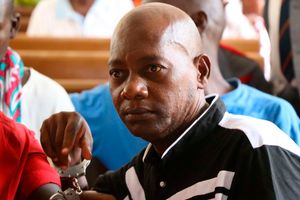
Kilifi cult leader Paul Mackenzie at the Shanzu Law Courts April 3, 2024.
Photo credit: File | Nation Media Group
The discovery of mass graves in Shakahola in 2023 , followed by the chilling revelations from Kwa Bi Nzaro in 2025 , has once again raised the question: why do tragedies in Kilifi keep repeating themselves despite national outrage and government crackdowns? The answers point to a dangerous mix of geography, poverty, weak regulation, and fragile relations between locals and security agencies.
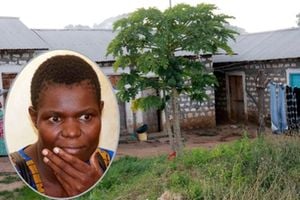
A police officer manning the home in Bi Nzaro Area, Kilifi County.
Photo credit: File | Nation
Chakama Ranch alone spans 52,000 acres of dense bushland. It is a patchwork of thorny thickets, elephant tracks, and predator trails that stretch into Tsavo East. Security officers say it is nearly impossible to patrol.
Without proper roads, aerial surveillance, or ranger stations, groups can operate for months without being detected.
Kilifi Governor Gideon Mung’aro admitted as much: “This land is vast, difficult to patrol, and impossible to monitor effectively. The best solution is to open up settlements—allow people to farm, live there, and make the land useful. A living, working community will always provide natural oversight, which a deserted forest cannot.”
He added that without clear settlement plans, “Every tragedy here will be a replay of the last one, only worse”.
But until that vision materialises, the bush remains a perfect hiding place. Even at Shakahola, police only found graves after whistle-blowers tipped them off. By the time state machinery moved in, dozens had already perished.
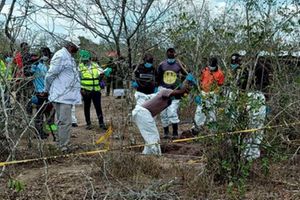
Some of the bodies exhumed from mass graves in Shakahola, Kilifi County, on May 18, 2023, in the investigation into cult leader Paul Mackenzie and his Good News International Church.
Photo credit: Kevin Odit | Nation Media Group
Recent statistics show that Kilifi County remains among the poorest in Kenya, and the scale of deprivation helps to explain how cults like Shakahola and Kwa Bi Nzaro take hold, and why intervention is difficult.
According to the Kenya Poverty Report 2024 , using data from the 2022 Kenya Continuous Household Survey, Kilifi has an absolute poverty rate of 61 percent, placing it in a league with some of the most impoverished counties in the country. This means well over half of the county’s population fall below the national absolute poverty line.
Droughts routinely destroy crops, while elephants from Tsavo trample what little survives. Basic services—roads, clean water, electricity—are absent in many villages. For residents of Kwa Bi Nzaro, neglect has become normal.
“We want land title deeds, water, roads, and electricity. Instead, we are known for cults and disappearances,” said David Karisa, a local.
It is this desperation that cult leaders exploit. Promising salvation, healing, or even food, they lure families who feel abandoned by the state. Once indoctrinated, followers are cut off from relatives and warned against modern medicine or schooling. For the desperate, faith becomes both an anchor and a trap.
The state has struggled to rein in rogue religious groups. Cult leaders easily register associations with minimal scrutiny. By the time authorities act, the damage is done.
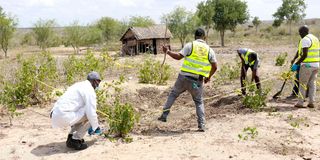
A deserted homestead at Chakama Ranch, Kilifi County belonging to one of Pastor Paul Mackenzie's followers.
Photo credit: File | Nation
Mackenzie’s Good News International was allowed to operate for years before Shakahola exposed its deadly theology. After Shakahola, the government promised tighter regulation, but Kwa Bi Nzaro shows little has changed.
Anindo, believed to be a Mackenzie disciple, quietly set up her homestead in Chakama Ranch and recruited followers without raising alarm. Her aides—Kahindi Kazungu Garama, Thomas Mukonwe, and James Kazungu—enforced her rules, ensuring silence and obedience.
Kwa Bi Nzaro Suspects James Kahindi Kazungu, Thomas Mukonwe, Kahindi Kazungu Garama and Sharleen Anido Temba at the Malindi Law Courts in Kilifi County on September 12, 2025.
Photo credit: Kevin Odit | Nation
Perhaps the biggest obstacle is mistrust. In Kwa Bi Nzaro, three men—Gona Charo, Karisa Gona, and elder Safari Kenga—played a key role in exposing the cult. They infiltrated Temba’s compound under the guise of aid workers and handed evidence to authorities. Yet instead of being protected, they were arrested and accused of complicity.
“If you arrest whistle-blowers, you discourage others from coming forward,” Governor Mung’aro said.
Their families openly protested their arrests saying that without them, the government would never have known what was happening.
“We now fear telling the authorities anything because whistle-blowers too can be arrested and treated as suspects,” she said.
Whereas the trio were later on released on free bond by the court, their arrests highlight how fragile the relationship between the locals and the state is. Where there is little trust, vital information remains locked within communities and cults exploit the silence.
A drive from Kilifi town to Kwa Bi Nzaro is itself a testimony to neglect. The Kilifi-Ganze road is incomplete, littered with detours and damaged culverts. Beyond Dida market, the road narrows into Arabuko Sokoke Forest before spilling into Matanomane centre. A murram road measuring 23 kilometres then leads one to Baolala, where we find the first tarmac road after over 50 kilometres from Kilifi town.
From Baolala, the C103 Malindi-Salagate road into the emptiness of Chakama Ranch. For nearly 20 kilometres, houses are rare, electricity poles vanish, and silence dominates. Painted rocks advertising land for sale dot the roadside, evidence that pieces of the contested ranch are being hawked to private buyers. Instead of structured development, the land has become a vacuum filling up with despair, cults, and graves.
Bodies exhumed from mass graves in Shakahola forest, Kilifi County are loaded into a vehicle during the operation on May 12, 2023.
Photo credit: Kevin Odit | Nation Media Group
After Shakahola, government vowed never again. Yet two years later, Kwa Bi Nzaro proved otherwise. Security forces cite terrain; leaders cite poverty and faith manipulation. But locals are tired of explanations. What they want are settlements, proper infrastructure, and vigilance. Without these, tragedies will continue to happen.
“People here have no work, no farms, and no schools nearby. That’s why preachers get away with anything,” Karisa said.
“We must turn these ranches into productive land. Until we do, it will be very difficult for police [to patrol] the large, unoccupied tracts of land, and things that are not desirable can easily thrive in such places,” he said.
The paradox of Kilifi is stark. Its wilderness is beautiful, its communities resilient. Yet it is this very silence, this emptiness, which has twice turned into a graveyard—first at Shakahola in 2023, then at Bi Nzaro in 2025.
The story of Kwa Bi Nzaro began with a phone call, but the broader lesson is larger: without infrastructure, regulation, and trust, Kilifi’s wilderness will be difficult to police. And unless the silence is broken, it is unlikely Kwa Bi Nzaro will be the last name added to Kenya’s tragic roll call of faith gone wrong.