Each day, the sun rises over Kirinyaga County’s sprawling plantations, casting light on a bustling economy powered by a single grain—rice.
From the farms to shopping centers and towns, rice dominates livelihoods here, shaping the rhythm of daily life.
Men transport paddy from the 30,000-acre Mwea Irrigation Scheme to mills while women work in processing plants and retail outlets, vying for customers from across the country.
A view of Mwea Town in Kirinyaga County, where a good road network and thriving rice farming have significantly boosted the local economy.
Photo credit: Joseph Kanyi | Nation Media Group
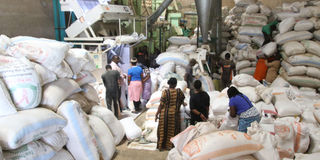
In towns such as Mwea, Sagana, Kerugoya and Kagio, milling machines hum from dawn to dusk, fuelling a 24-hour rice economy.
Residents regard rice in near-sacred terms, crediting it with transforming lives. Before the liberalisation of milling, trade and marketing around 2010, life was far harder.
“There was only one government-controlled mill and farmers were forced to deliver their produce at poor rates. We were impoverished. After 2010, private mills were allowed and the rice economy literally exploded,” says Priscilla Muthoni who is the owner of a 20-tonne daily-capacity mill at Ngurubani.
Over 14,000 farmers are now engaged in rice farming, a practice that dates back to 1954 under colonial initiatives.
Today, the Mwea irrigation scheme produces over 150,000 tonnes annually, accounting for 80 percent of the country’s rice output.
Rice drives economic activity in Kirinyaga, generating over Sh25 billion annually, according to General Manager of the Mwea Rice Growers Multipurpose Cooperative Society Anthony Waweru. Mills have proliferated in Mwea, Ngurubani, Kutus and Kagio, turning the region into an industrial hub. Maize and animal feed mills have also sprung up, attracting national attention.
“Rice for processing is plentiful, which is why there are more than 100 mills in the towns. We employ thousands of residents, and my factory alone employs over 300 people. Our capacity is 55 tonnes of paddy per day,” says James Wambugu, Director of Golden Grain Rice Millers.
For farmers and traders, rice has become a reliable source of income.
“Through rice proceeds, we meet financial obligations and educate our children. To us, rice is gold,” said Ms immaculate Kamau, a trader. She earns Sh40,000 weekly from selling 100 kilos of processed rice.
Nice Digital City in Mwea Town, Kirinyaga County, one of the region’s rapidly growing urban centres driven by rice farming.
Photo credit: Joseph Kanyi | Nation Media Group
"Through rice proceeds, we are able to meet most of our financial obligations, including educating our children. To us, rice is gold and we embrace it with passion," Ms Immaculate Kamau, a trader, said.
"Every day I sell 100 kilos of processed rice and make a profit of Sh40,000 per week. Through rice business, I have educated my children, built a house and bought three acres of land," she added.
Ms Muthoni, the director of Trinity Rice Millers, narrated how she started the business as a small -scale trader. "I started as a trader, but now I have established my own mill. To succeed in rice business, you have to be patient and work hard. Currently, I'm an employer and I operate my business for 24 hours," she said.
"We buy paddy from farmers at between Sh80 and Sh85 per kilo and process it for sale with farmers playing a crucial role the industrialization of Kirinyaga towns," Ms Muthoni said, adding that marketing of the produce involves talking to customers across the country.
“With time, I have built a portfolio of customers in Mombasa, Kisii, Kakamega and Marsabit. When they need rice, they just call and we arrange for transport,” she said.
The Director of New Nice Rice Millers, Mr Charles Njiru, popularly known as Mkombozi, noted that as the leading economic activity, rice has contributed immensely in the development of the region.
Mwea Nice Rice Millers managing director Njiru Mkombozi (centre) explaining to a delegation of farmers from Mozambique, Madagascar and Uganda how rice is processed.
Photo credit: George Munene I Nation Media Group
"In my mill alone, I have employed more than 1,000 people including loaders. The rice industry has kept the youth busy, employing close to 100,000 people in Kirinyaga county," said Mr Mkombozi.
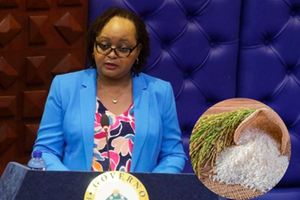
In 2017, Governor Anne Waiguru’s administration formulated a Sessional Paper dubbed ‘Mountain Cities Blueprint , which was part of the county’s Vision 2032 development agenda, leading to the transformation of major towns.
The county was divided into four major regions – Ndia, Mwea, Gichugu and Kirinyaga Central constituencies to guide investors and other development partners on investment opportunities in each area, with Sagana, Kianyaga, Ngurubani and Kerugoya towns, respectively, designated as Mountain Cities.
In the Blueprint, Kirinyaga Central was to serve as the Health City, Gichugu the Resort City, Mwea Agri - Green City while Ndia was identified as the Organic- Industrial City.
“The rebranding of the four major towns ushered a new chapter in the history of the County regions development programme. Investors were guided on how and where to put their investments,” Mr Geoffrey Murage said in a recent interview.
Sagana town was identified for industrial projects since it is strategically positioned due to proximity to the main highway linking Kirinyaga, Murang’a and Nyeri counties to the capital city.
A cabro-paving programme was launched in towns, turning the muddy, flood-prone centres into orderly and attractive areas for investors.
The Kenol-Marua dual carriage has boosted Sagana’s image as the most suitable for industries, rivalling other towns in neighbouring Nyeri and Murang’a counties. Introduction of new revenue streams, including parking fees, increases the county’s own source revenue.
For instance, Ngurubani, one of the towns has transformed following major infrastructural development projects by the national government.
The roads in the town have been tarmacked to ensure easier transportation of rice to the market, while street lights have been provided to make the town a 24-hour economy.
A stadium of international standards has been constructed in the same town at a cost of Sh300million. National Irrigation Authority rice stores and staff houses have been renovated, and foot path tarmacked.
“Some people think when we talk of rice being our lifeline, we’re exaggerating. But look at even that young man who spreads rice on the canvas to dry it. Earning an average of Sh100 per 90-kg bag, he can earn up to Sh5,000 daily. It tells you the kind of money in circulation,” says John Njeru, a resident of Kagio town.
This is the kind of money that has spawned growth in alluring nightlife in the towns, some of which have themed entertainment to Mombasa’s entertainment industry.
The towns host nightclubs where patrons throw parties and splash rice cash in strip clubs. “Inside these clubs, one feels the ambience of a joint in Nairobi’s Weslands or Mtwapa at the coast,” says James Kariuki, a resident of Mwea town.
However, the rice economy has had its share of challenges, ranging from inadequate water for irrigation to duty-free rice imports, which have dimmed farmers' prospects for better prices.
Mr Mkombozi observed that the demand of rice is so high and the government should construct another dam to increase production.
"More water is required to increase production because more rice mills, which operate day and night, are coming up. This is the only way we can tap from the rice economy that promises industrialisation and more jobs for the youth,” Mr Mkombozi said.
Also, since local production does not meet over 800,000 metric tonnes of Kenya’s local consumption demand, imports of up to 300,000 tonnes have to be procured, which sparks vicious trade wars pitting importers.
This year, imports of 250,000 grade one duty-free rice worth Sh15 billion was contested in court as 16 importers opposed the inclusion of four companies that had not gone through the competitive bidding process, even as Kirinyaga governor Anne Waiguru asked the government to reconsider the decision, saying imports would hurt farmers.
Farmers have also traditionally accused the government of reneging on promises to mop up the commodity in local stores before sanctioning the imports.
“Importation of cheap rice has always caused us sleepless nights because the moment it lands, our commodity loses market. We incur huge losses and we call on the government to buy all our rice before turning to imports,” said Mr Wambugu.