On the evening of February 24, 2024, Nyang’oma Village in Muhoroni sub-County descended into horror as Shem Akuku moved from one homestead to another, killing four members of his own family.
According to evidence before the High Court in Kisumu, the violence began shortly before 7pm at the accused’s home.
His first victim was his wife, Emily Adhiambo, who was five months pregnant with their second child. She was attacked with a machete.
Moments later, he turned the weapon on his seven-year-old son, Joseph Ouma Akuku, killing the child inside the same house.
With his wife and son dead, Akuku walked about 200 metres to the home of his uncle, Thomas Odula Nyameche.
He deceived the elderly man by claiming that his father urgently needed help to resolve a land dispute involving his brothers.
Believing he was responding to a genuine family emergency, Mr Odula accompanied his nephew. He never returned home.
His widow, Pamela Odula, later recounted the chilling events of that evening.
Pamela Adhiambo whose husband Thomas Odula, was among the people allegedly murdered by Shem Akuku Otieno at Wagunga village in Kisumu County.
Photo credit: File | Nation Media Group
“He came to our home and told my husband that his father needed help because there was a land dispute,” she recalled.
A few minutes later, Akuku returned alone.
“He said things had become worse before walking away. I thought perhaps the disagreement had escalated,” she said.
Concerned, Ms Odula followed with her daughter. What she found remains etched in her memory.
“I found my husband lying in a pool of blood. When I tried to lift him, my hand went into the deep cut on his nape,” she said.
After killing Mr Odula, the court heard, Akuku went to another nearby homestead in search of another uncle. However, he did not find him.
He then walked nearly 500 metres to the home of his aunt, Mary Kuya Otieno, who was resting inside her house, where she hacked her to death with the same panga.
Akuku’s mother, Phoebe Akoth, later told investigators that she had never imagined her son was that violent.
“Shem was not a violent person. In the seven years he lived with Emily, I never heard of quarrels between them, and he related well with the extended family,” she said.
“When I found two lifeless bodies in his house, I was completely shocked,” she said.
More than two years later, the family of the four relatives brutally murdered has welcomed the High Court’s decision sentencing the killer to death, saying the judgment has finally delivered justice after years of anguish.
Justice Joe Omido on Monday sentenced Shem Akuku Otieno, alias Daddy, to death after he pleaded guilty to four counts of murder arising from the killings of his seven-year-old son, Joseph Ouma Akuku, his 26-year-old pregnant wife, Emily Adhiambo Akuku, his 74-year-old uncle, Thomas Odula Nyameche, and his 56-year-old aunt, Mary Kuya Otieno.
Outside the Kisumu High Court, family members embraced moments after the sentence.
Thomas Odula’s widow, Pamela Odula, said the judgment had finally given the family the closure they had long sought.
“Even though I won’t see my husband again, I have gotten justice,” she said.
She added that the family had endured more than two years of pain while waiting for the case to be concluded.
“Nothing can replace my husband, but today I feel justice has been served,” she said.
Her son, Vincent Odula, said the family had followed every stage of the proceedings and was relieved that the court had finally brought the matter to a close.
“My father was among the four people who were killed. I am pleased that we have finally received justice,” he said.
He added that many relatives who had hoped to witness the sentencing were unable to travel to Kisumu because of financial constraints.
“But we are going to deliver the good news to them. They have been waiting for this day,” he said.
The court heard that after the killings, Akuku hid the murder weapon in a sugarcane plantation before fleeing.
He later surrendered to police after learning that angry villagers were searching for him and were planning to lynch him.
Akuku was initially charged with four counts of murder and denied all the charges when he first appeared before the High Court in May 2024.
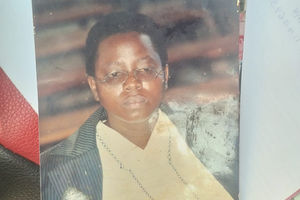
Pamela Adhiambo displays a photo of her husband Thomas Odula who was among the people allegedly murdered by Shem Akuku Otieno at Wagunga village in Kisumu County.
Photo credit: File | Nation Media Group
Months later, however, the case took an unexpected turn.
During plea negotiations, he abandoned efforts to pursue a plea bargain and admitted responsibility for the killings.
“I want to tell the court that I killed the four deceased persons. I want to plead guilty to all the four counts,” he told the court.
When asked whether he understood the consequences of his plea, he replied:
The court, nevertheless, ordered a psychiatric assessment, which confirmed that he was mentally fit to stand trial.
When the matter came up again, he declined legal representation.
“I know that I am entitled to an advocate, but I do not want one,” he told the judge.
After the prosecution outlined the facts, Akuku confirmed they were accurate, and the court convicted him on his own unequivocal plea of guilty.
Justice Omido said sentencing required careful consideration of both mitigating and aggravating factors, but observed that the case ranked among the gravest ever to come before the court.
“At the heart of this case lies the most sacred value protected by the law: the sanctity of human life. Human life is the foundation upon which every other right and freedom rests. Once unlawfully taken, it can never be restored by any sentence a court may pronounce,” the judge ruled.
He said the murders were aggravated by the fact that Akuku systematically targeted members of his own family who trusted him.
“The accused did not take one life. He extinguished four lives during a single criminal episode. Those victims were not strangers. They were members of his own family and immediate community, persons who trusted him and from whom no hostility had been demonstrated.”
Justice Omido described the murder of Joseph Ouma as one of the gravest violations of parental responsibility.
“Instead of discharging his sacred obligation to protect his child, the accused turned upon his own son and brutally cut him with a panga.”
On the killing of Emily Adhiambo, the judge observed that the matrimonial home should have been a place of refuge and safety.
“Instead, it became the place where her life was violently brought to an end by the very person who had undertaken to protect and cherish her.”
Turning to the killing of Thomas Odula, the judge condemned the deception employed by the accused.
“Trusting his nephew, the deceased accompanied him only to be mercilessly attacked and killed.”
He added: “The abuse of familial trust in order to facilitate the commission of murder is a particularly reprehensible aggravating circumstance.”
On Mary Kuya’s murder, the judge noted that she had been unwell and was resting inside her house.
“The accused similarly deceived her into leaving the safety of her home before fatally attacking her. The calculated exploitation of the deceased’s trust and vulnerability demonstrates a disturbing level of deliberation and callousness,” he ruled.
The court also heard that Akuku attempted to attack his sister, Monica Otieno, who escaped only after he fell while chasing her with a panga.
Justice Omido acknowledged that Akuku was a first offender and that his guilty plea had spared the victims’ families the ordeal of a lengthy trial.
However, the judge ruled that remorse alone could not undo the devastation his actions had caused.
“While the court accepts that statement as an expression of regret, remorse cannot erase the devastating consequences of the offences committed,” he ruled.
Justice Omido said that although the Supreme Court’s Muruatetu decision restored judicial discretion in murder sentencing, the death penalty remains lawful in exceptional cases.
“The offences were not the result of a momentary lapse involving a single victim,” the judge stated.
Instead, he said, Akuku systematically moved from one homestead to another, exploiting trust and targeting vulnerable members of his own family.
“They involved the systematic killing of four persons at different locations, accomplished through deception, the abuse of familial trust, the targeting of vulnerable victims and the almost complete annihilation of an immediate family unit,” he ruled.