On April 21, 2026, authorities in Kitui County had scheduled a peace meeting at Kwa Kamari Village between local farmers and camel herders from the neighbouring Tana River County.
According to Tseikuru Deputy County Commissioner, Anita Mwangi, the meeting was meant to defuse tensions, which had been building up between farmers and herders. The meeting did not happen.
Tseikuru Sub-County Deputy County Commissioner Anita Mwangi during an interview outside her office in Tseikuru, Kitui County, on May 4, 2026.
Photo credit: Bonface Bogita | Nation Media Group
“The camel herders did not send elders to the meeting," she said.
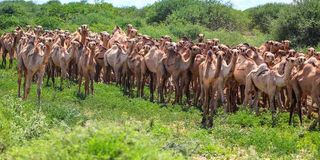
What followed four days later was devastating. Around 40 gunmen stormed Kwa Kamari township at midday, shot dead seven residents, broke into shops, stole assorted commodities, and set shops on fire before fleeing into the neighbouring Mwingi North Game Reserve.
The attack, which security agencies frame as “retaliatory”, has raised serious questions on the source of the conflict.
Following the murder of a 14-year-old boy, Joseph Mutemi, in Mwingi East sub-County in similar circumstances days later, the local residents closed off the Mwingi-Garissa road in an attempt to frustrate movement in and out of Garissa County.
Social media reports had initially insinuated that it was a full-blown conflict between pastoralist and farmer communities.
However, it has become clear that the conflict had different dimensions, and that it started way back in the 1960’s.
According to Musili Kauni, who has lived at Kwa Kamari for 40 years, the altercations began around 1967 during the Shifta conflict. The trigger? Herders, mostly from Garissa and Tana River counties, would move into Kitui District, as it was known then, to look for pasture.
Musili Kauni during an interview at his home in Tseikuru, Kitui County, on May 4, 2026. His two brothers, Kilonzi Kauni and Mulandi Kauni, who were among the seven victims of the Kwa Kamari bandit attack.
Photo credit: Bonface Bogita | Nation Media Group
“This was part of the Shifta riot from 1965 to 1967. I was very young, but we would see them coming over with their camels and other livestock. After every few months, they would show up,” says Kauni, who lost his two brothers in the recent attacks.
Chief Samson Syengo, who was born and raised in Tseikuru but now heads Kaningo Location, explains that the farmers and herders co-existed and even began trading with one another. However, from time to time, conflicts would emerge, and they would stop engaging in trade and herding as friends and become enemies.
“Initially, they used to attack us as Shiftas. Later, we started living together and even engaged in business. But soon, we could differ and stop trading. This would lead to attacks,” says Mr Syengo.
“The issues here have always been about pasture. It started with the farmers forcefully removing camels from their farms in the Mwingi Game Reserve. The herders then retaliated and killed a young man who was also looking after livestock in the reserve. After that, the farmers retaliated and killed five herders. Two weeks later, they came and killed seven farmers,” says Chief Syengo.
Mr Munywoki Muthui, who has lived in the area since 2000 and who lost his son, Titus Munyoki, in the recent attacks, says the conflict is usually sparked by armed pastoralists whose camels stray into farmlands.
He explains that whenever this happens, herders claim the farms are in the reserve and resort to violence.
“I could have died even before my son. If you look at my head, I have a scar sustained from a panga cut as we confronted pastoralists. They came to my farm to graze my crops. When I complained, they told me that my crops were meant for camels,” said Mr Muthui.
“They insist that this is the government's land and that they bought it. When there is no pasture around our lands, they just open the gates (to the farms) and let the animals in,” he adds.
Residents stand next to a tree to cellular reception in Kwa Kamari, Kitui County on May 3, 2026.
Photo credit: Bonface Bogita | Nation Media Group
The Nation established that the land at Kwa Kamari belonged to the government, and it was meant for the Mwingi North Game Reserve.
Over the years, people, mostly from Tseikuru, moved to the area and grabbed unutilised land at the edge of the reserve where they started farming.
“We subdivided the land for farming,” says Mr Muthui.
According to Mr Kauni, the squatters had encroached on the land earlier, before the government allowed them to farm.
“The Minister of Lands, between 2006 and 2007, told us that we could till the land,” said Mr Kauni.
Ms Mwangi explains that the disputes between farmers and herders have always been resolved before getting out of hand.
The DCC, who has served for about three years at Tseikuru and whose office is about 40 km from the village which borders the game reserve, says the two communities have a love-hate relationship.
She explains that when she got into the area in 2023, she found them coexisting peacefully.
“They co-exist very well at times, but now they cannot meet face to face. The herders bring their livestock to the Tseikuru Market, and in return, they boost the Tseikuru market by buying cereals from the farmers,” says Ms Mwangi.
According to the DCC, the government was aware of the conflicts and had commissioned peace committees to negotiate whenever there were conflicts.
“Most of the time, the disputes are sorted out quickly to avoid escalation. We condemn the killing of seven people,” she adds.
Garissa County Commissioner Mohamed Ramadhan Mwabudzo explains that the area experiences many conflicts.
On one hand, herders clash among themselves, with those from Tana River County, which borders Kitui County, wanting to preserve pasture, and on the other, herders looking for pasture and water clash with farmers in Kitui.
The administrator explains that the herders who descended on the farms near the reserve were not from one community. He said they come from both Garissa and Tana River, and they chose to graze in the Game Reserve since it is near the Camel Market in Bangale.
“In Kitui, we find conflict very common because many camel herders decide to go into the reserve and get into Kitui County. There are farmers who lease their lands, and animals would cross into someone else’s land, and conflict breaks out, ” says Mr Mwabudzo.
“The camel herders do not come from Garissa alone; they come from Wajir, Mandera, Tana River and those owners who live in Nairobi and the like can easily access their camels in Mwingi, which is near Bangale Township in Tana River County.”
He, however, explains that the conflicts are at times exaggerated by politicians for political mileage.
“The interference by politicians occurs because everyone has to look like they are siding with their people. Some are even camel owners. This explains why they met in Nairobi after the clashes,” says Mr Mwabudzo.
Previously, when seven people were killed, politicians came out to support their people.
For instance, the Health Cabinet Secretary Aden Duale, who is one of the most influential politicians in the North Eastern part of the country, claimed the camels that had been said to have caused havoc to farmers in Mwingi had the right to feed anywhere. However, following backlash, he asked the farmers and herders from the north to maintain peace.
“I am a camel owner, as it is a very prestigious animal to own. Let us not be divided by politicians. We all need peace. I have been voted for by the crop farmers in previous elections, and Kalonzo Musyoka wants to be president; therefore, he needs to have peace with everyone. No one chooses their neighbours,” said the Health Cs in an interview.
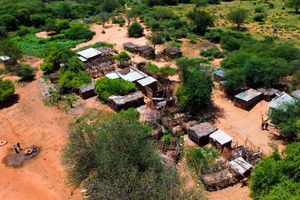
Aerial view of Kwa Kamari area in Kitui County, where bandits attacked and killed seven people.
Photo credit: Bonface Bogita | Nation Media Group
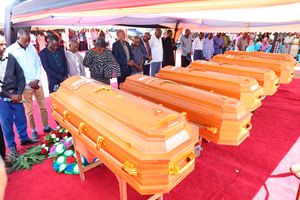
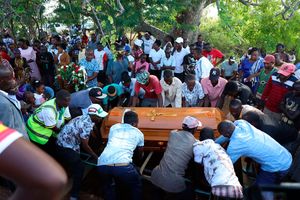
On the farmers’ side, Kitui Woman Representative Irene Kasalu, while addressing mourners during the joint funeral service for seven people killed in the clashes, called for the arrest of the killers.
“Since the shooting of our people happened, no one has been arrested. We want peace to prevail, but there will be no peace without justice,” said Ms Kasalu, who claimed the herders had the blessings of powerful individuals in government.
Kitui Governor Julius Malombe, however, wanted the county and the national government to push for structures that would allow registration of farmers and herders at the game reserve. He said that this would make it easier to follow up and bring to book anyone who infringes on the other’s rights.
“I would like to give my condolences to the families that have lost their loved ones. I am here because we need our people to be safe and for them to engage in farming. However, we must have structures that will enable us to deal with the conflicts. Anyone herding in the game reserve must be registered so that when an incident occurs, we can trace who did it,” said Governor Malombe.
“We need one another. Even the herders are Kenyans, and I need them to vote for me, let us not go into revenge,” he said.
However, Kitui leaders and locals have questioned how powerful the herders are, given that they had a militia of over 20 gunmen who fired around 50 bullets at a police station and walked scot-free.