A section of National Police Reservists at the Kyuso law courts in Kitui County on April 13, 2026. They are accused of gunning down a camel herder in the region.

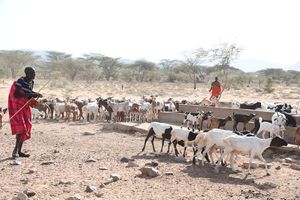
As night falls in Ngomeni in Kitui County, silence no longer descends on the landscape; instead, fear fills the air.More than 100 households now abandon their homes at dusk, retreating into nearby thickets where they spend cold nights in makeshift tents, keeping watch for danger. Snakes, insecurity and the fear of revenge attacks have become part of their nightly reality.This panic follows the killing of 18-year-old camel herder Osman Hassan Ali, who was shot dead last Monday in a confrontation at a private ranch straddling Kyuso and Mwingi Central sub-counties. This incident has once again exposed the fragile fault lines between farmers and pastoralists along the Kitui–Tana River border.Read: Relative calm returns to Ang’ata Barikoi after curfew impositionWhat began as just another incident in a long-running land-use conflict has now escalated to the point of mass displacement, arrests, and mounting accusations of injustice from both sides.Villagers say they feel exposed after the police arrested a dozen National Police Reservists and confiscated their firearms in connection with the shooting. For many, the arrests have deepened fears that they may be left defenceless if retaliatory attacks erupt.“We spend cold nights in the thickets, risking attacks by venomous snakes,just because we fear what our neighbours may do at night,” said Kambua Mutua, a village elder in Yumbandei area. The worst-affected villages include Inyanzai, Mukavoo, Yumbandei and Kasiluni.The sense of unease runs deep. Mutua’s husband was among the 11 National Police Reservists released on Monday, April 13, after spending five days in custody at Kyuso Police Station. They had been arrested after responding to a police summons for interrogation.In court, their defence painted a picture of confusion and overreach. Through their lawyer, Nyamu Mati, the reservists Musembi Kithethi, David Maswili, Mwangangi Mbiti, Muthui Kilonzo, Daniel Masakui, Peter Wambua, Peter Munywoki, Titus Nzaulo, Muthui King’ang’i, Kyalo Mbithi and Mwandikwa Mende denied any involvement in the killing, and accused investigators of building a flawed case.Lawyer Mati questioned how multiple suspects could be tied to a single bullet and challenged the credibility of the identification evidence presented by detectives.“How can 11 people be responsible for firing one bullet?” he asked Wellington Ogutu, the DCIO of Kyuso, who had sought to detain them for a further seven days to complete the investigation.Read: 'Where is the president?' Desperate families flee fresh bloodshed in NarokBut Senior Principal Magistrate Paul Mayova dismissed the application, freeing the reservists on a Sh100,000 bond or Sh20,000 cash bail each.This ruling has added another layer to the conflict, which is already defined by mistrust between communities, security agencies, and the justice system itself.For residents, however, the legal outcome offers little comfort, as the deeper fear is of retaliation.Security agencies have long flagged the Kitui–Tana River border as one of the region’s most volatile flashpoints where clashes between farmers and camel herders erupt repeatedly. The cycle is often triggered when herders move their livestock onto farms and to community water points, leading to confrontations that quickly spiral into violence.“The Constitution of Kenya guarantees every citizen the freedom to move and live anywhere in peace. Yet my brother’s life was taken when he was simply working. He did not deserve this,” said Mohammed Hassan Ali, brother of the slain herder, in a Facebook post.The violence is not isolated. Daily Nation has established that more than 10 people have been killed in Kitui and Tana River counties since March alone, including 13-year-old Kyalo Kimwele, who was killed in unclear circumstances at Kithinia village in Tseikuru two weeks ago. No arrests have been made in that case.The pattern of killings has intensified political pressure. Kalonzo Musyoka, the Wiper leader who hails from the region, has accused security agencies of a selective response and of failing to protect civilians.“The government has completely failed to guarantee the security of its citizens in the villages,” he said on Sunday, April 12.Read: Weapon of mass murder: AK-47 linked to terror deathsFormer Mwingi North MP John Munuve has also faulted what he terms as unequal policing of the conflict, arguing that responses differ depending on whether a farmer or herder is affected.“When a camel herder is injured or killed, the police swing into action. But when a farmer is affected, nothing happens,” he claimed.President William Ruto had previously praised Kitui Governor Julius Malombe for establishing eight police stations along the volatile border in an attempt to contain insecurity, though many remain under-resourced and without full police deployment.During a recent visit to the area, Interior Cabinet Secretary Kipchumba Murkomen renewed the government’s pledge to restore order, promising an increased security presence.“We shall deploy General Service Unit and Rapid Deployment Unit officers to enhance security patrols in this region,” he announced during a tour of Nuu Township.