For generations, donkeys have been the lifeblood of transport in Lamu Island, carrying everything from coral stones and mangrove poles to sacks of maize and weary travelers.
At 74, Mr Mahmoud Ahmed Abdulkadir’s eyes have witnessed nearly a century of the island’s rhythm, historically dictated by the steady clatter of hooves on stone along the narrow streets and alleyways.
Lately, however, some of Mahmoud’s quiet mornings and afternoons are interrupted by fascinating sights. Donkeys trot past normally, but some are not carrying the usual cargo.
Instead, their flanks are painted in vibrant political party colours and plastic campaign banners are draped over their wooden saddles.
“During our days, donkeys were the real beasts of burden. To see them today branded with political party banners, paraded into noisy campaign rallies, and used for political stunts is an unusual sight,” he says.
As the 2027 General Election preparations gather momentum countrywide, the traditional role of Lamu donkeys is actively shifting, moving far beyond their historic use as a quiet labour force into highly visible tools for political marketing and social engineering. Lamu Old Town, a United Nations Educational, Scientific and Cultural Organisation (Unesco) World Heritage site, has never allowed cars within the island.
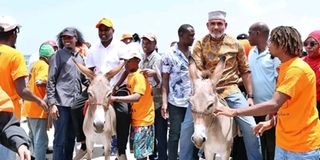
Last month, Lamu politician Umra Omar Bwana used the donkeys to launch her Chama Cha Ujenzi Party, whose symbol is the donkey.
Lamu former gubernatorial aspirant and humanitarian Umra Omar Bwana riding on a donkey shortly after launching her political party, the Chama cha Ujenzi Party, in Lamu Old Town on September 24, 2026.
Photo credit: Kalume Kazungu| Nation Media Group
Ms Omar, a former gubernatorial candidate widely recognised for her grassroots community healthcare work, launched the party on September 24, positioning it as the new political vehicle ahead of the upcoming 2027 General Election.
During the party unveiling, Ms Omar and her supporters, wearing branded T-shirts, marched through the town riding and walking with donkeys to symbolise grassroots strength and labour in nation-building.
“The party’s official symbol is a donkey. The donkey symbol is deeply significant, especially to this place because donkeys have historically been used to build and transport goods across Lamu's narrow, vehicle-free alleyways,” she stated.
Lamu former gubernatorial aspirant and humanitarian Umra Omar Bwana riding on a donkey shortly after launching her political party, the Chama cha Ujenzi Party, in Lamu Old Town on September 24, 2026.
Photo credit: Kalume Kazungu| Nation Media Group
Mr Suleiman Twalib, a resident, says there is no problem seeing the Lamu donkeys transition from everyday beasts of burden into prominent political symbols.
Mr Twalib acknowledges that Lamu is geographically unique compared to the rest of Kenya, something that forces people to do things differently. He further explains that while politicians and campaigners in the rest of Kenya have the pleasure of riding in luxurious vehicles during campaigns, those in Lamu Island have embraced the donkeys.
“Donkeys are the only thing close to vehicles here. Those politicians you see riding donkeys while visiting the archipelago for political campaigns and outreach events are doing so as a gesture often used to embrace our unique culture where donkeys are our primary mode of transport here,” said Mr Twalib.
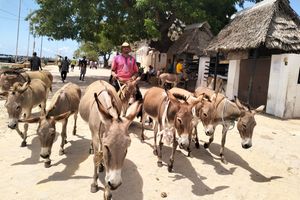
Mr Salim Hamadi, a resident, says while they still carry cement, sand, and water daily, the donkeys’ roles have adapted to the contemporary political and social landscape.
Donkeys loaded with cargo on a street in Lamu Old Town on Monday, October 12, 2026.
Photo credit: Kalume Kazungu| Nation Media Group
He says instead of traditional ribbon-cutting or standard rallies, modern political strategists in Lamu have in recent times been witnessed organising elaborate party events featuring decorated donkey processions.
“We’ve at times seen candidates arriving at rallies while riding donkeys decked out in party regalia, capitalising on the animal’s cultural visibility to draw massive crowds and create viral social media moments,” said Mr Hamadi.
Mr Mbwana Abubakar admits that seeing the donkeys used as loud, polarising instruments of political rivalry feels like a profound cultural shift.
“It’s surprising for the elderly like me to spot campaign songs echoing from portable speakers mounted on donkey backs. Donkeys are no longer treated just as community helpers. They’ve graduated to become a whole contested political canvas. The world is indeed changing, and even the donkeys of Lamu have been drafted into the modern theatre of politics,” said Mr Abubakar.
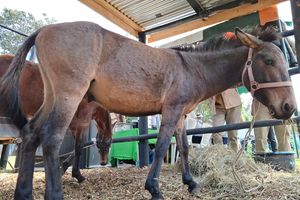
Donkey owners say that with the forthcoming 2027 General Election, they are looking forward to making good money through hiring donkeys.
Mr Hussein Miji, a donkey owner, said the cost of hiring a donkey depends on the status of the client. For instance, if a prominent politician like the president hires a donkey to enter Lamu Old Town, they charge between Sh20,000 and above.
For governors, MPs and others, they charge between Sh5,000 and Sh10,000 just for the few minutes of taking the politician from the Lamu Old Town Jetty to the venue of a political rally like Mkunguni, which is a 30 to 50 metres ride.
In the past, high-profile leaders, including national party figures such as the late ODM Party Leader Raila Odinga, President William Ruto, governors and others, have famously ridden donkeys whenever they made campaign stops or attended cultural-political events in Lamu Old Town.
Former Prime Minister, the late Raila Odinga, rode a donkey when he arrived in Lamu Island for a political rally at Mkunguni Square in November 2021.
Photo credit: Pool
Most recently, in February, Suna East MP Junet Mohamed and Mombasa Governor Abdulswamad Nassir made a symbolic joint entrance on donkeys during the Orange Democratic Movement (ODM) ‘Linda Ground’ tour in Lamu County.
Suna East MP Junet Mohamed and Mombasa Governor Abdulswamad Nassir making a symbolic joint entrance on donkeys during the Orange Democratic Movement (ODM) ‘Linda Ground’ tour in Lamu County on February 12, 2026.
Photo credit: Pool
In September, former Chief Justice and Presidential aspirant on the United Green Movement (UGM), David Maraga, drew public attention when he rode a donkey while flagging off a donkey race during the Maulid Festival in Lamu Island.
United Green Movement (UGM) Party Presidential aspirant David Maraga, riding a donkey shortly after flagging off a donkey race during the Maulid Festival on Lamu Island on September 10, 2026.
Photo credit: Pool
“During election seasons, political operatives paint party acronyms, symbols, and candidates’ faces directly onto our animals’ saddles and that's a money-generating venture for us,” said Mr Abdulkarim.
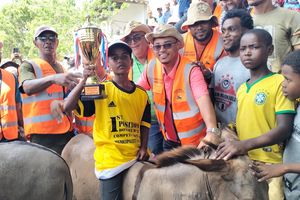
Apart from transportation, the donkeys of Lamu have also been historically used in sports and other recreational activities such as the famous annual Lamu Cultural Festival donkey race. However, they have also been embraced in sensitisation efforts.
On May 17, Lamu organised the first-ever donkey race for peace competition to help fight insecurity and preach peace amongst youth across the archipelago.
Ms Jamila Mitsanze, a donkey champion, welfare advocate and former Lamu County Director for Livestock and Cooperative Development, said that while political participation is expected for the Lamu donkeys as people approach the 2027 elections, the welfare of the animals must never be compromised.
Ms Mitsanze warned against the practice of directly painting live animals like donkeys for political campaigns. She said while freedom of expression and the creative nature of political campaigns are recognised, using live donkeys for party branding must be done humanely.
“Campaigners must avoid painting the animals' coats directly with harmful chemicals, as this exposes donkeys to severe health risks like lead poisoning and skin irritation. We urge all political parties and their supporters to ensure they strictly observe the animals' rights, providing them with adequate water, food, and rest, rather than subjecting them to undue stress and suffering," said Ms Mitsanze.