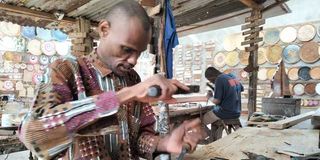
At Lamu’s Mkomani carpentry workshop, Mohamed Juma Bakari sits on a low wooden stool, his calloused hands steady and his eyes fixed on the task before him.
Scattered around are chisels and gouges of varying sizes. In his lap rests a half-finished circular wooden serving tray.
Holding a razor-sharp knife, Bakari makes a precise cut against the grain, the wood curling away in a single, delicate shaving. The 52-year-old is in no rush.
Lamu woodcarver Mohamed Bakari, 51, in action in Mkomani, Lamu Old Town, on 4 December.
Photo credit: Kalume Kazungu| Nation Media Group
His full attention is devoted to the quiet, almost meditative work of shaping raw wood into something lasting.
“I’ve been doing woodcarving for over two decades,” he says. “In Lamu, it isn’t just a craft. It’s symbolic. Every piece we carve markets the archipelago’s history and heritage to the outside world.”
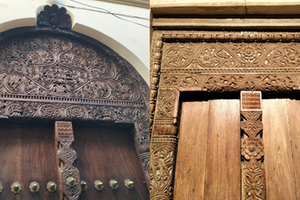
The carved, decorated doors of Lamu are shown in these photos taken on December 4, 2025.
Photo credit: Kalume Kazungu| Nation Media Group
The figures are often elegantly inscribed, making each item both a conversation starter and a timeless addition to a home or office.
Bakari says such pieces should not be viewed as ordinary décor but as works of art celebrating the county’s cultural identity. “If you look closely, you’ll see carvings of donkeys, dhows, fish and the Indian Ocean – elements that define Lamu’s unique character,” he explains.
Another artisan, Mohammed Lali, says woodcarvers consistently draw inspiration from symbols such as dhows, donkeys, the ocean, fish and the eye of the dhow, locally known as Jicho la Lamu. “These shapes define who we are as an island,” he says.
Lamu Old Town was listed as a UNesco World Heritage Site in 2001 for preserving its traditional functions and architecture.
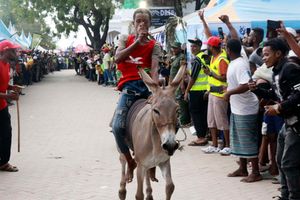
Donkeys are so central to daily life that Lamu is sometimes referred to as the “Donkey Capital of Africa”. Beyond that, artisans often include dhows, fish, ocean motifs and even maps of Kenya or Africa. “As long as we sell the image of the archipelago, the country and the continent to the world, we are doing our job,” Lali says.
For Fiona Lachlan, a tourist from Scotland, the carvings serve as enduring reminders of the island.
“I visited Lamu in 2019 and bought a table with a donkey and dhow carved on top. It’s now in my home in Edinburgh,” she says. “Every time I use it, I remember how fascinating Lamu was.”
“The dhow always reminds me of how these vessels have for centuries been the lifeblood of Lamu’s maritime history, used for trade, fishing and transport across the Indian Ocean,” she adds.
Coast Region heritage expert Abdulkadir Mubarak Abdalla has encouraged woodcarvers to continue embracing distinctive designs to help market Lamu, the Coast, Kenya and Africa globally.
The retiree says carvings of donkeys, dhows, fish, Jicho la Lamu and maps of Kenya or Africa can tap into global demand for authentic cultural art and ethically sourced décor.