The proposed Sh2 trillion East African Refinery backed by Nigerian industrialist Aliko Dangote has brought into sharp focus the impact it could have on the Lamu Port.
The planned 700,000-barrel-per-day refinery and associated 1,000MW power plant would be one of the largest private-sector investments in the region and could position Lamu as an important petroleum processing and energy hub.
The plant, if actualised as planned, is expected to serve Kenya and neighbouring markets including Uganda, South Sudan, Tanzania, Rwanda, Burundi and eastern Democratic Republic of Congo.
Its location gives it access to the deep-water port and the wider Lamu Port-South Sudan-Ethiopia Transport (Lapsset) corridor, potentially creating demand for crude imports, refined petroleum exports, storage, logistics and associated industries.
The emergence of Lamu does not, however, mean that Mombasa is likely to lose its position as Kenya’s principal maritime and commercial hub, according to stakeholders in the sector.
Lamu Port is emerging as an important alternative maritime gateway in East Africa, but inadequate roads linking it to regional markets continue to constrain its ability to compete with the established Port of Mombasa.
Despite its deep natural berths, capacity to handle some of the world’s largest vessels and renewed interest from shipping lines, Lamu remains heavily dependent on completion of the Lapsset corridor infrastructure to unlock its full commercial potential.
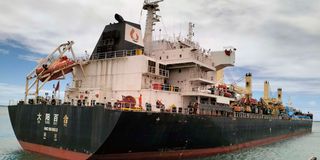
First caller vessel MV DA YANG BAI HE arrives at Lamu Port in Kililana, Lamu West on Saturday, September 26, 2026. The vessel was laden with 2930.295 metric tonnes of project cargo for the construction of the East African Oil Refinery by Aliko Dangote.
Photo credit: Kalume Kazungu | Nation Media Group
Statistics from the Kenya Ports Authority (KPA) show that Lamu is handling more vessels, but relatively little cargo moves inland by road, leaving it increasingly dependent on transhipment and diverted cargo.
KPA Managing Director William Ruto said Lamu was not intended to replace Mombasa but to complement the country’s main commercial gateway and open new markets across East Africa.
“Lamu is our second commercial port. Though it had a slow start, the facility will complement Mombasa port, considering the cargo it is currently handling in transshipment as other infrastructure facilities are being put up,” said Mr Ruto.
The challenge is particularly acute along the Lapsset corridor, whose road network is expected to connect Lamu with northern Kenya and onward to Ethiopia and South Sudan.
The proposed route runs from Lamu through Ijara and Garissa to Isiolo and Moyale, providing the critical land connection needed to turn the port into a major gateway for landlocked economies. But sections of the road network remain incomplete, poorly maintained or vulnerable to flooding, undermining reliability.
A larger section of the Minjila-Witu road, completed about three years ago, is now characterised by potholes, making it difficult for heavy commercial trucks to use the route efficiently.
The United Nations Economic Commission for Africa (ECA) has also raised concerns about the quality and resilience of infrastructure along the Lapsset corridor, warning that some sections do not meet the standards required for major continental trade routes.
ECA Director of Regional Integration and Trade Stephen Karingi said recent flooding that damaged sections of Lapsset infrastructure demonstrated the need to complete missing links and upgrade existing roads to climate-resilient standards.
“Lapsset, which is a component of the Programme for Infrastructure Development in Africa, is crucial to the actualisation of a connected Africa by ensuring pending infrastructure projects are completed,” said Mr Karingi.
Some sections of the corridor are unpaved or too narrow, while others remain vulnerable to adverse weather conditions. Such weaknesses increase transport costs and make it difficult for Lamu to attract predictable transit traffic from Ethiopia, South Sudan and other landlocked markets.
Kenya has so far spent about Sh180.32 billion on roads and other infrastructure associated with the Lapsset project, although only three of Lamu Port’s planned berths are currently operational.
Lamu has three operational berths, each measuring 400 metres, with natural water depths of up to 18 metres. The berths can accommodate Neo-Panamax vessels carrying as many as 12,000 twenty-foot equivalent units (TEUs), compared with the approximately 9,000-TEU capacity of Mombasa’s existing facilities.
Lamu Port General Manager Abdulaziz Mzee said the facility’s natural deep-water characteristics gave it an advantage as shipping lines deploy increasingly larger vessels.
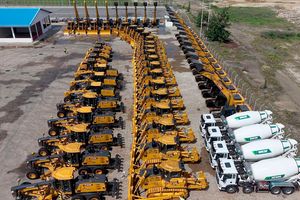
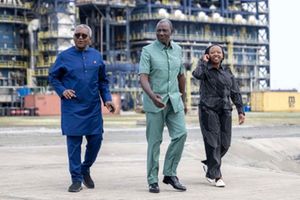
Equipment on site at the Lamu Port on September 28, 2026 ahead of the Dangote East Africa Refinery groundbreaking ceremony set for September 30.
Photo credit: Pool
“As the global shipping industry evolves and ships continue to grow, the Port of Lamu stands uniquely ready. 2026 is shaping up to be the port’s strongest year since operations began in 2021,” Mr Mzee said.
KPA data shows that Lamu handled 167 vessel calls between January and September 2026, with a target of more than 200 before the end of the year, compared with fewer than 50 during the same period last year. The surge has partly been driven by disruptions in global shipping routes and cargo diversions from other ports, and the oil refinery project.
Earlier this year, thousands of vehicles destined for East African markets were diverted to Lamu following disruptions affecting access to Dubai’s Jebel Ali Port, demonstrating the facility’s potential as an alternative gateway when conventional routes are disrupted.
Even after receiving the 167 vessels, fewer than 1,000 containers have been transported by road, according to port officials, highlighting the scale of the hinterland infrastructure challenge.
Commissioned in 2021, the port handled 12 vessels in its first year, four in 2022 and 36 in 2023 before activity declined again in 2024. In May 2024, Ethiopia imported its first major fertiliser consignment through Lamu, involving 60,000 tonnes, in what was seen as a test of the port’s potential to serve the Ethiopian market.
The shipment exposed significant logistical and infrastructure problems, particularly beyond the port itself. While Lamu Port successfully received the fertiliser, heavy rains and flooding damaged sections of the Lamu-Garsen road, leaving trucks stranded and disrupting evacuation of the cargo for weeks.
Maritime analyst and Kenya Ships Association chief executive Elijah Mbaru said that despite such challenges, Lamu remains a strategic long-term investment because of its physical capacity and potential for expansion.
“The port has all the advantages, including space to expand and deep natural berths unlike Mombasa’s, which are dredged. We hope the government will focus on roads to make the Lapsset project viable as it was envisioned as a 2030 project,” said Mr Mbaru.
Mombasa has decades of established shipping, logistics, banking, manufacturing and clearing and forwarding networks, as well as established road and rail connections to the Kenyan hinterland and neighbouring countries.
The port handled 45.45 million tonnes of cargo in 2025, a 10.9 per cent increase from 40.99 million tonnes in 2024.
Mombasa has become increasingly important to landlocked economies including Uganda, Rwanda, South Sudan and parts of the Democratic Republic of Congo, placing pressure on its terminals, yards and hinterland infrastructure.
According to KPA, Mombasa exceeded 40 million tonnes of annual cargo and two million TEUs (Twenty-foot Equivalent Units) about three years ahead of the projections contained in its strategic plan, stretching existing facilities. KPA has therefore embarked on expansion projects, including Dongo Kundu Berth One at the Mombasa Special Economic Zone (SEZ).
The KPA boss said construction of the Sh40.6 billion multipurpose berth was 16 per cent complete as of this month. The berth, part of a wider Sh73.45 billion SEZ infrastructure programme, will have a 300-metre quay and 15-metre draft and is expected to accommodate larger vessels.
The investments reflect changing competition among East African ports, where cargo volumes alone are not enough to determine the attractiveness of a gateway.
The proposed Dangote refinery provides Lamu with a large industrial anchor around which petroleum logistics, manufacturing, power generation and other industries could develop.
But without reliable roads, rail links, storage facilities, industrial infrastructure and predictable cargo flows, the port risks remaining underutilised.