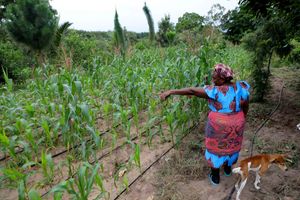
Mr Kamau Mbithi has been a dedicated smallholder bixa farmer in Poromoko village, Lamu West for the last ten years.
Mr Mbithi, 57, has been pouring his limited resources into weeding, pruning and harvesting the bright red, spiky bixa pods. The father of five has kept expecting that one day the demand for bixa would translate into a stable livelihood for his family.
As years go by, however, he has continued to trap himself in a cycle of poverty due to exploitation by unregulated middlemen and brokers in the area.
“I am exhausted and financially drained. The lack of a reliable, direct market for bixa in our county has paved the way for brokers to take advantage of the situation and exploit us. Currently, they buy a kilo of bixa seeds for Sh60 or less. Such throwaway prices can’t take us anywhere,” said Mr Mbithi.
He added, “If things continue this way, I’ll have to uproot these bixa trees entirely to switch to maize, cassava, sukuma wiki or watermelon farming to feed my family.”
His situation is one among many similar cases witnessed by bixa farmers in Lamu who feel alienated from the true value of their hard work, while brokers continue driving away with truckloads of the crop to sell to large processing exporters outside the county at immense profit margins.
A section of a farm with bixa trees in Muhamarani Village, Lamu West, in this photo taken on September 11, 2026.
Photo credit: Kalume Kazungu| Nation Media Group
Farmers high expectations
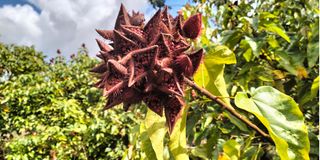
Bixa is known at the Coast as ‘mrangi’ because of its bright red fruits, which contain numerous seeds. As they ripen, the fruits dry and harden into brown capsules.
The fruit is harvested for its seeds, which contain bixin, used for colouring cheese, fish, salad oil, margarine, and cosmetics like lipsticks. Extracts from the seeds can also be used to kill mosquito larvae, research shows.
Mr Samuel Maina, a bixa farmer in Hindi, Lamu West, says three years ago he dedicated two acres of his land to grow bixa with high expectations that once harvested, the crop would translate into a stable livelihood for his family.
Because he lacks direct access to market pricing, Mr Maina has been selling the crop through middlemen and brokers who have always taken advantage by telling him that global demand has plummeted or that his crop is of ‘low quality,’ hence forcing him to accept rock-bottom prices.
Mr Maina further revealed that since the local brokers are aware of the bixa market unavailability in Lamu, sometimes they approach them and even offer immediate cash advances on the condition that they sell their entire upcoming harvests exclusively to them at fixed, extremely low pre-harvest rates.
A section of a farm with bixa trees in Muhamarani Village, Lamu West, in this photo taken on September 11, 2026.
Photo credit: Kalume Kazungu| Nation Media Group
“We’re suffering as bixa farmers of Lamu. As for me, I don’t see any future in bixa farming. I plan to quit the sector and venture into other crops. Prices are already low, but the same brokers always manipulate the weights during actual sale. You’ll see actual heavy weights registered as very low weights on the brokers’ faulty scales,” said Mr Maina.
Ms Mercy Njuguna, a bixa farmer in Hongwe in Mpeketoni Division, Lamu West, says even after agreeing to the already depressed prices, sometimes the brokers take their yields on credit, leaving them waiting for months to receive payments.
“We feel the future of bixa farming in this place is threatened entirely by rogue brokers and middlemen who keep on buying our harvests at poor prices. They have kept delaying our payments after taking our harvests. The government should do something to revive bixa farming,” said Ms Njuguna.
In Lamu, the main bixa farming or producing areas are Hongwe ward, Mkunumbi ward and Hindi ward, all in Lamu West sub-County. Others are Kiunga on the Kenya-Somalia border.
On average, bixa production per acre in Lamu ranges between 1,500 and 3,000 kilograms as per records from the County Government Agriculture and Food Security Department.
Lamu County Executive for Agriculture and Food Security, James Gichu, acknowledged that in past years, bixa farming and production have been a challenge owing to an unreliable market.
Mr Gichu, however, said a lot has transpired in the sector, noting that continued efforts are on to ensure there are direct market linkages to the local producers.
A section of a farm with bixa trees in Muhamarani Village, Lamu West, in this photo taken on September 11, 2026.
Photo credit: Kalume Kazungu| Nation Media Group
“Bixa has been trading at only Sh60 or less for a very long time. Sometimes farmers sell their harvests on credit. We’re fighting for these innocent farmers to ensure even the brokers and middlemen buy their produce at Sh90 to Sh100 per kilo.
“I view the future of Lamu bixa farming as a bright one. We already have a company buying bixa harvest from the local farmers at the moment,” said Mr Gichu.
Mr Gichu said the county government of Lamu has already leased a five-acre piece of land to the new company named Botanical Kenya to install a state-of-the-art Bixa processing factory within Hongwe Ward.
“The investor is ready to start the factory any time this year. We are waiting for land documentation to be ready. My happiness is to see bixa farming flourishing to an extent of hitting Sh120 per kilo in the near future,” said Mr Gichu.
He encouraged bixa farmers in the county to form cooperative societies and get registered to enable them to sell their produce through the cooperatives and avoid brokers’ headaches.
A section of a farm with bixa trees in Muhamarani Village, Lamu West, in this photo taken on September 11, 2026.
Photo credit: Kalume Kazungu| Nation Media Group
“Currently, farmers aren’t in any cooperative. That’s why they sell their produce through brokers. We’ve begun registering and giving them seedlings to scale up production. Our target is to see them selling their bixa directly through cooperatives,” said Mr Gichu.
There are at least 25,000 bixa farmers across the Coast region. Apart from Lamu, other areas where bixa is grown in the Coast are Msambweni, Masimbani, and Lunga Lunga in Kwale County, besides Malindi in Kilifi County.