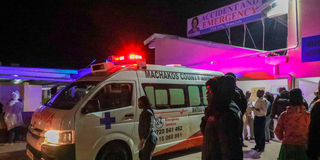
An ambulance at the Machakos level 5 Hospital carrying survivors of an accident.
In Kenya, there are two ways to become a senior surgeon.
You could do the traditional route – complete your bachelor’s degree, internship and work as a doctor and then pursue a master’s degree in medicine.
Or, you could go through the collegiate system. Here, after completing your bachelor's degree and beginning work as a medical doctor in a public hospital, a regional academic body supervises hands-on training and awards specialist qualifications.
In Sub-Saharan Africa, the collegiate system is anchored by the prestigious College of Surgeons of East, Central and Southern Africa (COSECSA), among other bodies. It was designed to turn public hospitals into gold-standard training grounds.
COSECSA is the regional body responsible for producing qualified surgeons across 14 countries. Its Membership (MCS) and Fellowship (FCS) qualifications are the standard by which a surgeon is deemed fit to practice independently.
But at Machakos Level 5 Hospital, doubt has been cast on the programme’s ability to churn out industry-ready professionals even as it still graduates surgeons who go on to practice across the country.
Governance failures trigger suspension of surgical training
On September 5, 2025, COSECSA Country Representatives Dr Karen Mbaabu and Dr Caesar Bitta wrote to the hospital's program director, suspending intake for the collegiate programme under Machakos Level V Hospital.
An ambulance at the Machakos level 5 Hospital carrying survivors of an accident.
The letter raised concerns over a lack of structural governance, noting that none of the local trainers possessed signed appointment letters or formal training commitments.
Shockingly, neither the program director nor the assistant program director held official appointment letters from the hospital, while the trainees themselves operated without HR files, defined terms of reference, or monitored duty schedules.
The academic program was hollow, lacking clinical rotation plans, formal teaching timetables, or structured resident assessments.
The breakdown forced an immediate institutional freeze, with COSECSA officially delaying the upcoming January 2026 intake and threatening to completely strip the hospital of its residents if the systemic deficiencies were not resolved.
It also triggered a site visit by COSECSA in the same month, which the institution told the Nation cleared the air and resolved all issues.
A source close to the programme and who spoke with the Nation said that the teaching faculty at Machakos Level 5 Hospital lacks formal credentialing, job descriptions, or official appointment letters to act as educators, yet the hospital administration aggressively coerced them into assuming instructional and supervisory roles anyway.
“My job description is a surgeon to discharge clinical duties,” the source stated during an interview. “I am now given a responsibility to train them, but the support is lacking.”
COSECSA operated like what the source described as the “Uber or Airbnb of surgical training” – owning no physical facilities, employing no direct faculty on-site, and leaving local specialists completely uncompensated for the heavy burden of residency oversight.
No duty rotas
For prolonged periods, residents failed to provide basic duty rotas to the hospital staff. Consultants were routinely woken by phone calls from frantic ward nurses because the trainees assigned to the floor simply refused to show up for work.
Medical Superintendent at Machakos Level V Hospital Dr K.D. Katua has denied that there are investigative findings to the effect that COSECSA’s collegiate programme has failed at the facility.
Despite internal audit showing that at least three surgical residents have been treating patients without active civil service contracts or county engagement letters, Dr Katua maintained that all COSECSA residents held formal admission letters and operated under strict specialist supervision.
The administration also denied targeting trainers who have been vocal on the alleged substandard programme.
Machakos Level V Hospital instead argued that a department head whom our sources said was transferred to prevent “psychological torture” of resident doctors was actually being rewarded with an opportunity for further studies abroad.
An ambulance at the Machakos level 5 Hospital carrying survivors of an accident.
The hospital further maintained that there is no leadership vacuum with the COSECSA Programme Director being away on a two-year study leave, as the facility has a capable deputy.
COSECSA declined to furnish us with timestamps to show that trainee surgeons had actually logged in their hours on the dates and times alleged, holding that the move would go against the privacy of the affected individuals.
COSECSA kicked the responsibility for protecting the faculty back down to the hospital floor.
Addressing the alleged administrative pressure and retaliatory reassignments faced by senior consultants who have failed some of the residents, COSECSA stated that internal trainee conflicts are strictly handled at the facility level, in this case Machakos Level V Hospital, under the human resource department.
"We are not aware of any documented structural challenges at Machakos Level 5 Hospital since the inception of its training program," said Dr Mbaabu, one of the signatories to the COSECSA letter of September 5, 2025, which suspended further intake for the collegiate programme.
Audits by COSECSA's Kenya Secretariat unmask underlying issues. One anonymous fourth-year resident, identified as the son of a powerful politician, logged just 203 total surgical cases across his entire training against a mandatory minimum of 500; his digital logbook recorded zero cases in 2023 and exactly one case in 2024.
Official secretarial audits noted he possessed zero documented exposure to core emergency procedures like tendon repairs or neurosurgical interventions. Another fourth-year resident logged only 228 cases in four years, resulting in a formal recommendation that he repeat his third year due to catastrophic gaps in basic surgical knowledge.
During a grueling four-month national doctors' strike in 2024, public health facilities were completely paralyzed and the residents vanished from Machakos entirely.
Yet, despite being physically absent for a third of the year, several trainees' digital logbooks miraculously recorded complex, major surgeries performed during the strike period, fabrications that the COSECSA online portal allegedly accepted without verification.
The local faculty was entirely locked out of this data loop.
“Apparently, before, when COSECSA came and started this program, they left the then surgeons who retired within a year or two with an online platform,” the source said. “Many of us have never seen it. Apparently, it is called the School of Surgeons platform. We do not have access. But we are the teachers, the trainers. No one is filing”.
One of the cases that sticks out like a sore thumb involved a fifth-year resident entering final fellowship examinations.
An official audit revealed that out of 502 cases logged by this resident, dozens were performed at unaccredited sites, leaving him far short of clinical requirements.
On the basis of these absolute failures, the COSECSA Secretariat issued a formal letter in November 2024 declaring his records deficient and explicitly deeming him ineligible to sit the final clinical examination.
Yet, in December 2024, the central office permitted him to sit the high-stakes fellowship exam anyway, validating modified digital logs and hiding behind missing local paperwork.
Unpaid trainees fuel concerns over supervision and accountability
When local consultants tried to enforce clinical baselines and discipline errant residents, it is alleged the hospital leadership actively turned on them.
Internal audit documents and leaked rosters expose the exact commercial transaction at play: up to three of the seven active residents were providing clinical labor for Machakos County entirely for free.
They operated on the promise of future pay, and without a stipend. This created a toxic, symbiotic incentive: the hospital administration gained free ward labor, and in exchange, they insulated rogue residents from discipline.
Follow our WhatsApp channel for breaking news updates and more stories like this.