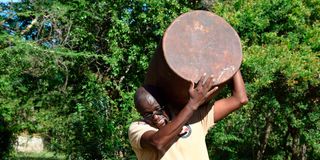
Julius Muindu, the founder of Akamba Cultural Centre and Museum at Uvilisyani Village in Makueni County, carries a drum at the museum on March 22, 2026.

When Julius Muindi walked into the Stockholm Museum of Ethnography in Sweden in 2009, the university student had no idea he was stepping into a future in cultural anthropology.
Today, the community museum he set up in Makueni County is poised to become a global phenomenon after securing a Sh7 million grant from the United Kingdom.
The Akamba Cultural Centre and Museum, which promotes elements of Kamba culture is among seven cultural initiatives worldwide awarded a total of Sh60 million by the British Council to collect, document and preserve cultural heritage.
At the Uvilisyani village museum, Mr Muindi was putting the final touches on a digital heritage laboratory to document Kamba cultural artefacts.
“The world has finally recognised our efforts,” he proudly says in an interview with Daily Nation.
With the grant, Mr Muindi plans a festival of endangered Kamba traditional dances in April, alongside workshops throughout the year to intensify efforts to collect and preserve the community’s cultural assets.
“We aim to document and digitise 5,000 Kamba artefacts withtangible items like baskets and drums as well as intangible heritage such as folklore, riddles and songs. Using 3D scanners, we will upload these cultural assets online for the world to see,” he explained.

Julius Muindu, the founder of the Akamba Cultural Centre and Museum at Uvilisyani Village in Makueni County, carries a drum at the museum on March 22, 2026. The museum has secured a grant from the British Council to preserve Kamba cultural artefacts.
Beyond the Akamba Cultural Centre, the British Council awarded grants to six other projects including Nairobi’s Ukombozi Library, which documents Kenya’s social justice movement and MaritimEA in Pakistan, which preserves cultural heritage.
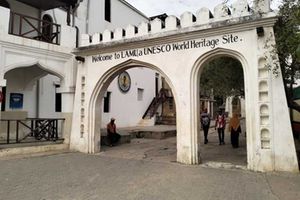
“Scriptease will document and dramatise the living heritage of East Africa’s Swahili Coast through immersive virtual reality. Climate change is weakening UNESCO-listed sites such as Lamu Old Town and this project will create an East African VR Heritage Collection while supporting the local creative economy,” reads a statement from the British Council.
Daniel Head, head of grants at the Cultural Protection Fund, said: “These projects are truly innovative and will help heritage practitioners explore how digital technologies can safeguard culture for future generations.”
For Mr Muindi, the grant is a milestone.
Three years after his visit to Sweden, he reflects on the experience that inspired the museum.
“I was shocked to see Kamba artefacts on display there. It made me wonder why Europeans were holding our indigenous heritage while demonising it as they spread Christianity in Kenya,” Mr Muindi says.
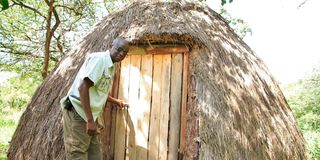
Mutuku Muindi poses outside a traditional hut at Akamba Cultural Centre in Makueni County. The trained teacher has cut a niche in cultural tourism.
Among the museum’s exhibits is a drum over 100 years old, once used to entertain Mzee Jomo Kenyatta and other dignitaries, alongside a grooved tally stick numerical system called Kika, which resembles ancient Egyptian hieroglyphic numbers.
The museum also showcases traditional weapons, grain preservation methods and other artefacts.
“The museum is attracting growing interest from tourists, students and filmmakers. We perform Kilumi and other traditional dances at hotels and social events. Digitiation will immortalise Kamba heritage while expanding our business,” Mr Muindi said.
The journey has not been without challenges.
Julius Muindu, the founder of Akamba Cultural Centre and Museum at Uvilisyani Village in Makueni County, carries a drum at the museum on March 22, 2026.
Collecting artefacts at risk of extinction has been difficult, and negative perceptions of indigenous knowledge have caused friction with relatives and neighbours.
At one point, a Catholic church excommunicated him. He has also prevented several attempts to steal museum artefacts.
The British Council grants come at a time when the government has increased efforts to safeguard and commercialise indigenous knowledge.
Through the Natural Products Initiative, a Vision 2030 flagship under the National Museums of Kenya, authorities hope to leverage indigenous knowledge to create jobs for youth.
“The economic value of cultural heritage is immense. We are working closely with county governments to unlock the potential of indigenous knowledge and assets,” said Evans Teracha, national coordinator of the Natural Products Initiative.
He made these comments during his recent visit to Makueni, where he met with Governor Mutula Kilonzo Junior.
Follow our WhatsApp channel for breaking news updates and more stories like this.