Fatuma Adan Bulle’s two daughters have stopped attending Border Point One (BP1) Primary and Junior Secondary School.
The mother of two hopes that her decision will avert any risk to her children’s lives if tension between Jubbaland forces camped in her village and Federal Government of Somalia troops turned into war and spilled into BP1.
Border Point One Primary and Junior School on September 8, 2025. The school is recording low student attendance due to fear Jubbaland forces in the area.
Photo credit: Manase Otsialo | Nation
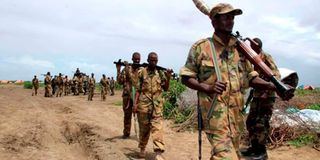
The Jubbaland forces crossed into Kenya on August 3, 2025, after a week-long fight with Federal Government of Somalia troops in Bula-Hawa.
The entry of the Jubbaland militia in late August caused tension in Border Point One location, Mandera County, as many Border Point One villagers fled their own homes.
“The situation is not good for my only two girls to attend school. When these groups clashed and the Jubbaland forces ran here, I spent two days in bushes with my children. I will stay with them at home until the military men leave my village,” Fatuma said in an interview with the Nation on Monday.
She is one of several parents whose children have stopped attending school this third term – the shortest, but most critical of terms for learners.
A Nation investigation has established the presence of armed Jubbaland militants in Mandera County, regrouping as they plan to challenge Somalia’s forces for control of Bula Hawa, a town just 3km across the border.
BP1 elders have raised concerns over several youths from Mandera and Ethiopia being lured into the Jubbaland military in preparation for an attack aimed at capturing Bula-Hawa.
According to the elders, some youths were turned away over trust issues as the community continues to oppose the force's presence.
“We had two youths from this location who attempted to join them but the officers refused, fearing that locals would betray their course because we have been pushing for their removal,” Jibril Hussein Farah, our host and one of the BP1 elders, said in an interview.
The militants have settled on farms owned by BP1 villagers, a move now hurting those who had invested in agriculture on the lands.
The land occupied by the militants lies in the BP1 Irrigation Scheme, which was previously a national government project before being handed to the county government, in the spirit of devolution.
Some of the farms have now become a military camp, forcing out residents who depend on the land for food and income for their families.
A source at BP1 Primary and Secondary School said that most parents have kept away their children fearing the effects of the simmering war.
“We have fewer students attending classes unlike before the Jubbaland forces crossed the border. We are operating but with fear. We start classes late in the day just because nobody is sure of the morning hours,” he said.
As the Jubbaland regroup and plan their next move in Mandera, Federal Government of Somalia troops are on the other side of the border guarding Bula-Hawa town against an invasion by the President Ahmed Modobe men.
A map showing the Bula Hawa region in Somalia. Kenyan and Somalia authorities in Mandera and Bula Hawa have pledged to work together to fight terrorism. GRAPHIC | GOOGLE MAP
Last month, a battle for Bula-Hawa went in the Federal Government of Somalia’s favour. Those troops are bent on maintaining the status quo as Jubaland President Modobe maintains that it is his government’s territory.
Moments after our host Jibril told our team of the presence of the militants, we encountered a man dressed in Jubbaland fatigue, walking from the direction of Kenya’s border with Somalia towards the Border Point One centre.
“You see, that is a member of Jubbaland forces returning to their camp on our farms. They have continued to stay here, causing a lot of fear in our community,” Jibril said.
A few metres away, we bump into another man in similar military fatigue, carrying a black polythene bag.
“That one is from buying miraa (khat). When walking around, they are never armed with heavy weapons like the AK47 rifles but they carry pistols,” Mr Adan Sheikh, our host in Border Point One village said.
Homes are deserted with a few people in the vicinity, with a few men left behind to guard family property. Some homes had a few people, contrary to typical Somali family settings in which the patter-chatter of little children at play tends to drown out most background noises.
“We keep our livestock at home because we are not safe in the grazing fields anymore. The simmering war can break up at any time between these two groups,” Mr Farah said.
Hussein Ali, another resident, said that many women opted to flee with their children, against the stand of their husbands, which was to stay and protect the place they call home.
“We are now experiencing family issues, including couples getting separated because women want to run for safety while men are adamant that the family stays to protect property,” he said.
Elders in BP1 are now worried that locals may start acquiring illegal firearms on the cheap from Jubaland forces and worsen the security situation in Mandera.
“Too many risks are associated with this situation because our people will start acquiring firearms illegally and cheaply from the Jubbaland forces. They are already complaining of delayed payment and to sustain themselves, they will start selling the weapons,” a Mandera resident who requested anonymity said.
To silence several voices agitating for the removal of Jubbaland forces from Mandera, local security agencies have been summoning and warning vocal community members.
“We had a protest on August 28, 2025, and on the following day, I was called by the criminal investigating officers. They warned me against leading any push to have the forces kicked out,” a community leader in Mandera who was among those who led the protests said, also requesting not to be named for his safety.
On Monday, senior security officers in Mandera could not be reached to respond to the claims, as they were said to be in Nairobi attending a meeting on the situation.
The Federal Government troops were led by Mr Abdirashid Hassan Abdinur, also known as Abdirashid Janan in the battle for Bula-Hawa.
Once at the forefront of the Jubbaland government’s armed confrontation with Mogadishu in 2020, Janan has now pledged allegiance to the federal government under President Hassan Sheikh Mohamud.
Janan is now the regional chief of the National Intelligence and Security Agency (Nisa) for Jubbaland.
His arrival in Bula-Hawa on July 28, 2025, escorted by federal forces, triggered a renewed sense of unrest in the long-contested Gedo region.
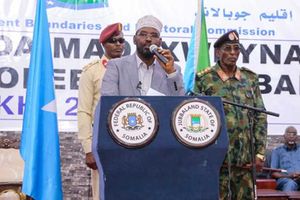
To give moral support to the forces, Jubbaland Vice President Mahmoud Sayid Adan has stayed in Mandera town, living and working out of a hotel for a second consecutive month.
A well-placed source in the security circles in Mandera confided in us that the Jubbaland Vice President has held several meetings with Ethiopia representatives both in Suftu (Ethiopia) and in Mandera.
As Mandera remains tense, hundreds of refugees from Bula-Hawa returned home two weeks ago, but some expressed fear of staying in a tense environment.
“We chose to go back home rather than being registered as refugees and taken into refugee camps in Kenya. The authorities in Mandera gave us two options and we chose to come back to Bula-Hawa,” Mr Isac Mohamud, a resident of Bula-Hawa said by phone.